When technology stopped working during a family meal, a Canadian mother found an unusual way to make sure her autistic son would never be without a voice.
Jessica Fletcher was eating out with her 11-year-old son Hunter when his Augmentative and Alternative Communication (AAC) tablet ran out of battery. For Hunter, who is non-speaking and relies on AAC technology to express himself, the dead battery meant losing access to his usual communication system.
But instead of becoming frustrated, Hunter found another way.
11-year-old draws keyboard on napkin
Hunter picked up a napkin and sketched a keyboard on it. He then pointed at different letters with his finger to communicate what he wanted to order.
The simple moment stayed with Fletcher. She began wondering whether the same idea could be turned into something Hunter could carry with him everywhere.
“If technology fails, what else can we use?” became the question behind her solution.
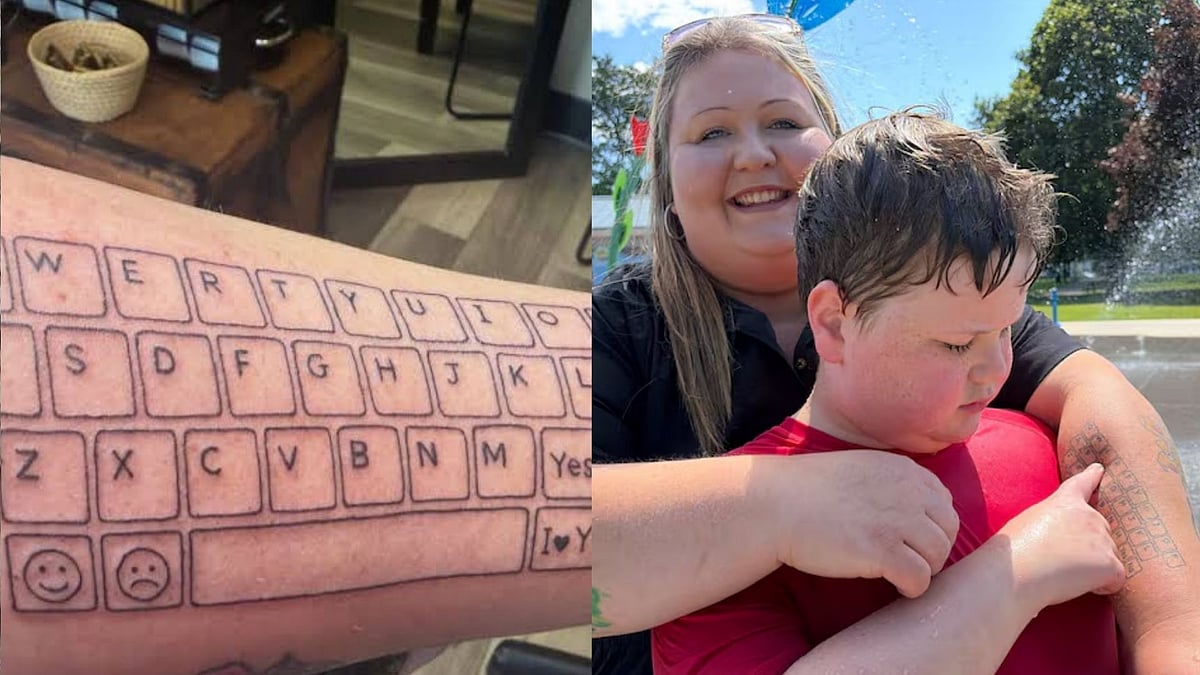
Fletcher eventually approached a tattoo artist and had a keyboard permanently inked onto her forearm.
The tattoo contains letters that Hunter can point to, along with symbols such as a happy face, sad face and an “I heart you” button.
Hunter's first word was ‘mama’
The tattoo was not merely an idea in theory. Hunter began using it almost immediately.
When he first saw his mother's tattoo, he used it to spell his first message: “Mama.”
For Fletcher, the moment confirmed that the tattoo could become more than an emergency solution.
Speaking to CTV News, she said, “That sparked the idea for me that I can’t limit him to technology because technology does fail us.”
The tattoo now gives Hunter another way to communicate when he is with his mother. By tapping individual letters on her arm, he can spell out words and sentences without needing his electronic device.
Tattoo also gives hunter more privacy
The unconventional communication method has another benefit — it can be discreet.
AAC devices can sometimes produce spoken audio as a person selects words or symbols, meaning people nearby may hear what is being communicated. With the tattoo, Hunter can silently spell something directly on his mother's arm.
That has allowed the pair to have private conversations in public places without drawing attention to what Hunter is trying to say.
Fletcher later posted a video of Hunter using the tattoo on Facebook on July 8. The clip attracted huge attention online and, according to the New York Post, went on to receive more than two million likes.
Idea inspires keyboard shirts
The idea did not stop with Fletcher's tattoo.
Hunter's school friends became interested in the communication method and wanted a way to use it while spending time with him. Fletcher said some children wanted shirts with keyboard designs so they could communicate with Hunter quietly while playing.
That eventually led to a collaboration with a clothing company to create shirts with keyboard layouts along the sleeves.
The concept has also attracted interest from parents, healthcare workers, doctors and first responders around the world, Fletcher said. Some have explored whether similar communication tools could help non-speaking autistic people communicate in classrooms, hospitals and other settings.
Tattoo artists have even offered to create similar designs for parents at no cost.
‘We’re giving non-speakers the chance to show us who they really are’
Fletcher's experience highlights the importance of having multiple ways to communicate, particularly for people who rely on AAC devices.
AAC can include electronic speech-generating devices as well as non-electronic methods such as picture boards, communication books, gestures and letter boards. Having alternatives can be particularly useful when a device loses power, breaks down or is unavailable.
For Fletcher, however, the tattoo has become about much more than having a backup plan.
“When we remove communication barriers, we’re giving non-speakers the chance to show us who they really are,” she told CTV News.
And her commitment to keeping that door open for Hunter is unwavering.
Fletcher said she would endure “a thousand scars” if that meant giving her son a way to communicate and ensuring that a dead battery could never silence him.

