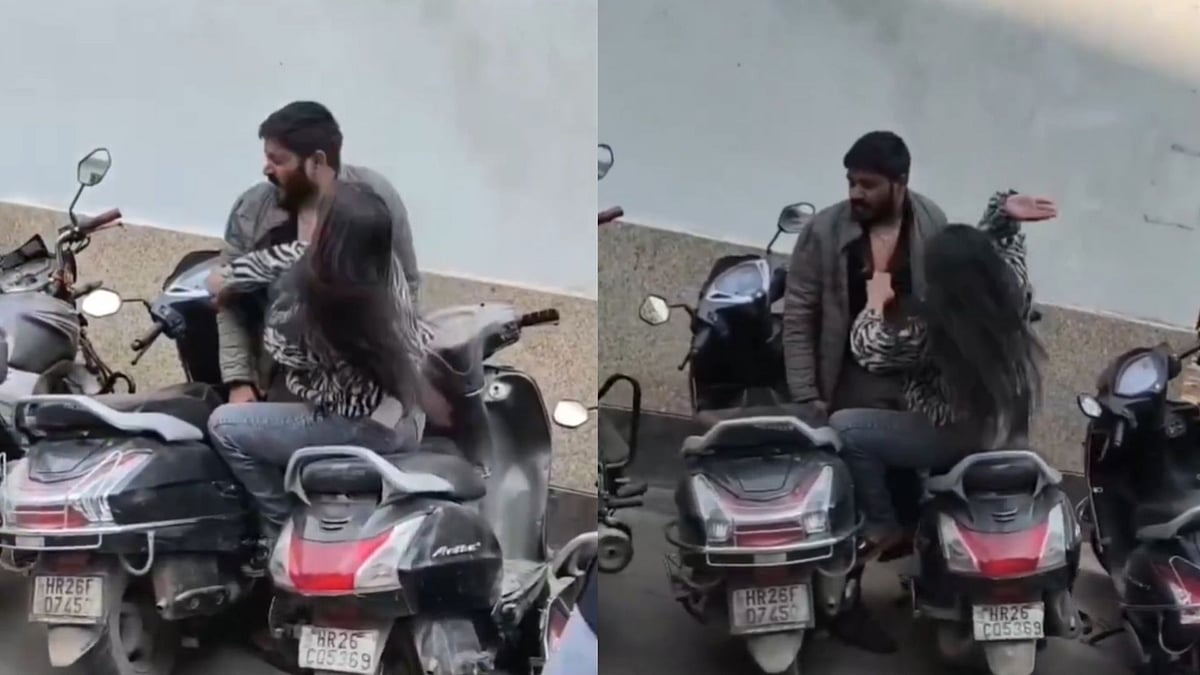
A shocking case of public violence in Gurugram has reignited conversations around gender dynamics and safety in crowded urban spaces after a video of a woman assaulting her boyfriend surfaced online.
The incident came to light when footage began circulating on social media showing a woman repeatedly slapping and verbally abusing a man on a busy street in Gurugram. In the clip, she can be heard shouting, “Call the police,” even as she continues to hit him. The man appears largely unresponsive, not attempting to shield himself rather or retaliate aggressively, while stunned bystanders watch without intervening.
The public nature of the altercation has intensified debate, especially as it unfolded in a densely populated area where immediate help might have been expected.
Public assault and the bystander effect
Incidents like this highlight a troubling urban trend, personal disputes escalating into physical confrontations in full public view. Despite the chaos, onlookers often fail to step in, a phenomenon commonly referred to as the “bystander effect,” where individuals hesitate to intervene when others are present.
Instead, many choose to record the altercation on their phones. While such videos can serve as crucial evidence, they also reveal a growing social disconnect, where documentation replaces action.
Rethinking gendered narratives around violence
The viral clip has also revived discussion about how domestic or relationship-based violence against men is perceived. Public discourse frequently centers on women’s safety, an essential and ongoing concern, but cases like this challenge assumptions about who can be a victim in street-side conflicts.
The psychological toll of being assaulted in public can be severe, regardless of gender. Yet social reactions often range from disbelief to mockery when men are seen as victims, potentially discouraging them from seeking help or legal recourse.
Accountability and equal enforcement
Legal experts have long maintained that assault, irrespective of the perpetrator’s gender, is a punishable offense under Indian law. Calls are growing for law enforcement agencies to approach such cases without bias and ensure that any act of physical violence captured on camera is investigated fairly.
