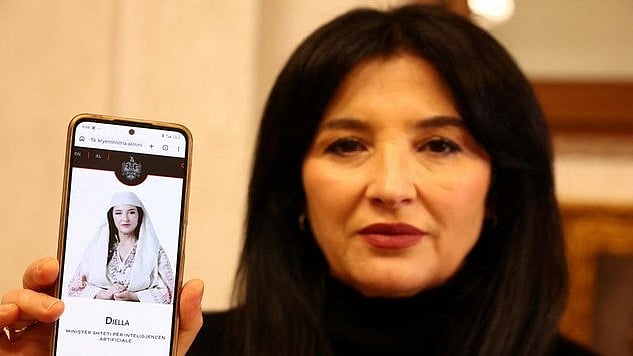
On September 11, 2025, Albanian actor Anila Bisha was at home watching Prime Minister Edi Rama unveil Albania’s new cabinet when she witnessed something astonishing, a virtual minister bearing her exact face and voice.
The avatar, named “Diella,” was introduced as the world’s first AI-powered minister for artificial intelligence. But for Bisha, the moment was shocking. Months earlier, in December 2024, she had signed a contract allowing her likeness and voice to be used for a year as a digital assistant on e-Albania, the government’s online public services portal.
She says she never agreed to her image being elevated to a ministerial role.
What began as a chatbot guiding citizens through administrative procedures had suddenly become a political figure, addressing parliament and appearing at official events. While the government framed it as a bold step toward digital governance, Bisha saw it as a breach of trust.
Legal battle over image and personal data
Bisha has taken the matter to the Administrative Court, seeking suspension of the avatar’s use and €1 million in moral damages. She has named the Council of Ministers, the National Agency for Information Society (AKSHI), the private tech firm behind the avatar, and Prime Minister Edi Rama as defendants.
Legal scholars in Albania argue the dispute centers on personal data protection rather than copyright. Under laws aligned with EU GDPR standards, a person’s biometric data, including facial image and voice, is protected. Any use beyond agreed contractual terms could constitute a violation.
The government has rejected the claims, maintaining that the case lacks legal foundation.
Innovation, ethics and public perception
Internationally, Diella has been praised as a symbol of forward-looking governance, even receiving recognition at the World Governments Summit in Dubai in 2026. However, experts note that the system functions as a chatbot within Albania’s broader e-governance infrastructure rather than as an autonomous AI decision-maker.
Complicating matters, Albania’s Special Anti-Corruption Prosecution has launched a separate investigation into alleged procurement irregularities within AKSHI, the agency overseeing state digital systems.
For Bisha, the issue is deeply personal. Strangers now call her “Minister Diella.” What was presented as technological progress has evolved into a courtroom debate over identity, consent and the ethical limits of artificial intelligence in public office.

