Ranjita Biswas is enthralled with Cordoba’s architecture, swaying palm trees, cobbled streets and history.
Also Read: Explore Thailand through its history and cultural legacy
Cordoba. The name had only vague connotations for me. Now that I was standing on a street of the southern Spanish city, it seemed still unreal. The architecture, a mix of the East and West, the swaying palm trees, the cobbled streets, all combined to keep me in thrall, as it must had thousands who have visited this medieval city in Andalusia.
The first place to explore had to be the Mezquita, the mosque cum cathedral that defines Cordoba’s chequered history. The grand mosque of the thousand pillars took two hundred years to build, from the 8th century to the 10th century. At that time, Cordoba was recognised as the most sophisticated city in Europe, an outstanding centre of art and culture as well as an economic hub. An estimated half a million people lived there.
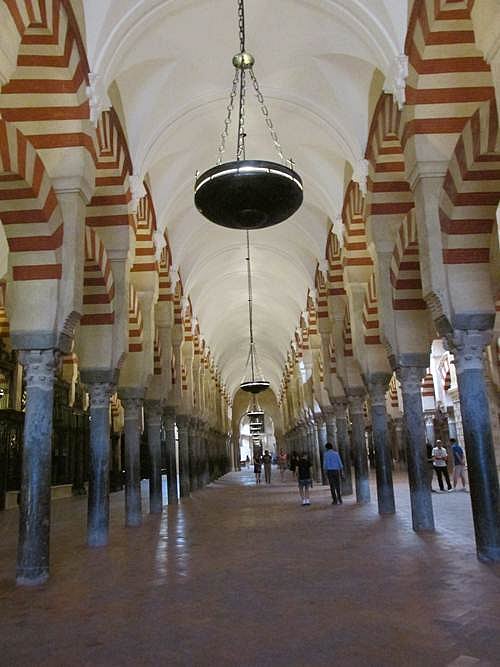
Inside the Cathedral |
Cordoba’s golden period began under the rule of an exiled royal family from today’s Syria. Umayyad clan prince Abd-al-Rahman had escaped the massacre of his family by his rivals, the Abbasids, in Damascus, and settled down in Cordoba in 756 AD to found the first great Muslim civilization of Spain.
Originally at the site of mosque was a Roman temple dedicated to Janus, the two-faced god. When the Visigoths took over Cordoba they built a church dedicated to Saint Vincent over it; then the Moors from Morocco overthrew them and built their own place of worship on the same premises. Till the Ummayeds came in from Damascus, during the rather fractious time in between, the place was used both by the Christians and Muslims devotees.
While building a mosque to rival the famed one in Damascus, the Umayyads used material from the old church to fashion the arched pillars striped in red and white making Cordoba’s Meszquita like no other. When finished, its roof was supported by 856 (originally there were 1,293) columns made of porphyry, jasper, and many-coloured marbles.
But like all great cities and civilisations, Cordoba too fell, rather suddenly. Moor-held Andalusia broke into mini states called taifas (small principalities). Cordoba held onto its Moorish identity till the Reconquista army marching to retrieve their lost lands succeeded.
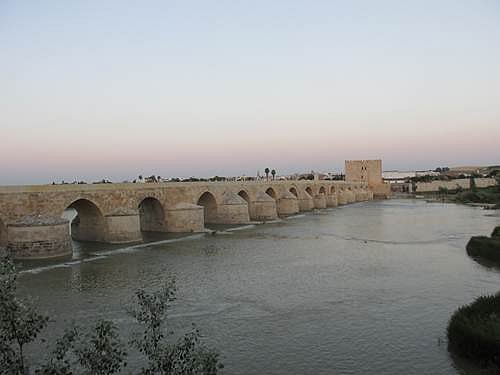
Old Roman Bridge |
With the Spanish royalty re-established, plans were afoot to build a Cathedral at the same location, now dedicated to Virgin Mary. But not the entire mosque was destroyed by the Catholics. Thus it led to this unique place of worship in the western world, a baroque cathedral and mosque existing side by side.
A sense of awe overcame me on entering the mosque as a ‘forest’ of columns in the huge prayer hall welcomed me. It was overwhelming indeed with intricate work, symmetry of decorative motifs and exquisite inlay handiwork.
Muslim and Christian motifs co-exist too. The richly decorated mihrab (sacred place beside which the Imam leads the prayer) has a horse-shoe arch which was common to the Visigoths. It shows off golden mosaic work, which, according to historians, was fashioned by Byzantine artists sent by Christian emperor Niceforo Foca of Constantinople, today’s Istanbul.
The 16th-century Baroque choir of the cathedral might look like an imposition in this ambiance but it merges seamlessly with its intricate ceiling and richly carved 18th-century choir stalls.
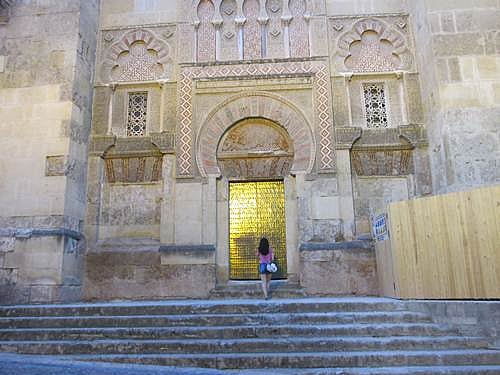
Mezquita wall in the evening |
In its heyday, Córdoba was the most modern city in Europe. Accounts say that the streets were well-paved, with raised sidewalks for pedestrians. During the night, the main streets were illuminated by lamps. Cordoba also had 900 public baths.
Art and culture blossomed under the Ummayads. The work of astronomer and mathematician Geber opened up ways to develop trigonometry in Europe. Its knowledge of pharmacology influenced medical practices in Europe.
Cordoba was also famous for its libraries as the Caliphs were great bibliophiles. The library of al-Hakam II (Caliph from 961 to 976) was said to number some 4,00,000 volumes.
Also Read: The mesmerising clock tower of Bern
Cordoba is compact enough to explore on foot. Walk around the historic centre around the mosque, a Unesco heritage site since 1984 to feel how Muslims, Jews, and Christians lived together here. Outside the walls of historic quarter as the afternoon sun drew golden patterns, I stood near the Roman bridge with its 16 arches which connects Córdoba with its suburbs on the other side of the Guadalquivir River.
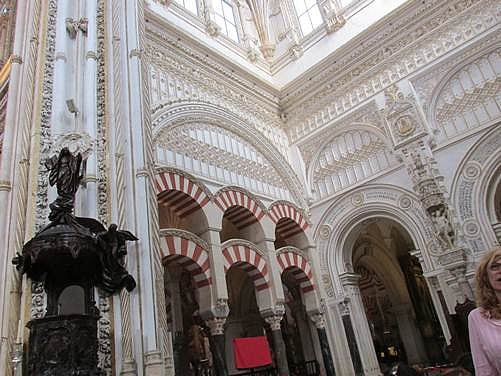
Cathedral and mosque merge |
This bridge was first built by the Romans in the early 1st century BC. The Moors rebuilt and renovated it a couple of times. On the southern end of the bridge is the Calahorra fortress which was built to guard the entrance to Cordoba in old days. The tower was declared a national monument in 1931. Inside is Museo Vivo de Al-Andaluz to offer a glimpse through an audio-visual presentation life in Cordoba around the 10th Century.
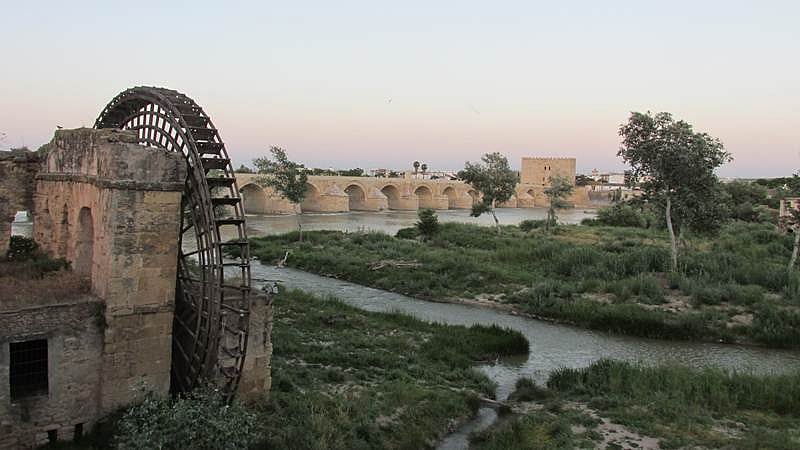
Near the bridge a quaint water mill from the Moor’s time stood silhouetted against the afternoon glow. The mill was built to carry river water up to the Alcazar (palace) nearby. Called naura in Arabic, it was dismantled at Spain’s beloved Queen Isabellla’s order who hated the constant noise it created. But today the water wheel is on the city’s coat of arms.
[alert type=”e.g. warning, danger, success, info” title=””]
Fact File
Getting there: Cordoba is two hours by train from Madrid
Stay: As a popular destination, it has hotels to cater to every budget.
What to do: Discover the old quarter, visit the Mezquita. Sample the fabulous local food.
[/alert]
