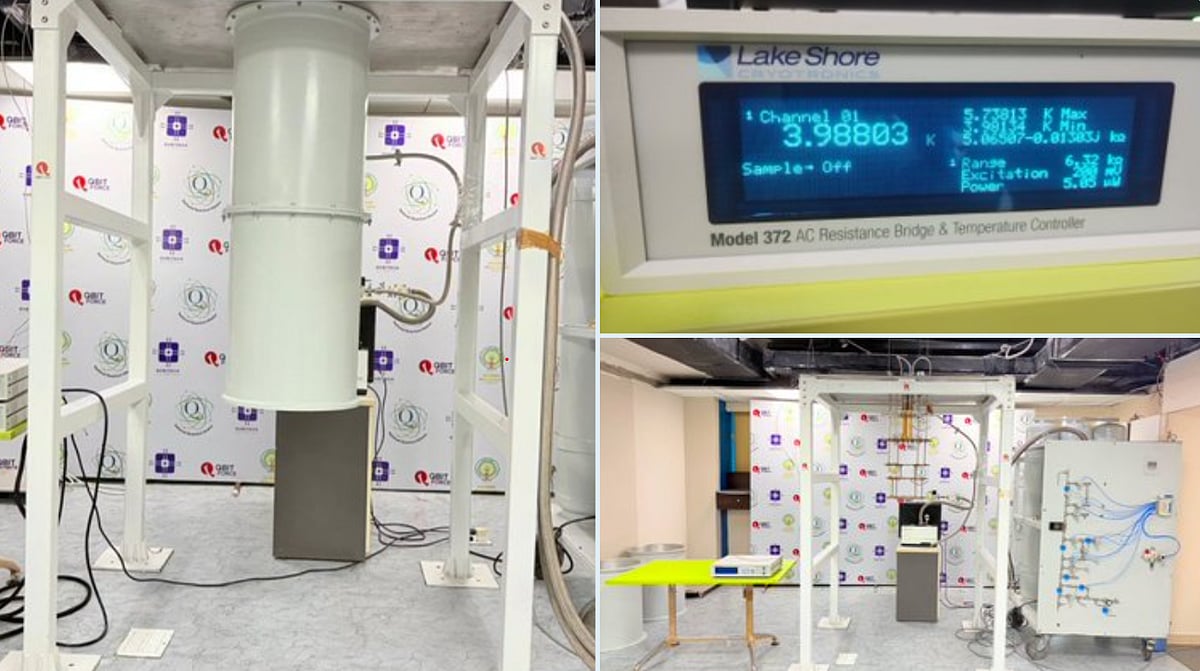
In a significant milestone for India’s emerging quantum computing hardware ecosystem, Amaravati Quantum Valley (AQV) has successfully developed an indigenous dilution refrigerator that has achieved temperatures as low as 4 Kelvin, or minus 269 degrees Celsius.
The breakthrough was recorded at the Quantum Reference Facility located at Medha Towers in Amaravati.
According to sources, this temperature range is among the lowest achieved in any research facility in India, and what makes the development notable is that more than 80 per cent of the system components were sourced domestically.
This highlights a growing capability in India’s deep-tech manufacturing ecosystem.
Operating at 4 Kelvin is critical for quantum research as such ultra-low temperatures are required to test and characterise foundational technologies used in quantum computers, secure communication systems, advanced sensing platforms, and other next-generation scientific applications.
C V Sridhar, mission director of the Andhra Pradesh State Quantum Mission and one of the key architects of AQV, said the achievement strongly supports the government’s “Make in India” initiative.
He noted that the success demonstrates the feasibility of building complex quantum systems with a largely indigenous supply chain.
Earlier, in September last year, scientists, researchers, startups, and industry leaders had presented findings to Chief Minister Nara Chandrababu Naidu showing that nearly 85 per cent of quantum computing hardware components could be developed within India.
This encouraged the state government and IT Minister Nara Lokesh to push for an indigenous ecosystem under the vision “Made in Amaravati for the World.”
AQV has also partnered with Qbit Force and Qubitech to map India’s quantum hardware supply chain and identify opportunities in cryogenic engineering and related technologies.
In April, India’s first Quantum Reference Facilities were established at Medha Towers and SRM University in Andhra Pradesh. These centres serve as national platforms for testing, validation, and integration of quantum technologies, supporting startups, researchers, and industry players.
The facility enables development of cryogenic systems, vacuum engineering, control electronics, and quantum processors. Experts note that while low temperatures have been achieved earlier globally, they were largely dependent on imported components, making this indigenous breakthrough particularly significant for India’s self-reliance in quantum technology.

