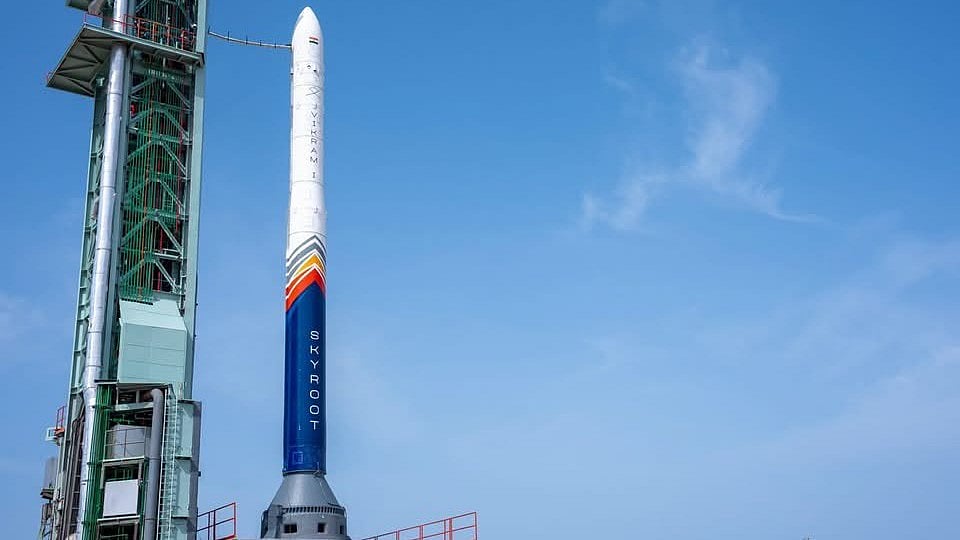
Indian Prime Minister Narendra Modi opened the Monsoon Session of Parliament, by spotlighting the success of Hyderabad-based Skyroot Aerospace's Vikram-1, India's first private orbital rocket. He noted the team's average age of 28, adding, "I am not speaking of a 56-year-old youth," a remark widely linked to opposition leader Rahul Gandhi, who turned 56 last month. Modi urged productive debates grounded in facts, tying the achievement to India's recent space milestones, including an astronaut's visit to the International Space Station, as the session heads into a session-long agenda of key bills and the Budget through August. Here is an explainer on the rocket that was at the centre of Modi's remarks.
What is Vikram-1? A private rocket that reached orbit
Vikram-1 is a four-stage, expendable orbital small-lift launch vehicle developed by Skyroot Aerospace, named after Vikram Sarabhai, the founder of India's space programme. Its first three stages are solid-fuelled, while the fourth is a liquid stage. The rocket lifted off on its inaugural flight on July 18 from the Satish Dhawan Space Centre, becoming the first commercial Indian rocket to reach orbit. The launch made India just the third country with private orbital launch capability, after the US and China.
Inside Mission Aagaman
The debut flight was called Mission Aagaman, Sanskrit for 'arrival'. Liftoff was delayed by 35 minutes because of a technical issue detected at the T-minus-5-minute mark in the countdown, but the rocket then closely followed its planned flight path, with all three solid-fuel stages performing as expected. The rocket deployed a liquid-propellant kick stage, known as the orbit adjustment module, which fired for about six minutes, and the upper stage reached its planned 450-kilometre low Earth orbit roughly 15 minutes after liftoff. The mission carried two cubesats, one built by Skyroot itself and the other by fellow Indian startup Grahaa Space. Mission control declared the flight 'a grand success' less than 20 minutes after liftoff.
Vikram-1: Design and technical specifications
The rocket incorporates carbon-composite airframes to reduce structural mass, along with 3D-printed liquid engines and modular avionics systems. Its Kalam-250 stage uses thrust vector control for steering, while the upper stage carries reaction control system thrusters for attitude control. Vikram-1 is designed to place up to 350 kilograms into low Earth orbit, while an upgraded variant with strap-on boosters, called Vikram-1U, will raise that capacity to 550 kilograms. Skyroot has marketed Vikram-1 as a responsive launch system built for rapid integration and launch operations with minimal ground infrastructure.
What is Skyroot Aerospace?
Skyroot Aerospace is based in Hyderabad and was founded in 2018. The company unveiled the Vikram-1 launch vehicle in October 2023, following the successful flight of its suborbital demonstrator Vikram-S in November 2022, which made Skyroot the first Indian private company to launch a rocket from ISRO's launch facilities. The company said it plans a series of test flights before beginning commercial launches, and an executive said at an industry conference this month that up to two more Vikram-1 launches are planned this year. Skyroot raised 60 million dollars in May to scale up production of Vikram-1 and to develop a larger vehicle, Vikram-2.

