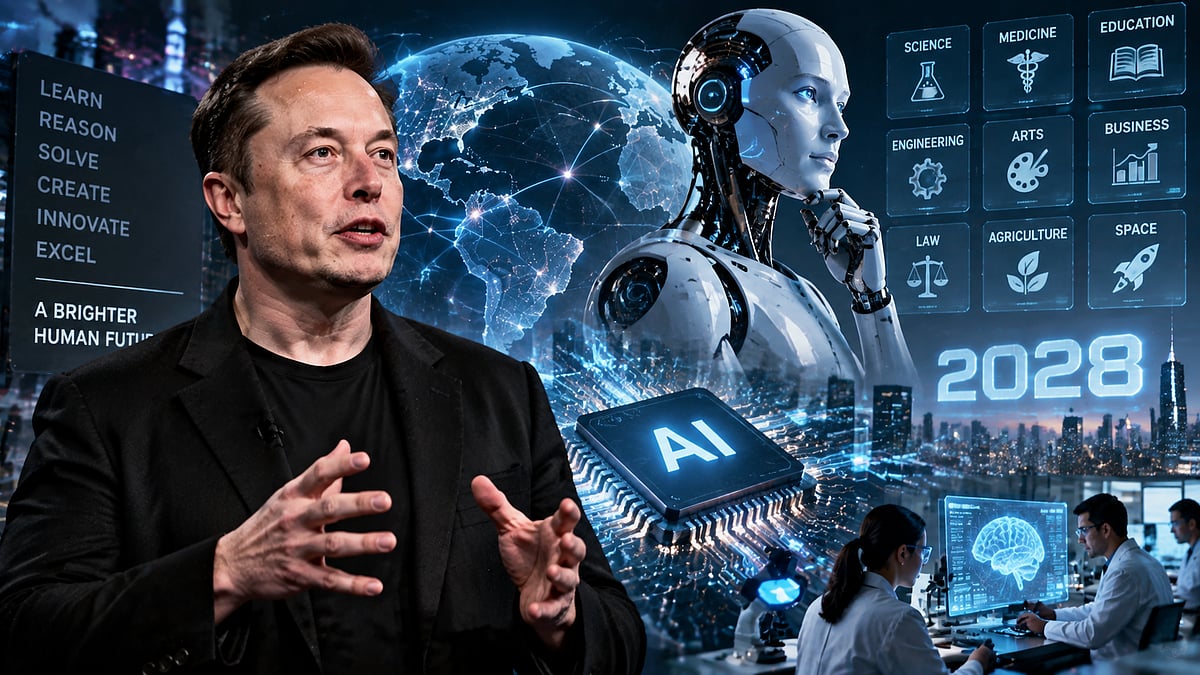
Elon Musk has once again brought forward his timeline for artificial intelligence to surpass human capabilities, saying AI could “beat all fields” by the end of 2027 or 2028 at the latest. His latest prediction came in response to AI researcher François Chollet, who had argued years ago that almost every branch of science would eventually become a branch of computer science.
Chollet made the prediction in 2021, when he posted a thread on X, then known as Twitter, outlining how science could change over the next 10 to 20 years. He argued that fields including physics, chemistry, biology and even archaeology would increasingly depend on computing. Nearly five years later, Chollet revisited the prediction, saying an idea that had faced considerable pushback in 2021 was now “looking obvious by the day”.
Musk thinks the change will come sooner
Musk responded to Chollet’s post by calling his timeline “conservative”. He wrote, “AI will beat all fields by the end of next year or maybe 2028, at the latest”.
The remark suggests Musk believes advances in AI are moving considerably faster than the 10-to-20-year period Chollet had envisaged. However, what it means for AI to “beat” or “master” a field remains open to interpretation. If the benchmark is AI becoming an essential tool across scientific disciplines, the transition is already under way.
AI is increasingly being used to run simulations, analyse large volumes of data and identify patterns that humans could miss. The technology has already played a role in discoveries and research involving protein folding, materials science and climate modelling.
From tech companies to AI-powered science
Chollet’s original argument drew a comparison with the transformation of businesses through technology. In 2000, the idea that most companies would eventually become technology companies might have seemed far-fetched. Two decades later, businesses such as Walmart and FedEx rely heavily on software while continuing to operate their traditional retail and logistics businesses.
His point was that science could undergo a similar transformation. Rather than computer science remaining a separate discipline, computing and AI could become fundamental tools across scientific fields. Seen in that context, Chollet’s prediction is less about AI replacing entire disciplines and more about technology becoming deeply embedded in how research is conducted, India Today reports.
Musk, however, is making a much stronger claim by suggesting AI could outperform human capabilities across all fields within the next two years. Such a timeline is striking, particularly because his own predictions about AI surpassing human intelligence have repeatedly moved closer.

Musk’s AI timeline keeps shrinking
In 2017, Musk responded to a study predicting that AI would outperform humans at everything by 2060. He said at the time that he expected the milestone to arrive much sooner, around 2030 to 2040.
By 2024, Musk had shortened that timeline considerably. He predicted that AI would become smarter than any individual human by the end of 2025 and would surpass the combined intelligence of humanity within five years.
At Davos in January 2026, Musk moved the date forward again. He said AI could become smarter than any human by the end of 2026 or by the end of 2027 at the latest. He also predicted that AI could surpass humanity’s collective intelligence within five years after that.
His latest response to Chollet now puts another milestone, AI mastering or outperforming every field, somewhere between the end of 2027 and 2028.
Also Watch:
A bold prediction, but the definition matters
AI safety and the technology’s wider impact have become major subjects of debate as AI systems grow more capable. Against that backdrop, Musk’s latest prediction adds to a series of increasingly ambitious forecasts about how quickly the technology will progress.
There is also an important distinction between AI becoming indispensable in a field and actually outperforming the best human experts in it. Evidence of AI’s growing role in scientific research supports the argument that it will become deeply integrated into more disciplines, but that is not necessarily the same as mastering every field.
For now, Musk’s prediction remains just that, a prediction. But the rapid adoption of AI across science means the broader shift identified by Chollet is already visible. The bigger question is whether AI will merely become an essential tool for human experts or advance as quickly as Musk believes and begin outperforming them across virtually every discipline.

