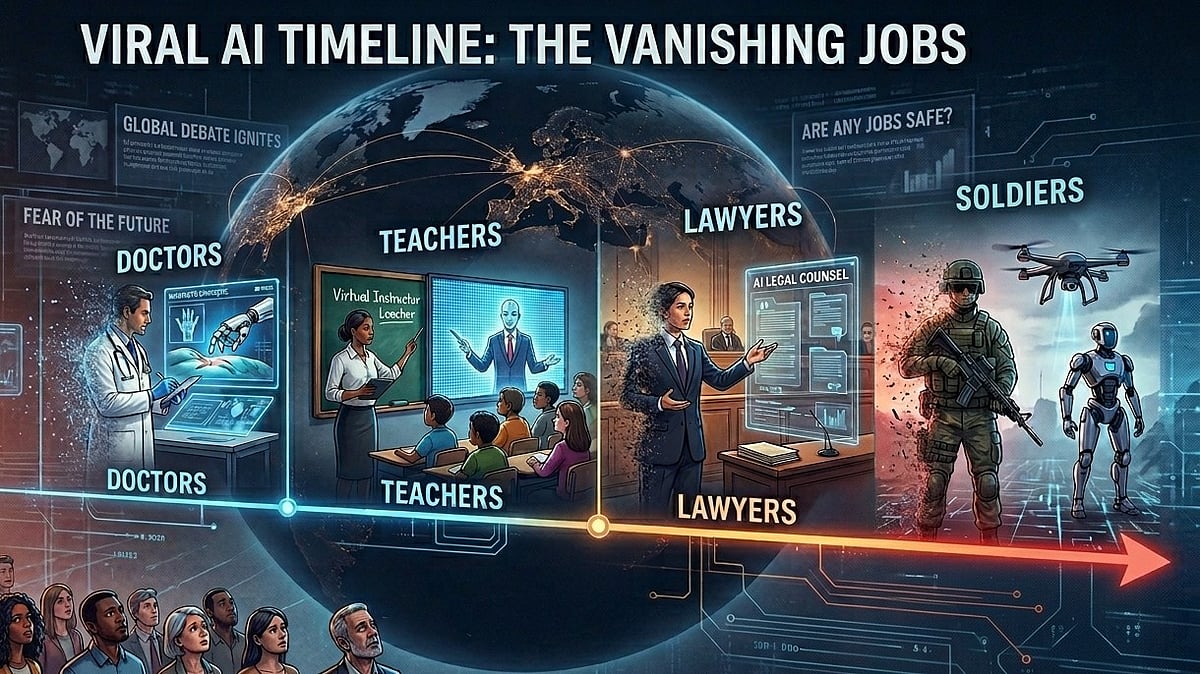
An AI job replacement timeline has gone viral. This timeline, drawn from a book, predicts that most white-collar jobs - including doctors, teachers, artists, drivers, and even lawyers - will vanish by 2033. The first to vanish will be coders in 2028, wherein AI will write and rest all code, requiring zero human intervention. Drivers to be heavily impacted in 2029, wherein almost 12 million drivers will become unemployed as self driving becomes ubiquitous.
The timeline, drawn from Ben Sigman's Bitcoin One Million book, maps out a profession-by-profession schedule for when AI will reach 'technical capability' to replace entire human job categories. The dates are close. In some cases, they're already here. And a cascade of real-world layoffs is making the projections harder to dismiss.
Job redundancy forecast: Year by year, job by job
2028 - Coders: According to the book, this is the first to fall.. AI writes, tests, deploys, and maintains code without human assistance. The prediction is already under pressure from events: tools like Anthropic's Claude Code and OpenAI's Codex have taken over significant portions of software development work, and tech platforms are quietly cutting engineering headcount.
2029 - Drivers and Teachers: Self-driving becomes ubiquitous, rendering an estimated 12 million drivers unemployed. In the same year, personalised AI tutors capable of providing individual attention to every student emerge at scale, threatening the economics of traditional classroom teaching.
2030 - Doctors and Artists: AI diagnostics outperform human physicians - never forgetting a symptom, never misreading a scan, never prescribing incorrectly. The creative industries face the same reckoning. AI-generated images, songs, and films become available on demand, at near-zero cost.
2031 - Lawyers and Factory Workers: AI reads the entire corpus of case law instantly, writes perfect contracts and legal briefs, and closes the gap between junior associates and senior partners. Simultaneously, total factory automation - 'lights out manufacturing' - spreads everywhere, eliminating the last blue-collar production roles.
2032 - Surgeons: Robotic surgery with zero tremor and perfect precision every time removes the final premium on human hands in the operating room.
2033 - Soldiers: AI-controlled drones and robots power automated warfare systems, removing humans from battlefield decision-making entirely.
The timeline includes an important caveat, "Actual adoption may lag due to regulatory and cultural friction." But the author's point is that technical capability will arrive on schedule regardless of whether society is ready for it.
We are currently in the augmentation phase
Before full replacement comes something arguably more disruptive in the near term: augmentation.
The forecast describes a transitional period in which top professionals gain 10 to 100 times their current productivity using AI tools. A senior lawyer who once billed for 60 hours of research can now produce the same work in three. A doctor with AI diagnostics can see five times as many patients. An engineer with AI coding assistants can maintain systems that once required a team of twenty.
The result is not, as many assume, that everyone gets richer. It is that far fewer people are needed to do the same amount of work - and the gap between those who can leverage AI and those who cannot widens dramatically. Critics warn this augmentation phase concentrates economic power at the top while quietly eliminating the entry-level positions that once served as on-ramps to professional careers.
Anthropic CEO issues warning as well
The projections in Sigman's book coincide with a stark public warning from one of the most influential voices in AI development. Anthropic CEO Dario Amodei warned that AI could eliminate 50 percent of all entry-level white-collar jobs within the next five years, potentially pushing US unemployment rates to 10–20 percent. Amodei has called what's coming a possible 'white-collar bloodbath,' stressing that the disruption will hit specialised, highly educated professionals in ways that may prove very difficult to reverse.
Layoff's are already underway
The most striking recent example is Block, the company behind Square, Cash App, and Afterpay, announced it is cutting its staff by 40 percent - more than 4,000 people, reducing the workforce to just under 6,000. The stated reason, "intelligence tools," according to a letter to shareholders by co-founder Jack Dorsey.
Block is not alone. Amazon is laying off 16,000 employees in 2026, its second major round of job cuts in three months. Across 2025, nearly 55,000 job cuts were directly attributed to AI, according to Challenger, Gray & Christmas, out of a total 1.17 million layoffs - the highest level since the 2020 pandemic.
