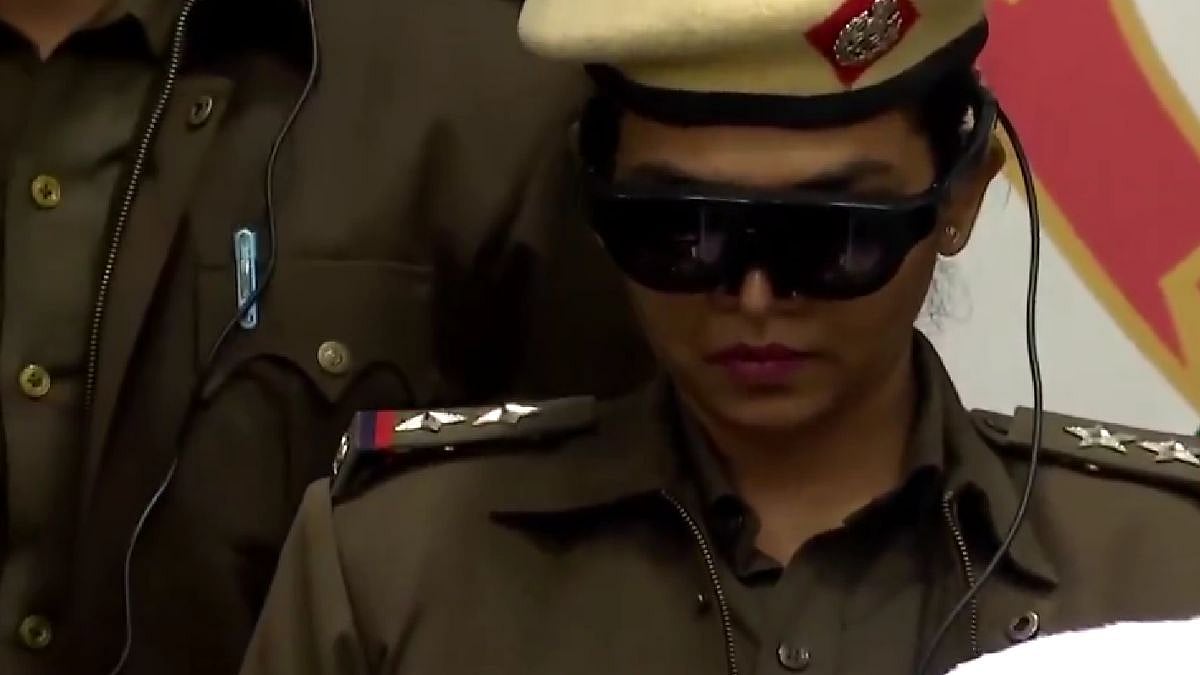
Delhi Police has announced the deployment of AI-enabled smart glasses for the first time during the 77th Republic Day parade. The technology aims to bolster security by identifying potential threats in real time amid large crowds.
The Indian-made glasses incorporate facial recognition and thermal imaging features. They connect to a database of criminals and suspects, allowing officers to spot individuals with records instantly.
How do the AI-powered smart glasses function?
The smart glasses link to mobile phones carried by police personnel. This connection provides access to an encrypted database stored locally on the devices. The system displays a green box around faces with no criminal history and a red box for those with records.
Advanced algorithms enable the glasses to identify people despite disguises, such as makeup, masks, caps, or beards. The database has been trained on various images, including old photographs and those showing changes in appearance like long hair or facial cuts.
DCP Devesh Kumar Mahla, Additional Commissioner of Police (New Delhi), explained that the standalone systems are not connected to the internet for security reasons. Each mobile phone holds its own zipped database file. The glasses also feature thermal scanning to detect hidden weapons or suspicious items on attendees.
Other technologies being used in surveillance arsenal
In addition to the smart glasses, Delhi Police will equip thousands of CCTV cameras with video analytics and facial recognition systems. These cameras form part of a multi-layered security grid in the New Delhi area.
Mahla says, "We will make full use of technologies that are beneficial to us from a security perspective. Definitely, all our CCTV cameras will be equipped with video analytics and facial recognition systems (FRS). There are various types of video analytics, and we will utilise them as well. This time, we are also using specially developed cameras and wearable glasses. We have fed different algorithms into the database of these standalone systems. If wanted individuals are detected or spotted, even if they are wearing makeup, a mask, a cap, or have a beard, our algorithm will identify them. The cameras we have installed, along with the database, have been tested and found effective... The FRS cameras installed in place will be connected to our standalone system, which is not connected to the internet."
"Additionally, we will load the database onto individual mobile phones for the wearable glasses. This will also not be connected to the internet. So, each mobile phone will have its own individual database in a zip file. This database has been trained using different algorithms so that it can identify a person regardless of how they look, whether it's a photo from 20 years ago or a recent one, whether they have a beard or long hair, or even a cut on their face. Another feature is that it can identify someone even if they are wearing a face mask or it's just a photo," he added.
A comprehensive security setup includes six layers of checking and frisking, along with multi-layered barricading. Around 10,000 police personnel will be deployed across the New Delhi district alone.DCP Mahla noted that three layers of physical checks will apply to pedestrians and similar protocols for vehicles.
