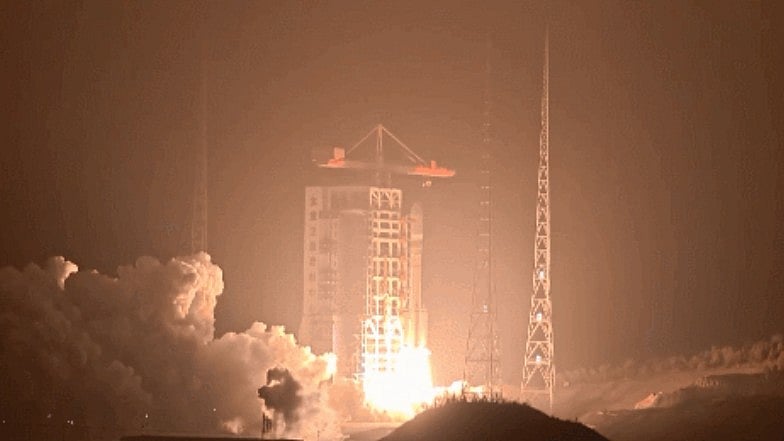
China has successfully launched 18 new internet satellites, adding to its ambitious low-Earth orbit (LEO) constellation designed as a direct rival to SpaceX's Starlink.
The mission, described as the seventh batch of the Qianfan constellation (also known as 'Thousand Sails' or Spacesail), advances China's goal of building a massive satellite network for global broadband internet services.
Qianfan launch details
The satellites lifted off aboard a Long March-8 or Long March-8A rocket in a night launch from the Hainan Commercial Space Launch Site . The illuminated night sky over Hainan marked a milestone for the site, which conducted its 14th launch overall. This was also the first mission where the site's weather team independently managed operations.
Qianfan is widely positioned as China's answer to Starlink, aiming to deliver high-speed, secure, and reliable broadband internet from space. The constellation ultimately plans for thousands of satellites (with ambitions scaling toward 10,000+ in some projections) to provide global coverage.
It particularly targets support for the Belt and Road Initiative, offering secure digital connectivity for Chinese businesses, infrastructure projects, and international partners worldwide. Unlike purely commercial models, the project emphasizes strategic and state-backed applications, including resilient communications.
Technical and operational highlights
- Rockets: The launch utilised advanced Long March-8 variants, described as a 'one-two punch' system capable of carrying 5-ton to 7-ton payloads. This enables faster, large-scale deployment of satellite batches.
- Orbit: The satellites entered a preset low-Earth orbit, consistent with LEO internet constellations for reduced latency and high-speed data services.
- Progress: This batch brings incremental growth to the Qianfan network, which has seen multiple prior deployments. China continues to invest in "super factories" and rapid production to accelerate constellation build-out.
The launch underscores China's accelerating push into commercial and strategic space capabilities. With multiple state-backed projects (including Qianfan and others like Guowang) in development, Beijing aims to challenge Western dominance in satellite internet while securing orbital slots and spectrum for future needs.
Experts view these efforts as part of a larger competition in low-Earth orbit, where satellite mega-constellations could reshape global connectivity, digital infrastructure, and even geopolitical influence.
China's space program has conducted hundreds of Long March rocket missions, demonstrating growing reliability and capacity for frequent launches. Future batches are expected to follow rapidly as production and launch infrastructure expand.
This development comes amid ongoing global interest in satellite broadband, with systems like Starlink already serving remote and underserved areas worldwide. Qianfan's progress signals intensifying rivalry in the sector.

