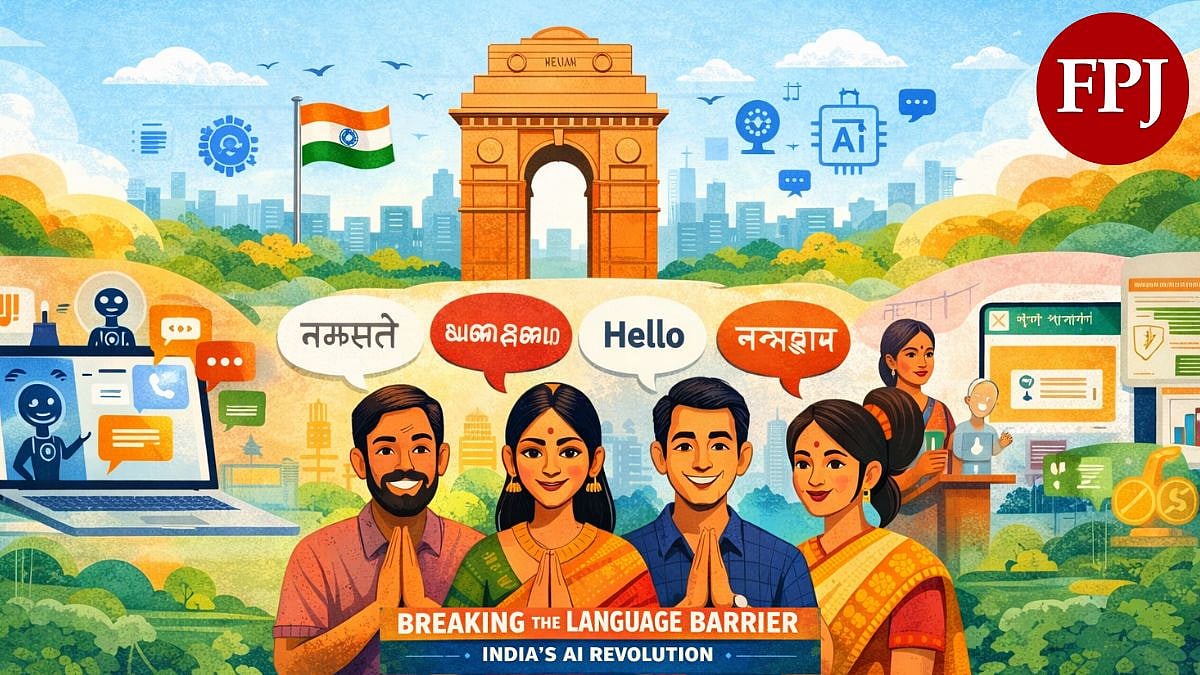
As India celebrates its 76th Republic Day, a quiet revolution is underway - one that promises to fulfill the constitutional promise of equality not just in law, but in digital access. While India's linguistic diversity has long been celebrated as cultural wealth, it has simultaneously created one of the most persistent barriers to technological inclusion. Today, artificial intelligence is emerging as the bridge that could finally democratise technology for over a billion Indians who think, dream, and communicate in languages other than English.
The Language Divide: India's Digital Paradox
The numbers tell a stark story. Despite having more than a billion native language speakers across 22 scheduled languages and hundreds of dialects, less than 1 percent of digital content exists in Indian languages. Meanwhile, 98 percent of users access content in Indic languages like Tamil, Telugu, and Malayalam, and 57 percent of urban internet users prefer regional language content. This structural barrier has long excluded millions from participating fully in the digital economy.
Nakul Kundra, Co-founder & CEO of Devnagri AI, frames the challenge with clarity, "In a linguistically diverse country like India, language should never be a barrier to technology adoption or economic participation. If the digital revolution is to be truly inclusive, AI cannot remain anchored in English or a handful of global languages."
His company has scaled its multilingual AI platform to support 22 Indian languages and their dialects, trained on hundreds of millions of data points. "Our journey has seen notable milestones from pioneering India's first enterprise-ready multilingual AI solutions, to being recognised as a top three finalist in the Government of India's IndiaAI Innovation Challenge," Kundra notes, adding that their AI contact center solution has been acknowledged for its potential to bridge language gaps in public services.
Government Leading the Charge
The transformation is being catalysed by ambitious government initiatives. Bhashini, launched under the National Language Translation Mission, offers real-time translation for 22 Scheduled and several tribal languages, facilitating citizen access to government services, digital content, and parliamentary debates. The platform has already demonstrated its power. Prime Minister Narendra Modi used Bhashini to translate his real-time speech for Tamil audiences, while Finance Minister Nirmala Sitharaman deployed it during her 2024 Union Budget speech.
Complementing Bhashini is BharatGen, which develops advanced text-to-text and text-to-speech translation models using datasets from the Scheme for Protection and Preservation of Endangered Languages (SPPEL). The Adi-Vaani platform goes even further, serving as India's first AI-driven system for real-time translation and preservation of tribal languages like Santali, Bhili, Mundari, and Gondi.
At the ongoing World Economic Forum in Davos, India's IT Minister Ashwini Vaishnaw strongly defended the country's position in the global AI landscape during a panel discussion that included IMF Managing Director Kristalina Georgieva. Vaishnaw questioned the IMF's classification of India as a "second-tier" AI power, citing Stanford's assessment that ranks India third globally in AI preparedness and second in AI talent. "I don't think your classification in the second bouquet is right. It's actually in the first," he stated directly.
The Startup Ecosystem Steps Up
The private sector is equally energised. Ankit Sarawagi, CFO of Verloop.io, observes that AI has moved from experimentation to measurable impact, "Today, majority of enterprises are actively using AI solutions and most of them have multiple generative AI use cases, signalling a shift from pilots to performance across industries. By focusing on multi-lingual support, seamless integration, and real-time customer impact, we are helping Indian businesses transform customer engagement."
Madhav Sheth, CEO of Ai+ Smartphone, emphasises the cultural imperative, "In India, language is not just a way to communicate. It shapes how people think, learn, and interact with technology every day. True democratisation of technology means designing AI for the way India actually speaks, across multiple languages, dialects, and everyday mixed-language conversations." His company is building multilingual AI platforms optimised for value-first smartphones, low bandwidth, and everyday use cases.
Beyond these players, Project Vani - a Google-funded initiative - is collecting speech data from about 1 million Indians and open-sourcing it for automatic speech recognition and translation. TranslateGemma and other startups are pushing the boundaries of what's possible in Indic language processing.
Global Tech Giants Join the Movement
Microsoft and Google are making significant investments in India's vernacular AI ecosystem. Microsoft's Jugalbandi project enables users to interact with chatbots in multiple languages and receive information in their local dialect, democratising access to essential public services. The company has also committed to equipping 2 million Indians with AI skills by 2025 through its ADVANTA(I)GE INDIA initiative.
Google has expanded its Gemini Live AI platform to Hindi and eight regional languages including Bengali, Tamil, Telugu, Marathi, Kannada, Gujarati, Malayalam, and Punjabi. The company's Project Vaani represents one of the largest datasets of Indian dialects ever assembled, supporting the broader Language Inclusivity Initiative.
The Real-World Impact
The tangible benefits of vernacular AI are already visible across sectors. In healthcare, AI translators help rural workers communicate with patients using different dialects. In education, the AICTE's e-KUMBH portal provides free access to technical books and study material in multiple Indian languages, supporting the National Education Policy 2020 goal of teaching in the learner's mother tongue.
For commerce, the transformation is equally dramatic. Amazon's voice-enabled shopping assistant in Hindi, Tamil, and Telugu has proven transformative. 60 percent of new users during its 2024 Great Indian Festival sale came from vernacular segments. Research by Microsoft suggests that users are 2.5 times more likely to engage with content in their native language.
Financial inclusion is perhaps where the impact is most profound. Digital payment platforms now use NLP-based multilingual chatbots, with vernacular content delivering a 40 percent increase in customer engagement among customers in Tier-II and Tier-III cities.
The Market Momentum
The numbers underscore the opportunity. India's AI market is projected to reach $5.10 billion in 2025, growing at a CAGR of 43.76 percent to reach $45 billion by 2031. NASSCOM projects India's AI market will grow at 25-35 percent CAGR through 2027, driven significantly by vernacular AI adoption.
With India's internet user base poised to exceed 900 million, driven by increased usage of Indic languages, and rural India accounting for 55 percent of the total internet population, the imperative for language-first AI has never been clearer.
Building the Future
As Devnagri AI's Kundra concludes, "Technology that ignores India's linguistic reality risks leaving behind millions of potential participants in the digital economy. But when AI speaks the language of the people it becomes a bridge to education, healthcare, financial inclusion and civic participation."
On this Republic Day, as India reaffirms its commitment to equality and justice for all, vernacular AI stands as a powerful tool to translate constitutional promises into digital reality. The revolution will not be in English - it will be in Hindi, Tamil, Bengali, Marathi, and the hundreds of languages that make India truly incredible. For the first time, technology is learning to speak India's language, and in doing so, it's ensuring that the digital future belongs to everyone, not just the English-speaking elite.

