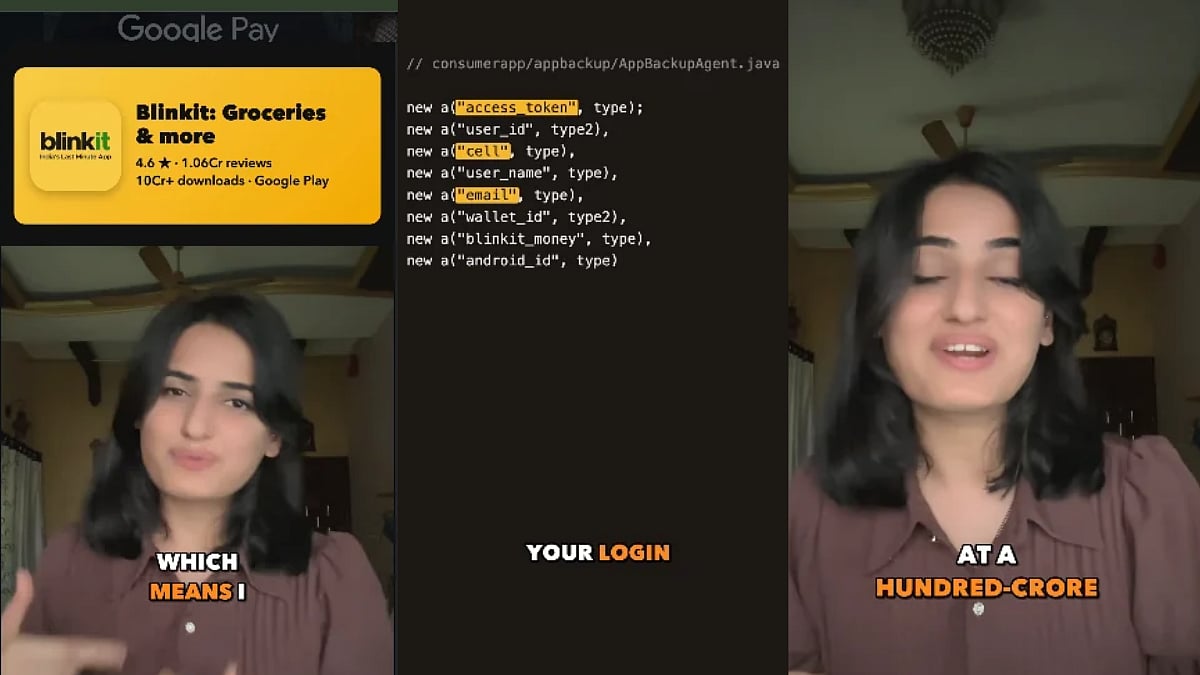
A video by creator Anika Beri that picks apart the Android code of quick-commerce app Blinkit has set off a debate about how much device data delivery apps collect and what they do with it. The app allegedly reads installed apps, Wi-Fi names and battery status, the creator says. Blinkit says the checks serve functional purposes and are covered in its privacy policy.
What the video claims
Beri says she decompiled the app, meaning she reverse-engineered its code, and found several data checks. According to her video, the app:
- looks for 21 other apps on a user's phone, including Instagram, Zomato and Slack
- records screen size, zoom level and whether a screen reader is on
- backs up a single file that holds a user's login token
- saves the Wi-Fi network name alongside the user's location with each order
- records the phone's battery level
She argues these signals could be used to profile users. In her reading, the installed apps could show where ads should be aimed and whether a person is employed. Large text and screen-reader settings could point to an older user who is less likely to compare options. A shared Wi-Fi name could link family members into one household. She also cites Uber research suggesting people with low batteries are more likely to accept higher prices. She says the app can effectively guess a user's age, who they live with and how urgently they need an order.
The login token
Beri called the backed-up login token the most alarming finding. She says it could let someone sign in on a new phone without entering an OTP.
Blinkit's explanation
Blinkit replied to the creator with an explanation. It said the checks support specific functions. It cited integrations with other apps, faster location detection, features that help users, and better performance on low-end devices. The company added that all of this is disclosed in its privacy policy.
The row sets the convenience of 10-minute deliveries against concerns about quiet data collection. Blinkit and other quick-commerce apps have not been shown to use these signals to set prices or profile users, and Blinkit's explanation says they serve functional purposes.
Blinkit's statement:
From the Blinkit Android team - context on some of these, since there's actually a technical reason behind most of them instead of a marketing one.
For installed apps, we look for apps within the Eternal family, like Zomato and District, to make things work better across them with things like "Login with Zomato". WhatsApp is there because you can share recipes with friends and family (creates a cart with all the ingredients), and Instagram is used for sharing your year-end recap directly to Stories.
The font scaling, screen reader and accessibility checks are there because not everyone uses their phone the same way. Some people use larger text, some rely on screen readers, and we want to make sure they can use Blinkit and place orders just as comfortably.
The Wi-Fi SSID bit is actually a performance optimisation, not something we use to identify households or for marketing. We cache your location against a Wi-Fi network so that the next time you open Blinkit on the same network, we can get you started faster instead of waiting for GPS.
And the battery level or cpu level helps us make Blinkit work better on phones that might not have a lot of resources available. We use it to dial down fancy animations and other nice-to-have features when needed, because the core order experience matters a lot more.
We've actually talked about a lot of this publicly! There's a talk called "Delivering Performance in a Blink" from droidCon India where we go into the Wi-Fi caching (~7:20) and device optimisations (~22:00) in a lot of detail. We also open-sourced our device optimisation library, Droid Dex, if you're curious: https://github.com/grofers/droid-dex
Hope this helps explain some of what you're seeing in the code. Happy to answer questions! :)

