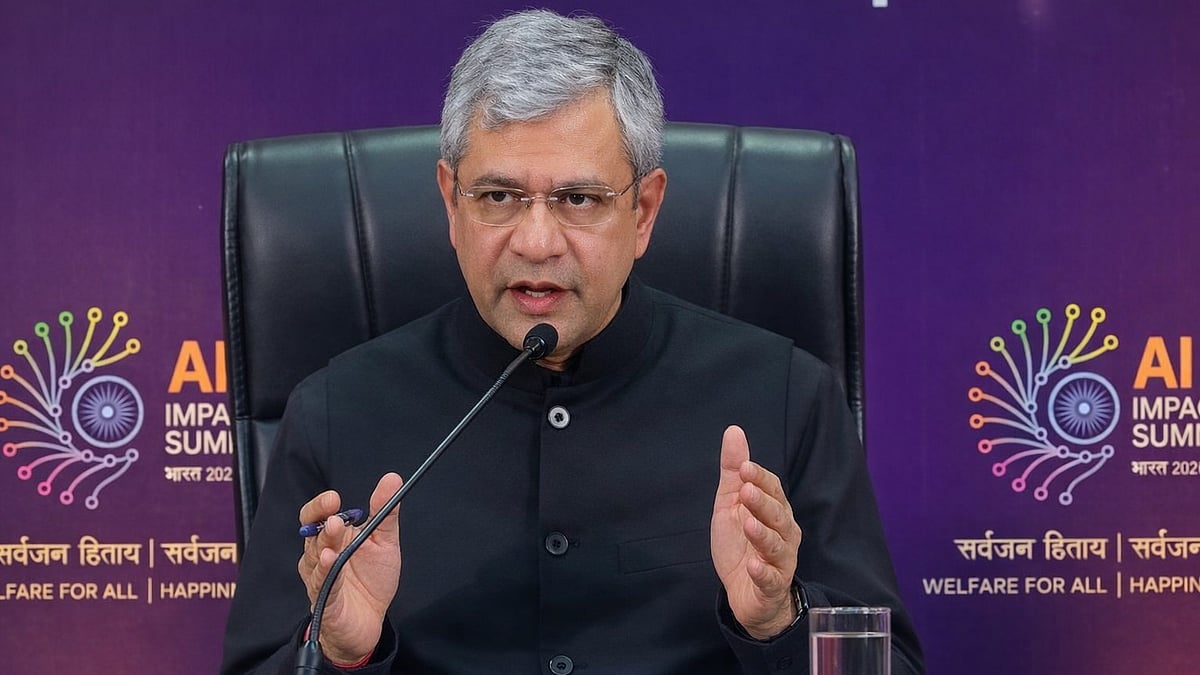
Ashwini Vaishnaw, Union Minister for Electronics and Information Technology, addressed the media at the India AI Impact Summit 2026 at Bharat Mandapam, New Delhi. During his speech, he touched upon various topics - from deepfakes to GPU procurement, to age-gating social media, and even announced a new UPI-style AI platform. In particular, he said that the government is in talks with social media organisations on age-related restrictions.
Deepfakes, Age Gates and the Constitution
Vaishnaw reserved some of his sharpest language for social media platforms and the creeping harm of AI-generated content. On deepfakes, he signalled that the period of dialogue was approaching its limits. "I think we need a stronger regulation on deepfakes. It is a problem growing day by day. We need to protect our society from this harm. We have initiated a dialogue with the industry on this," he said.
The government is also pushing platforms toward age-based access restrictions, with active negotiations underway. "“Government is in talks regarding age-based restrictions with social media companies," he said.
And on the broader question of platform accountability, the minister was unequivocal, "Whether it is Netflix, YouTube, Meta or X, all must operate within the constitution of India." He framed it as a matter of sovereignty, not just policy. "We are committed to ensure that our destiny remains in our control," he said.
Vaishnaw apologised for the chaos on opening day
Vaishnaw did not shy away from the opening day chaos that left attendees frustrated and drew sharp criticism on social media. "My apologies to those who felt difficulties yesterday," he said simply, before steering the conversation toward what the government believes is the bigger narrative — India staking its claim in the global AI order.
$200 Billion investment
The investment numbers were the summit's loudest signal yet. "So far, in the coming two years, we should be seeing more than $200 billion investment across the five layers of the AI stack," Vaishnaw said, before making clear that figure was already being left behind. "As we go forward, we expect investments to surpass $200 billion as well," he added.
An additional $17 billion has been committed specifically for deeptech and the application layer, above and beyond the headline number, reflecting the government's intent to ensure India builds AI, not just buys it.
To keep the compute pipeline moving, the government announced it would place orders for another 20,000 GPUs, to be deployed within six months under the IndiaAI Mission.
NVIDIA in the Room, Huang on the Phone
The absence of NVIDIA CEO Jensen Huang - one of the summit's most anticipated attendees - was addressed directly by the minister. "Mr Jensen Huang reached out to us and said that due to something really unavoidable, he has deputed his very senior executive to join us," Vaishnaw said, adding that "NVIDIA is working with some Indian companies for some very large investments in AI in India." The remarks were clearly intended to signal that the relationship remains intact despite Huang's no-show.
'AI ka UPI'
The most striking domestic announcement was the government's plan to replicate the UPI playbook for artificial intelligence. "We will be creating 'AI ka UPI', a bouquet of trusted solutions which will be presented as a UPI-like platform which will be available for people to build on," Vaishnaw said.
Under IndiaAI Mission 2.0, the platform will host AI solutions across healthcare, agriculture and other sectors — tried, tested, and free. The architecture mirrors UPI's founding logic: build the rails, open them to everyone, and let innovation follow. The government's message is unambiguous — AI in India should not be the exclusive domain of those who can afford frontier model licences.
A Word for the IT Industry
With anxiety mounting over AI's impact on India's vast IT workforce, Vaishnaw had a pointed message for the sector: the government's position is adaptation, not protection. His advice to the industry was direct - concentrate on upskilling and reskilling talent. It was a signal that the state intends to build the infrastructure and set the rules, but expects industry to meet it halfway.
