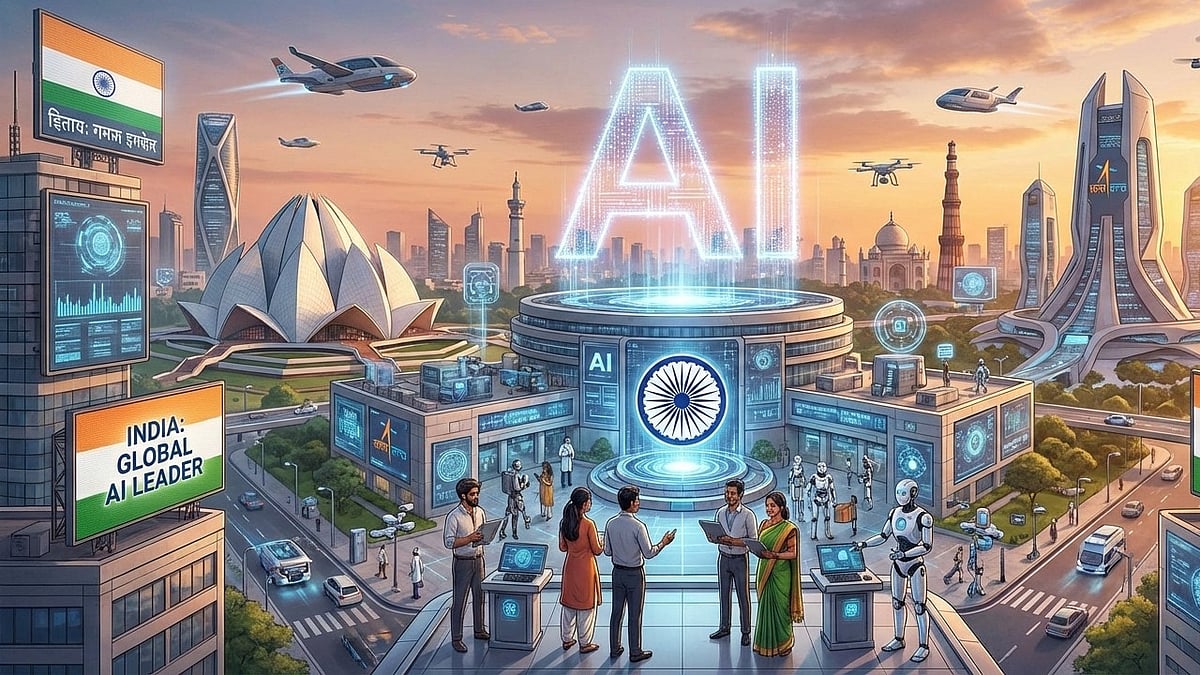
As the dust settles on one of the most consequential gatherings in the country's technology history, legal and policy observers are drawing attention to the far-reaching implications of the 2026 India AI Impact Summit. Probir Roy Chowdhury, Partner at leading law firm JSA, offered his assessment to the Free Press Journal, calling India's participation in global AI governance both timely and transformative.
A Bold Vision: M.A.N.A.V. and the New Delhi frontier AI commitments
At the heart of the summit's policy agenda was the unveiling of the M.A.N.A.V. vision - a framework that signals India's intent to anchor artificial intelligence development in human-centric values. Running alongside it, the New Delhi Frontier AI Commitments set out a multilateral blueprint for responsible innovation, drawing signatories and observers from across the global AI community.

Roy Chowdhury, who has closely tracked the evolution of India's tech regulatory landscape, described these developments as "important steps towards responsible innovation." He noted that the frameworks reflect a maturing approach - one that balances the country's ambitions in AI with the need for guardrails that protect citizens and institutions alike.
PM Modi's three-point regulatory agenda and the SAHI framework
Adding political weight to the governance discussions, Prime Minister Narendra Modi unveiled a three-point regulatory agenda that is expected to serve as the cornerstone of India's AI policy architecture in the years ahead. Complementing this, the SAHI framework - aimed at ensuring safe, accountable, harmonised, and inclusive AI deployment - was presented as a cross-sectoral tool for managing the technology's impact across industries from healthcare to finance to public administration.
"PM Modi's three-point regulatory agenda, alongside the SAHI framework, reflects a commendable effort to outline how this technology can be thoughtfully managed across sectors," Roy Chowdhury said.
$250 billion: Unprecedented infrastructure push
Beyond policy, the summit made global headlines for the sheer scale of financial commitments it attracted. According to reports from the event, the 2026 India AI Impact Summit secured over $250 billion in infrastructure investments - funds earmarked to expand India's data centre capacity and build out the compute infrastructure that AI systems depend upon.
This figure, if realised, would represent one of the largest concentrated investments in AI infrastructure anywhere in the world, positioning India not just as a regulatory voice but as a physical backbone for AI computation in the Asia-Pacific region and beyond.
India at the forefront: A strategic moment
Roy Chowdhury's overall assessment was unambiguous. "By hosting this historic event and making strides in both oversight and infrastructure, India is definitely at the forefront of development of AI and has a front row seat to witness and shape the next decade of global AI development," he told the Free Press Journal.
The dual emphasis - on governance on one hand, and hardware and investment on the other - is seen by analysts as a deliberate strategy to avoid the fate of nations that shaped the rules of a technology they did not build, or built the technology without adequately governing it. India, it appears, is attempting both simultaneously.
What comes next
The commitments made at the 2026 India AI Impact Summit will now face the harder test of implementation. Translating frameworks like M.A.N.A.V. and SAHI into enforceable policy, and converting $250 billion in pledges into operational infrastructure, will require sustained political will, regulatory capacity, and international cooperation.
For now, however, the summit has firmly placed India in the conversation - not as a passive observer of the global AI race, but as an active architect of its rules and its infrastructure.

