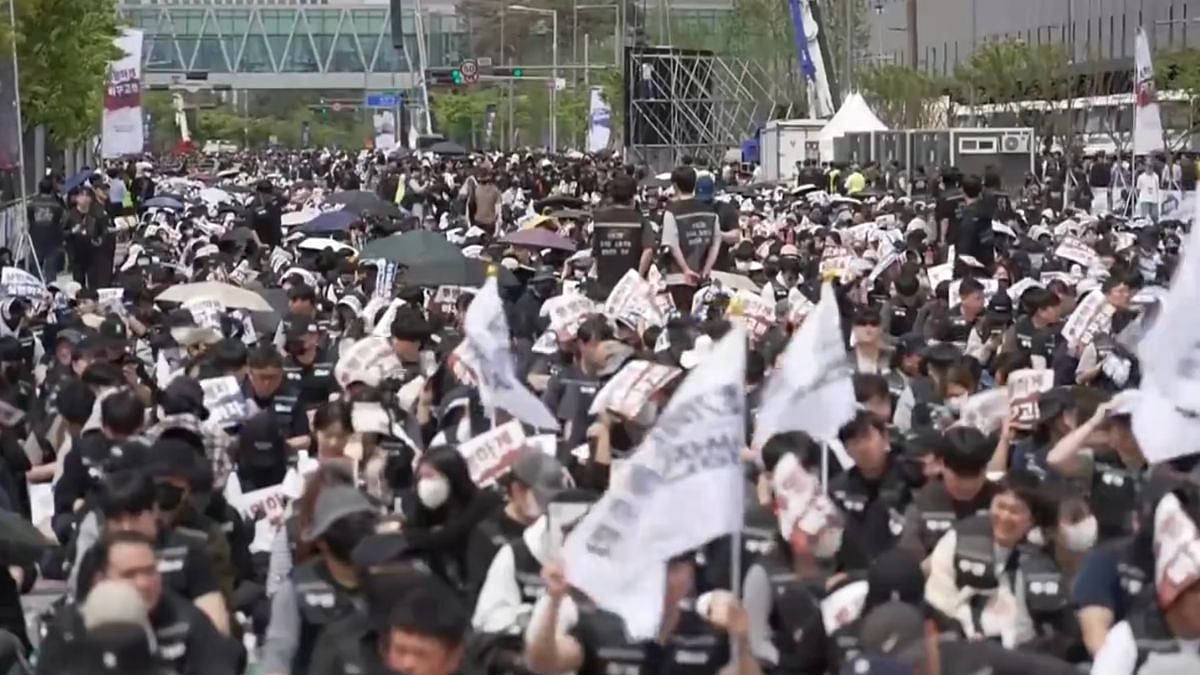
Tens of thousands of workers descended on Samsung's sprawling chip factory complex, demanding fairer wages even as the tech giant rides a wave of surging profits driven by explosive global demand for AI infrastructure.
Unions representing Samsung workers said approximately 37,000 employees are now heading to attend the rally at the company's massive semiconductor complex in Pyeongtaek, south of Seoul. The demonstration marks one of the most significant shows of labour strength at a company that, until recently, had long been seen as untouchable by worker unrest.
Samsung, the world's biggest chipmaker, was historically known for its aggressive union-busting practices. But that era appears to be over. Workers walked off the job for the first time in 2024, and union membership has since tripled to more than 90,000, now representing over 70 percent of Samsung's South Korean workforce of 125,000, according to Reuters.
Samsung rally mainly to protest wage gap
At the heart of the dispute is a growing sense among employees that they are not sharing in the company's spectacular financial recovery.
Workers are pushing for sweeping pay reforms, including a demand to scrap a cap on performance bonuses currently set at 50 percent of annual base salary, a demand management has outright rejected. Unions are also calling for 15 percent of annual operating profit to be set aside as performance pay and a 7 percent hike in base salaries.
Management has countered with an offer of 10 percent of operating profit for performance pay, along with additional funding to ensure workers in the memory division receive higher payouts than competitors this year. The two sides remain far apart.
Samsung workers compare with SK Hynix workers
Much of the worker frustration has been fuelled by comparisons with crosstown rival SK Hynix. In September, SK Hynix accepted union demands for compensation reforms and hefty bonuses, including the removal of a bonus cap, a move that Samsung's unions say has widened the pay gap dramatically.
SK Hynix reported a more than five-fold jump in first-quarter operating profit to a record high, further deepening the sting.
"The phenomenal growth in union memberships reflects a unified and urgent call among employees for change at Samsung Electronics," Choi Seung-ho, who leads Samsung's biggest union, said last week, as reported by Reuters.
Choi also warned that talented engineers were already voting with their feet, leaving for SK Hynix and being courted by rivals including US memory giant Micron and electric vehicle maker Tesla.
Strike threat looms over global chip supply
If no agreement is reached, unions have threatened an 18-day strike beginning May 21, a prospect that has alarmed industry analysts given the current tightness in global chip markets.
Seo Ji-yong, a business administration professor at Sangmyung University, told Reuters that a prolonged strike could delay shipments to customers, push chip prices even higher, and hand a significant advantage to Samsung's rivals. Some experts, however, said factory automation and Samsung's use of subcontractors could soften the blow.
Samsung has warned it will pursue legal action if unions interfere with safety facilities that require more than 2,000 workers to operate.

