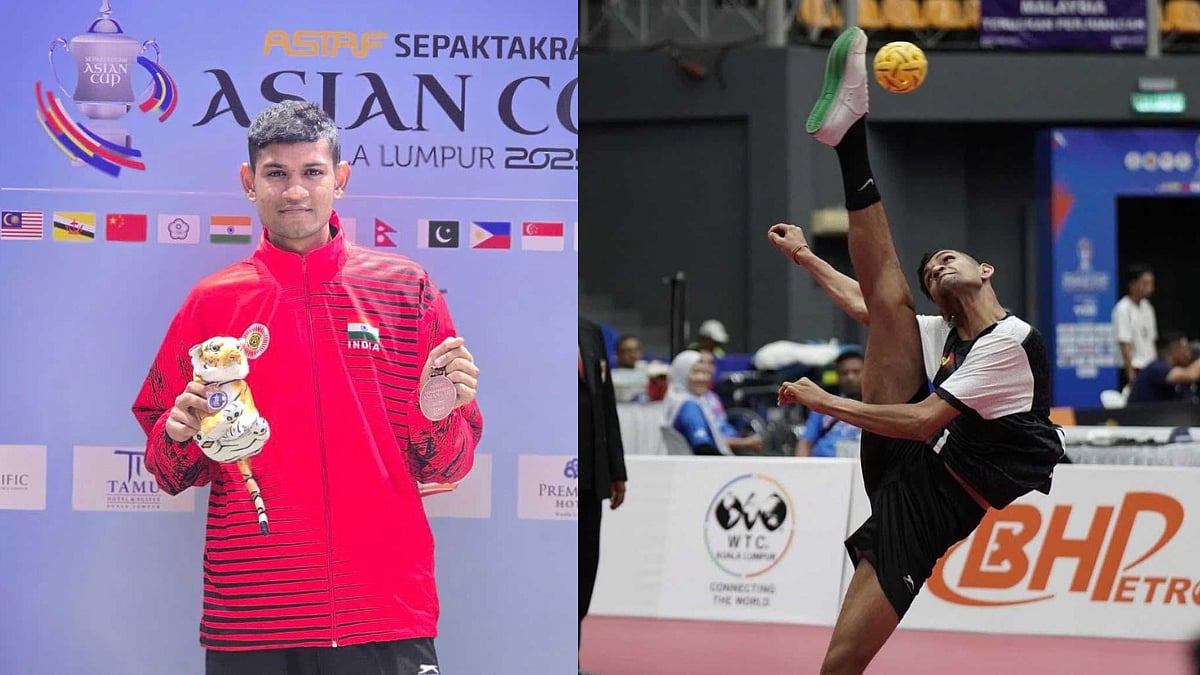
At just 23, Delhi’s Arun is set to represent India at his second Asian Games, competing in the men’s team regu and quadrant events in sepak takraw. His journey to the continental stage has been anything but easy, having balanced school, work and training from the age of 13 amid financial struggles.
Speaking exclusively to The Free Press Journal, Arun opened up about his inspiring journey, his love for the unique sport and his dream of winning gold for India.
Excerpts...
1. Could you tell us a little about your background and childhood? What was Arun like before sepak takraw became such an important part of his life?
I saw sepak takraw when I was in school. From then on, I became interested in sports. My physical education teacher was showing us this game.
2. What was your family or friends’ reaction when you took up the sport as a career?
Their reaction was very good. The sport was very unique for me and different from others, so I was very intrigued by it.
3. Sepak takraw is still relatively new to many Indian sports fans. How would you explain the sport to someone watching it for the first time?
I would say that if you compare sepak takraw with other sports, it is very unique. This game is a compilation of three sports: gymnastics, volleyball and football’s bicycle kick.
4. What have been the biggest challenges you have faced in your career so far, and how did you overcome them?
My father builds houses for a living, so there were financial problems. I started working when I was around 13 or 14 years old. I used to go to school, work and practise as well. Whatever money I earned went towards my diet and other expenses. In 2016, I competed at the national level and won gold. I received a scholarship from the Delhi Government, which helped me and my family a lot financially.
5. What does a typical training day look like for you? How do you divide your time between technical practice, match preparation and fitness?
Our training session is from 6:30 am to 9:30 am. After that, we have breakfast and rest. Then we have an afternoon session. During breaks, we discuss tactics with our teammates. Once a week, we analyse our performances and work on our game plans and strategies.
6. Sepak takraw requires flexibility, agility, balance and explosive power. What kind of gym and strength-and-conditioning routine do you follow?
If we do gym training regularly, there is a chance of losing flexibility. So, we focus more on building endurance and doing leg exercises.
7. What does your diet look like during an intense training or competition phase? Are there any particular foods or nutritional habits that you make sure to follow?
Our diet is different for training and match schedules. After training, SAI provides us with a diet that includes milk, boiled eggs, vegetables and so on.
Our matches are usually in the morning, so we warm up and have a light breakfast. This is so that nobody feels uncomfortable or vomits during the match. We also carry fruits such as apples and bananas.
8. What is your favourite cheat meal?
Homemade rajma chawal.
9. You have been selected to represent India in both the men’s team regu and men’s quadrant events at the Asian Games. What was your reaction when you found out that you had earned a place in the Indian contingent?
This is my second Asian Games. So, I feel proud to come from a humble background and represent my nation. My parents are also proud. I want to win gold and hear our national anthem.
10. How do you and your teammates prepare for the pressure of playing together in a major multi-sport event like the Asian Games?
We analyse the performances of our opponents. Then, we decide on our tactics. We also conduct a SWOT analysis.
11. How are you preparing yourself mentally to handle the pressure of representing India and competing against some of the best teams in Asia?
I have a lot of experience, so it has become a habit for me and the pressure doesn't matter as much. I want to perform for my country and make my family, friends, coach and nation proud.
12. Finally, what would winning an Asian Games medal mean to you personally, and what message would you like to give to the Indian fans who will be supporting the team in Japan?
Watch our matches, pray for us and support us. The future is also good in terms of jobs and scholarships. The highlight reel is also awesome.

