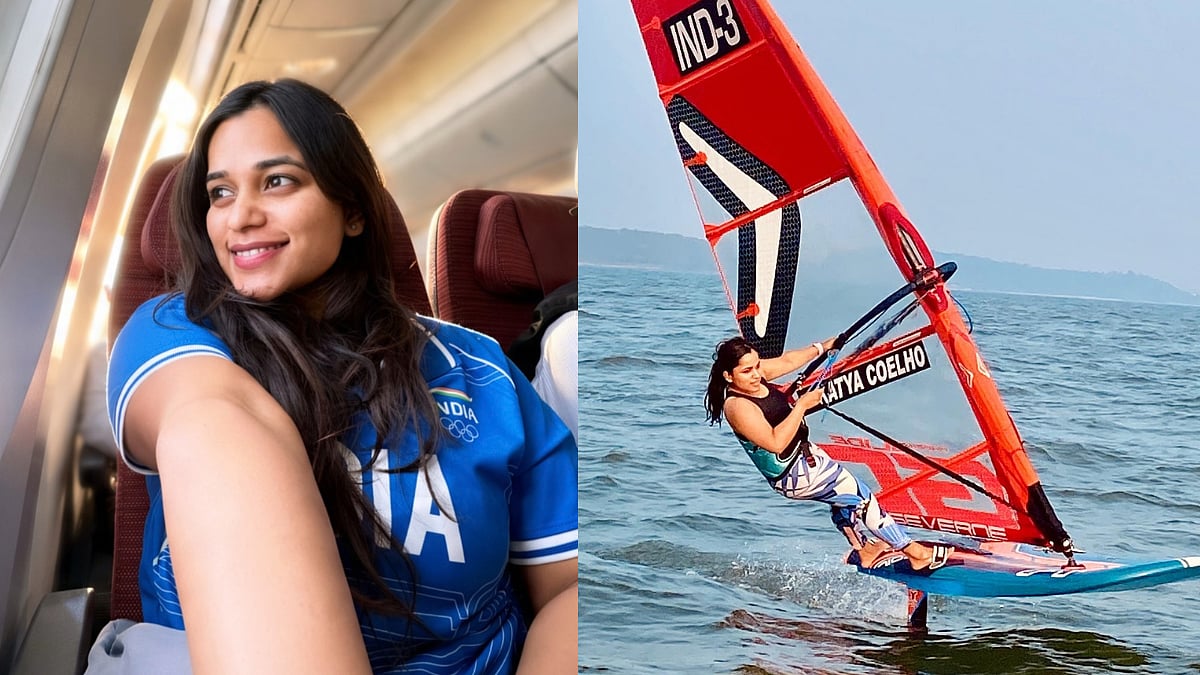
Indian windsurfer Katya Coelho is set to represent India at the Asian Games 2026, returning to the continental stage four years after a heartbreaking setback kept her out of the 2022 edition. Speaking to The Free Press Journal, Coelho opened up about her journey from growing up by the sea in Goa to becoming an international windsurfer, the challenges she has faced and the significance of getting another opportunity to compete at the Asian Games.
Growing up in Goa, the ocean was a natural part of Coelho’s childhood. She was introduced to sailing at a young age and gradually found herself drawn towards windsurfing. Her father, Donald, has been her coach and mentor since the beginning and played a crucial role in shaping her career. What started as something she enjoyed as a child eventually became a serious pursuit, taking her to the Youth Olympics level and international competitions.
Excerpts...
1. Could you tell us about your childhood in Goa and how windsurfing first became a part of your life?
I grew up in Goa surrounded by the sea, so the ocean was always a very natural part of my childhood. I was introduced to sailing when I was young, and over time I found myself becoming more and more drawn to windsurfing. My father, Donald, has been my coach and mentor since I started, and he played a huge role in my journey.
What started as something I enjoyed as a child gradually became something I wanted to pursue seriously. I competed at the Youth Olympics level, represented India at international events, and slowly realised that this could become my life as an athlete.
2. What was it about being on the water that attracted you to windsurfing in the first place?
I think it was the feeling of freedom. When you’re on the water, it’s just you, the wind and the board. There is something very peaceful about it, but at the same time, it’s incredibly challenging.
The conditions are never exactly the same, so you are constantly learning and adapting. I love that combination of freedom, speed and unpredictability. You can never completely control the ocean; you have to learn to work with it.
3. How did your family react when you decided to pursue windsurfing professionally?
My family has been a huge part of my journey. My father has coached me since I started, and my family has supported me through every stage of my career.
There have definitely been difficult moments because pursuing an Olympic sport from India isn’t easy. There are sacrifices involved, financially and personally, and there have been many setbacks. But my family has always encouraged me to keep going and to believe that what I was doing was worth it. A lot of what I’ve achieved is not just my achievement; it’s something my family has built with me.
4. Windsurfing is a physically demanding sport. What does your training routine look like on and off the water?
My training is a combination of time on the water, strength and conditioning, mobility and recovery. On the water, a lot of the work is about technique, starts, manoeuvres, speed and learning to read the conditions.
Off the water, I work on strength, core stability, balance, endurance and explosiveness. Because iQFOiL is a very physical discipline, you need to be strong enough to handle the equipment while also being able to maintain technique throughout a race. And because it’s a sport where small technical decisions can make a big difference, training isn’t only about becoming stronger; it’s also about becoming more efficient.
5. How important are strength and conditioning, nutrition and recovery in your preparation?
They are extremely important. At this level, you can’t separate performance from recovery and nutrition. Strength and conditioning allow me to handle the physical demands of the equipment and racing. Nutrition gives me the energy to train and compete, while recovery allows my body to actually adapt to the training. I’ve also learned that recovery isn’t something you do only when you’re tired or injured. It has to be part of your training plan from the beginning.
6. How do you prepare yourself to deal with changing wind, waves and weather conditions during a competition?
You have to be prepared to adapt constantly. In windsurfing, you can arrive with a plan, but the conditions can change and you have to be able to change with them.
I spend a lot of time studying the wind, the water and the forecast, but ultimately you also develop a feel for the conditions through experience. You learn how the wind behaves, where the pressure is on the course and how the water is moving. The biggest thing is not getting too attached to one plan. You have to stay calm, observe and make decisions quickly.
7. What is the most challenging aspect of windsurfing that people watching from outside may not understand?
I think people don’t always realise how physically and mentally demanding it is. From the outside, it can look like you’re simply riding a board with a sail, but you’re constantly making decisions while moving at high speeds.
You’re dealing with wind, waves, equipment, other competitors and your own physical fatigue; all at the same time. And sometimes you can do everything right and still lose because the wind shifts in another direction. That’s one of the hardest things to accept in the sport: you have to control what you can and let go of what you can’t.
8. You had qualified for the 2022 Asian Games but were ultimately unable to compete, which was understandably a difficult setback. Now that you have qualified again for the 2026 Asian Games, how much more meaningful is this opportunity for you?
It’s incredibly meaningful. Missing the 2022 Asian Games was one of the most difficult moments in my career because I had worked towards that opportunity and qualified, but circumstances meant I couldn’t compete. So qualifying again four years later carries a completely different emotion. I’ve grown a lot as an athlete and as a person since then.
Coming back to the Asian Games after everything that has happened makes me appreciate the opportunity much more. It’s not just about the competition itself; it’s about everything it took to get back here.
9. What does representing India at the Asian Games mean to you?
Representing India is something I never take for granted. Every time I put on the India jersey, I feel a huge sense of responsibility and pride.
I am the only Indian who’s qualified and represented the country, no one has done this before me so I didn’t have a path to follow, I had to make my own
I’m from Goa, a small state, and windsurfing is still a relatively niche sport in India. So being able to represent my country at a major multi-sport event means a lot to me. I also hope that when young girls see an Indian woman competing internationally in windsurfing, they realise that this is something they can dream about too.
10. How are you approaching the competition mentally and physically this time around?
I’m trying to approach it with a lot more maturity. Earlier in my career, I was very focused on the result and on proving myself. Now I’m much more focused on the process; doing my preparation properly, staying present and taking each race as it comes.
Physically, I want to be strong, healthy and fresh going into the competition. Mentally, I’m reminding myself that I’ve already overcome a lot just to get here. Of course, I want to perform well and give everything I have on the racecourse.
11. What are the biggest lessons you have learned from the setbacks and challenges you have faced in your career?
Probably that setbacks don’t necessarily mean the end of the journey. I’ve had injuries, missed opportunities, disappointments and moments where things outside my control have affected my career. There have been times when I’ve genuinely questioned whether I should continue. But every time, I’ve found a way to keep moving forward.
I’ve also learned that resilience isn’t about never struggling. It’s about allowing yourself to struggle, learning from it and still choosing to continue.
12. What would a successful Asian Games campaign look like for you?
A successful campaign for me would be knowing that I gave everything I had and competed to the best of my ability. Of course, every athlete wants a medal, and I’m going there with ambition. But success isn’t only measured by the colour of a medal. For me, it would also mean executing what I’ve trained for, making good decisions on the course, staying mentally strong and finishing the competition knowing I left nothing behind. If I can walk away knowing I gave my absolute best, that would mean a lot to me.
13. What would you like to tell young athletes, especially girls, who want to take up sailing or windsurfing?
Don’t be afraid to start just because you don’t see many people like you doing it. When I started, I didn’t have a roadmap for where windsurfing could take me. I simply loved being on the water and kept going. Over time, that passion took me to places I never imagined.
There will be people who doubt you, and there will be moments when you doubt yourself. But you don’t need to have everything figured out at the beginning. Start, stay curious, work hard and give yourself permission to dream big.
And especially for girls; I would say don’t let the fact that something is physically demanding or traditionally male-dominated make you feel like you don’t belong there. You absolutely do.

