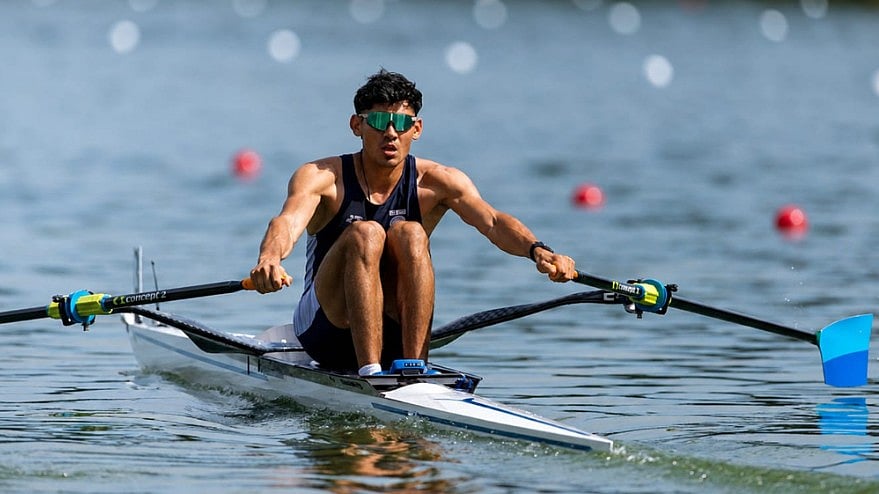
Indian rower Ajay Tyagi’s journey to the Asian Games is a story of an unlikely transition from farming fields in Sara village, Ghaziabad, to competing for India on the international stage. Coming from a farming family and having no sporting background, Tyagi never imagined that rowing would become a defining part of his life.
In an exclusive conversation with The Free Press Journal, the Army athlete opened up about his journey, the sacrifices of his family, his transformation as a rower and his ambition of winning gold at the Asian Games.
Excerpts...
1. Could you tell us about your childhood in Sara village, Ghaziabad, and the environment in which you grew up?
My childhood was not particularly exciting. I was born into a farming family, far removed from sports. I myself pursued farming before joining the Army.
2. What were your early interests, and did you always see yourself pursuing a career in sport?
Sports was never on my list. I simply had a keen interest in running and wanted to join the Army. I wanted to make my parents proud.
3. You come from a farming family. How important have your parents, Rakesh Tyagi and Kusum, been in supporting your journey?
Yes, I do come from a farming family, but I would say that I have been supported immensely by my parents throughout my journey. In the beginning, I never told them about rowing because I thought it was just a part of my duty. Later, when rowing became my passion, I told my family about it. They fully supported me and relieved me of all the family responsibilities, especially my father and brother.
4. How did you join the Indian Army in 2018, and what role has the Army played in shaping your career?
I joined the Army through relay recruitment, which included physical, medical and written tests. I didn’t know anything about rowing. I wanted to do a Para Special Forces course, but I ended up being selected for rowing in the battalion because of my height. I was not serious about the sport initially. I always wanted to run and, in fact, I ran away twice. I was punished by not being granted leave to go home. I started rowing again just to get my home leave, but after my first Inter-Centre competition in ARN, everything changed. My mindset towards the sport became completely different.
5. You have reportedly admitted that you were once afraid of water. How did you overcome that fear and develop a passion for rowing?
Yes, I was afraid of the water because, in my entire life, I had never seen so much water at a glance. ARN is huge. I overcame my fear through extensive swimming practice and balancing exercises in the boat. Rowing became my passion because of the patriotism I have for my country. I simply wanted to make my country proud.
6. What were the biggest challenges you faced while learning the sport and adapting to its physical demands?
The biggest challenge for me while learning the sport was balancing the boat. Physically, I wanted to focus on building my strength.
7. How would you describe your journey from your first rowing sessions to winning national and international medals?
Of course. During my first few sessions, I never thought I would go on to win medals at such a level. Everything felt difficult and challenging. But after winning medals at the national and international levels, I proved myself wrong. Nothing is impossible, and difficulties are meant to make us stronger.
8. You won gold in the lightweight double sculls at the 2022 Senior National Rowing Championships. How significant was that victory for your confidence?
Yes, winning gold in the lightweight double sculls at the 2022 Senior National Rowing Championships was a dream come true for me. That victory was definitely a huge boost to my confidence and motivated me to represent India and bring home more medals.
9. You won gold in the lightweight double sculls and silver in the lightweight quadruple sculls at the 2025 Asian Rowing Championships. How do you look back on those performances?
When I won gold in the lightweight double sculls and silver in the lightweight quadruple sculls at the 2025 Asian Rowing Championships, I experienced a completely different mindset and felt a new sense of confidence in my abilities. That was truly the period when I was performing at my best. I also got several opportunities that year to represent India. I started feeling like I could race against anyone, and I was determined to achieve nothing less than gold.
10. Could you take us through your typical training day, including rowing sessions, strength training and gym work?
My typical training day starts with going to the temple, for sure. Then we have the fall-in of the team, where the coaches instruct us about the workout. For a normal steady session focused on endurance and technique, I prepare myself mentally with positive thoughts, focusing on connecting well with the water and moving my boat further with every stroke. This is followed by rest and breakfast. The afternoon sessions are usually on the ergometer for endurance or focused on mobility. In the evening, our gym sessions are completely focused on strength. I am always hyped up for weights. The power I feel after a gym session is something I look forward to using in the next morning’s water session.
11. What does your diet look like during a major competition preparation phase?
My diet is completely based on what my nutritionist guides me to follow. It mainly consists of carbohydrates and protein, while I avoid sweets and fast food. Diet is a very important part of an athlete’s journey.
12. Rowing is physically demanding and mentally challenging. How do you maintain motivation during difficult training sessions?
For my training sessions, my mindset is always to improve by 5% from the previous session and give 100% in every session. I always want to feel satisfied with the training I put in. Whenever someone tells me that I can’t do something, that is when I tell myself that I will definitely do it. My mother is my biggest strength. She struggled a lot during my childhood, but she always stood strong and brave for our family. Talking to her always makes my mind more positive and gives me greater strength. She reminds me to keep pushing forward, no matter how difficult the situation is.
13. How do you prepare mentally before an important race, especially when competing against strong Asian teams?
Self-talk and self-assurance are the keys for me. I always believe in my training and the hard work I put in. Whenever I face a difficult moment, I remind myself of my parents and coaches, their support, sacrifices and struggles. Thinking about everything they have done for me gives me the confidence and motivation to keep going.
14. What do you think will be the biggest challenge for India at the Asian Games?
The biggest challenge would be to maintain our position and continue proving ourselves. Of course, our ultimate goal is to go after the gold. We want to give our best, stay focused throughout the competition and prove that we belong at the top.
15. How are you dealing with the expectations and pressure of representing India at a major continental event?
The expectations of my coaches and parents are also the expectations I have for myself, so I don’t really consider them pressure. Handling pressure is not easy, but I love sharing it with my brother. He always reassures me, motivates me and encourages me to give my best.
16. What would an Asian Games medal mean to you, your family and your fellow soldiers in the Indian Army?
Asian games medal would mean the dedication and hard work I gave was always counting. It will surely be a dream come true. For family I would really make them proud and fullfill all their wishes with the hard earned medal. My fellow mates will know that it’s not impossible to achieve dreams if we really work hard for them.
17. How important is the Army’s support in helping athletes like you balance military responsibilities and sporting ambitions?
The Army has supported us completely, whether it is our diet, coaches, training sessions or equipment. They have always motivated us to dream big and remain focused on our sport. Their support has allowed us to concentrate entirely on training and performance without having to worry about the other aspects of our preparation.
18. What are your long-term goals in rowing? Do you have your sights set on the Olympics?
My long-term goal is to improve every day and face every challenge wholeheartedly. I want to keep winning medals for India at every international event and continue raising my level as an athlete. Representing my country and winning medals on the biggest stages is a dream, and the Olympics is my ultimate goal.
19. Finally, what message would you like to share with young athletes from rural backgrounds who dream of representing India?
To the youth, I would say that your background never matters. What matters is your mentality and how strong you make yourself. Negativity is everywhere, but staying positive is the real challenge. Your aim should be so powerful that every other difficulty seems small in comparison. Believe in yourself, stay focused and keep working towards your goals.

