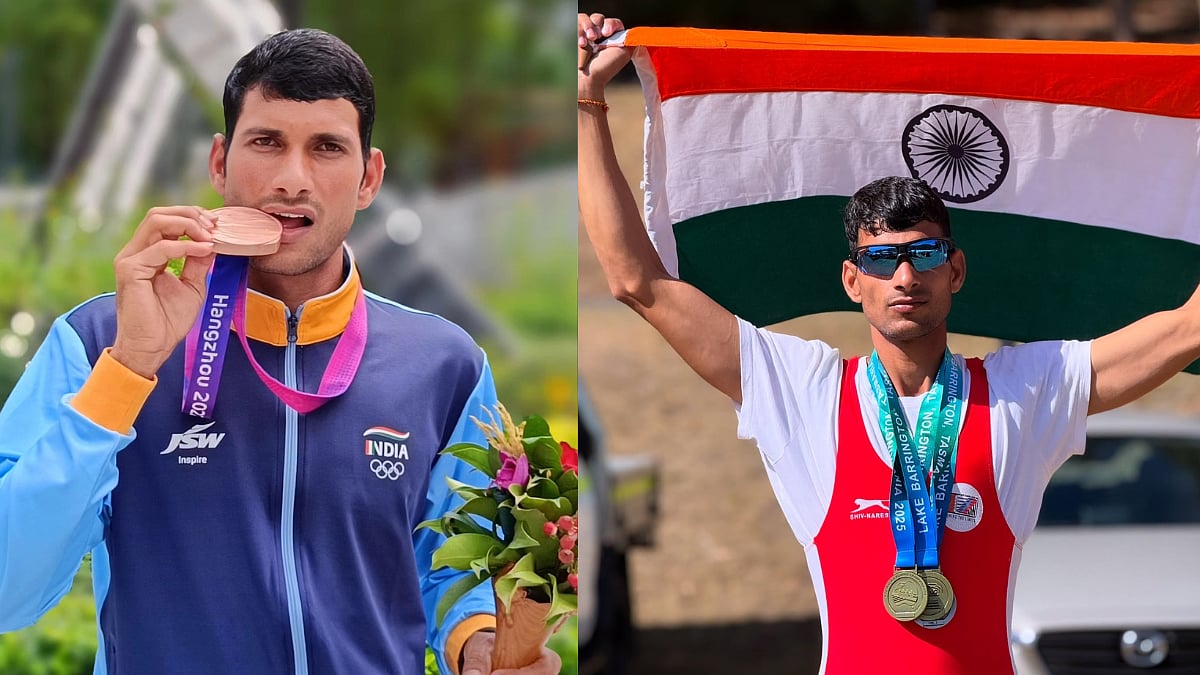
Indian rower Babu Lal Yadav’s journey from a simple and disciplined childhood in Rajasthan to representing the country on the international stage is a story of perseverance, sacrifice and self-belief. A serving member of the Indian Army, Yadav has built his sporting career on discipline, hard work and an unwavering commitment to improvement.
Speaking exclusively to The Free Press Journal, he reflected on his upbringing, his introduction to rowing, the role of his family and Army training, and his preparations for the Asian Games in Japan.
Excerpts...
1. Could you tell us a little about your childhood and upbringing in Rajasthan? What was Babu Lal Yadav like before rowing became such an important part of his life?
I spent my childhood in Rajasthan in a very simple and disciplined environment. From an early age, my family taught me the importance of hard work, discipline, and being honest with myself and my goals. At that time, I never imagined that rowing would become such an important part of my life. Initially, sport was just a physical activity for me, but gradually, it became my identity and my passion.
2. How did you first get introduced to rowing? Was it something you discovered yourself, or did someone encourage you to take up the sport?
My introduction to rowing happened unexpectedly. When I first saw the sport and got an opportunity to try it, I really liked its challenges and team spirit. It was completely new to me in the beginning, but I put in all my effort to learn it. The encouragement I received from my coaches and teammates inspired me to progress in the sport.
3. What attracted you to rowing, and when did you realise that you wanted to pursue it professionally?
The most special thing about rowing is that it requires strength, endurance, technique, mental toughness, and teamwork. I have always enjoyed challenging things. When I realised that I could continue improving in this sport and perform well at the national level, I began taking it seriously as a career.
4. How supportive has your family been throughout your sporting journey, especially as you began dedicating more time to training and competitions?
My family has made a huge contribution throughout my sporting career. Because of training and competitions, I often had to stay away from home for long periods, but my family always encouraged me. They never made me feel that I was alone. Behind every achievement of mine is also the sacrifice and support of my family.
5. You are also a serving member of the Indian Army. How did joining the Army influence your sporting career and discipline?
The Indian Army gave a new direction to my life and sporting career. The Army taught me discipline, the importance of using time properly, staying calm in difficult situations, and never giving up. Army training has played a major role in developing the mental toughness and confidence required as an athlete. Serving in the Army is a matter of pride for me, and representing India makes that pride even greater.
6. What have been the biggest challenges you have faced in your journey so far, and how did you overcome them?
Along with physical fatigue, mental pressure has also been a major challenge in my journey. I have had to face long training sessions, the risk of injuries, staying away from my family, and the pressure of competitions. I have treated every challenge as a learning experience. I believe that difficult times are what make an athlete's character stronger.
7. What does a typical training day look like for you? How do you divide your time between rowing practice, strength training and recovery
My training is quite disciplined. My day begins with fitness and rowing. After that, depending on the requirement, I focus on strength training, technical practice, and recovery. I give equal importance to rest, sleep, and recovery between training sessions because, for high-level performance, both the body and mind need to be fit.
8. Rowing demands tremendous endurance and strength. What does your gym and fitness routine look like during an intense training phase?
Rowing requires full-body strength and endurance. Therefore, my fitness routine includes strength training, core exercises, building strength in the legs and back, and working on aerobic and anaerobic fitness. As competitions approach, the intensity and volume of training are structured according to the goal.
9. What does your diet look like during training and competition? Are there any particular foods or nutritional habits that you make sure to follow?
For me, nutrition is a part of training itself. I focus on a balanced diet that includes sufficient protein, carbohydrates, fruits, vegetables, and adequate water. During intense training, it is very important to provide the body with enough energy. I do not eat only for taste, but also while keeping my body's requirements and recovery in mind.
10. You won a bronze medal in the men’s coxless pair at the 2022 Asian Games. Looking back, what does that achievement mean to you?
The bronze medal at the 2022 Asian Games is a very special achievement for me. That medal was the result of years of hard work and the support of my teammates, coaches, family, and the Indian Army. Standing on the podium and representing India was one of the proudest moments of my life.
11. How much did your previous Asian Games experience teach you about competing under pressure at a major multi-sport event?
The Asian Games taught me that physical preparation alone is not enough on a big stage. Mental toughness, handling pressure, strategy, and performing at your best at the right moment are equally important. That experience made me a better and more mature athlete.
12. What were the biggest lessons you took from the 2022 Asian Games that you can apply to your next Asian Games campaign
The biggest lesson was that it is important to maintain self-belief in any major competition. At the international level, even a small mistake can change the result. Therefore, this time I am paying even more attention to technique, fitness, mental preparation, and every stage of the race.
13. How different is the preparation for an Asian Games compared to a regular international rowing competition?
Preparing for the Asian Games is different from preparing for a regular international competition because the level of competition is extremely high and the hopes of an entire nation are attached to it. Along with fitness, special attention has to be given to race strategy, team coordination, mental toughness, and adapting to competition conditions.
14. What does representing India at the Asian Games mean to you personally, especially after already experiencing the podium in Hangzhou?
Representing India is a greater honour for me than any personal achievement. When I step onto the field wearing the Indian jersey, I carry the hopes of millions of Indians with me. The pride I felt when I saw the Indian flag on the podium in 2022 continues to inspire me to perform even better.
15. How are you preparing yourself mentally and physically for the competition in Japan?
I am focusing on every aspect of my preparation: fitness, technique, strength, endurance, recovery, and mental preparation. My focus is on daily training. I want to ensure that my body is fully prepared and my mind remains completely calm and focused on the day of the competition.
16. What are the biggest challenges you expect from the conditions, competition and overall atmosphere at the Asian Games?
Competition at the Asian level is always very difficult. The weather, water conditions, travel, a different environment, and strong international opponents can all be challenging. But as an experienced athlete, my focus will be on accepting the conditions and improving my performance rather than complaining about them.
17. Have you set yourself any specific goals for the Games? Are you targeting another medal, or are you focusing on improving your performance and giving your best?
My goal is clear: to give my best performance and make every effort to win a medal for India. Of course, I dream of winning another medal, but I do not want to put additional pressure on myself by thinking only about the result. My entire focus is on my technique, fitness, teamwork, and giving my best with every stroke during the race.
18. Rowing is a sport where coordination and teamwork are crucial, especially in pair and team events. How important is communication and trust between teammates during a race?
Teamwork is one of the most important aspects of rowing. The speed, timing, and strokes of every athlete in the boat are connected to one another. If there is no trust and coordination among team members, you cannot perform at your best. Therefore, understanding one another during training and having complete trust in each other during the race are extremely important.
19. What is one lesson you have learned from a difficult race or defeat that continues to help you as an athlete?
Every difficult race teaches me something. I have learned that a defeat should not be seen as the final result, but as an opportunity to improve. Sometimes, despite giving your best effort, you may not get the expected result. But if you identify your mistakes and prepare better the next time, that same defeat can become your strength.
20. Rowing is not always as widely followed in India as some other sports. What would you like more people to know about the demands and beauty of the sport?
I want people to understand that rowing is not just about moving a boat. It requires tremendous physical ability, endurance, technique, mental toughness, and teamwork. Many people may not understand its difficulty from the outside, but a rower knows how much hard work goes into every single stroke. I want rowing to receive greater recognition and support in India.
21. What are your long-term goals in rowing? Do you have any specific dreams beyond the Asian Games
My dream is to continue performing well for India at the international level and win medals for the country on the biggest stages. Apart from the Asian Games, representing India at a stage like the Olympics and giving my best performance there is also one of my major goals. At the same time, I want my performances to inspire young athletes to take up rowing.
22. Finally, what would winning another Asian Games medal mean to you personally, and what message would you like to give to the Indian fans supporting you in Japan?
Another Asian Games medal would not just be a medal for me. It would be a tribute to the faith and support of my family, coaches, teammates, the Indian Army, and the entire nation. I would like to tell all Indian fans that your love and support are a great source of strength for us. I will compete in Japan with complete honesty, hard work, and pride in representing my country, and I will make every effort to give my best. My aim will be to make the Tricolour fly high once again.
With the lessons of Hangzhou, the discipline of the Indian Army and the unwavering support of his family behind him, Babu Lal Yadav heads into the Asian Games with renewed determination. The target is another medal, but beyond the podium lies a bigger dream: to make the Tricolour fly high and inspire the next generation of Indian rowers.

