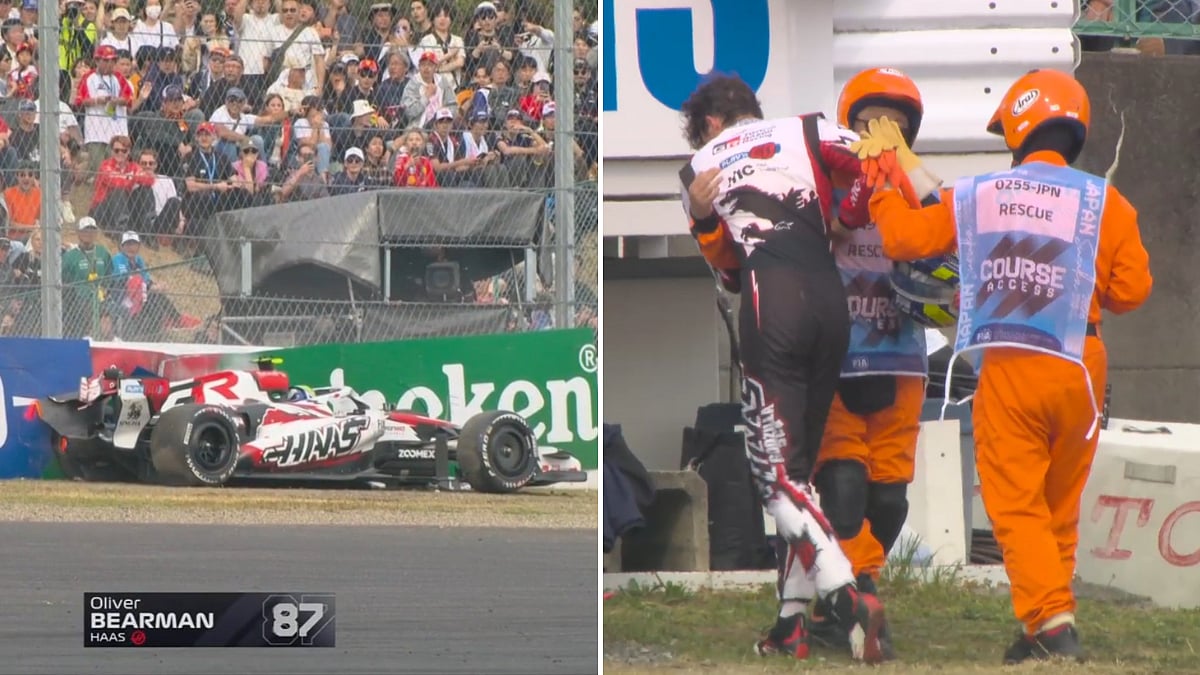
The FIA has issued a statement stating that it would review its rules following Haas F1 driver Oliver Bearman's horrific crash at the Japan GP in Suzuka. While Bearman escaped miraculously, he suffered a crash at the force of 50g, which more often than not can prove to be fatal. FIA confirmed a set of meetings in April before a final decision was made.
"A number of meetings are therefore scheduled in April to assess the operation of the new regulations and to determine whether any refinements are required,” FIA said in a statement.
During a high-speed section of the Suzuka Circuit, Bearman lost control of his car while navigating a fast corner. The rear of the car suddenly lost grip and slid outward—a situation drivers often describe as the car “stepping out.”
At such high speeds, once the rear tires lose grip, it becomes extremely difficult to regain control. The car spun off the track and eventually hit the barriers, ending his run. He was later handed 10-place grid penalty.
Fortunately, Bearman was not injured. He did limp out of the car and held his knees, but was miracusosly unhurt.
The crash involving Oliver Bearman at the Japanese Grand Prix has added to growing concerns about the current Formula 1 regulations. The modern ground-effect cars are extremely fast but also more sensitive to sudden losses of grip, especially when airflow is disrupted or tires fall out of their narrow operating window. This makes spins more abrupt and harder to recover, particularly at high-speed circuits like Suzuka. While the rules were introduced to improve racing, incidents like this highlight how small mistakes can quickly turn into high-impact crashes. As a result, the FIA is reviewing the regulations to ensure that the balance between performance and safety is maintained, and to reduce the risk of unpredictable loss of control at high speeds.
