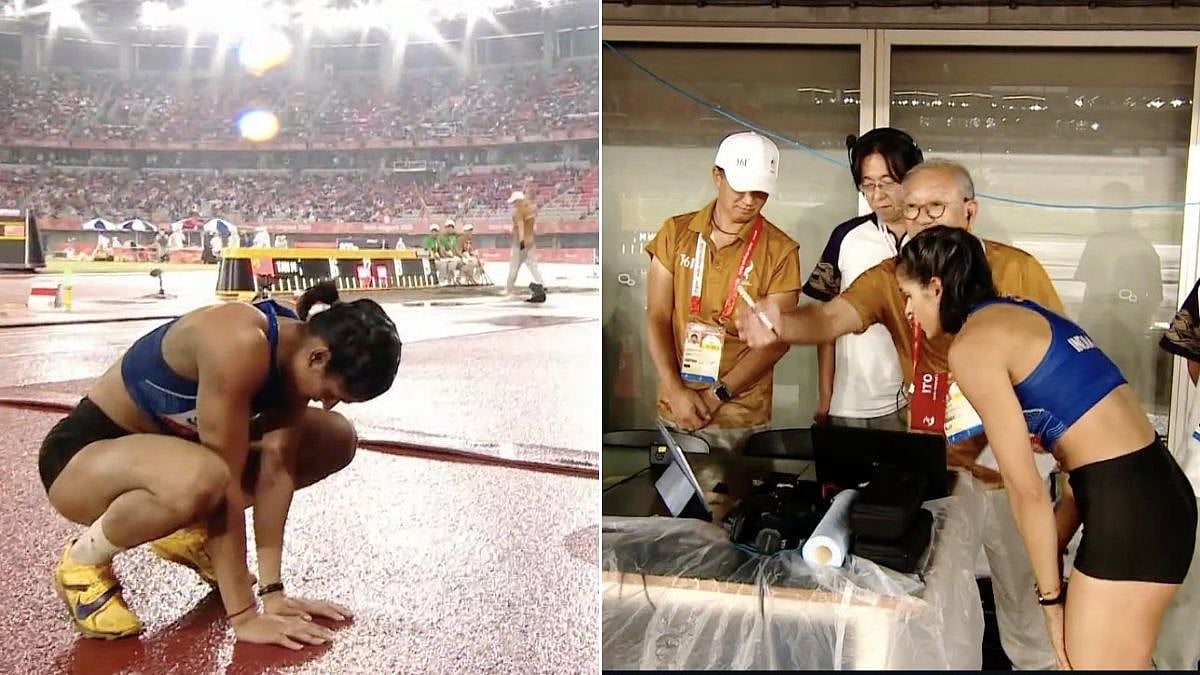
Shaili Singh’s medal hopes ended in dramatic fashion after a jump that appeared to clear 6.50m was officially measured at 6.42m. The Indian long jumper protested the decision after officials explained that her hair had left the closest mark in the sand, determining the distance under the rules. She remained in bronze-medal position until China’s Mengyi Tan produced a 6.46m jump with her final attempt, pushing Singh out of the medals.
Why was the jump measured at 6.42m?
What initialy seemed like a 6.50m jump, the measurement recorded was only 6.42m. Singh was visibly unhappy with the measurement and protested the decision. Officials explained that her hair had made a mark in the sand closer to the take-off board, and that mark therefore determined the official distance.
Singh then went over the video footage with the officials as they explained the decision. Despite the apparent distance of the landing, the measurement remained at 6.42m.
What do the rules say?
Long jump is measured from the take-off line to the closest break in the sand made by the athlete. Under World Athletics rules, that mark can be made by any part of the athlete’s body or by anything attached to the body.
That means hair can count if it reaches the sand and creates the nearest indentation. The measurement is therefore not necessarily taken from the athlete’s feet or the main point of the landing.
The 6.42m mark initially kept Singh in the bronze-medal position. However, the competition went down to the final attempts, with Tan still having one jump remaining. Tan then produced a 6.46m effort, four centimetres farther than Singh’s mark. That jump moved the Chinese athlete into third place and pushed Singh out of the medals.
Singh’s final result made the earlier measurement even more painful. Her 6.42m was only four centimetres short of Tan’s bronze-medal-winning 6.46m.

