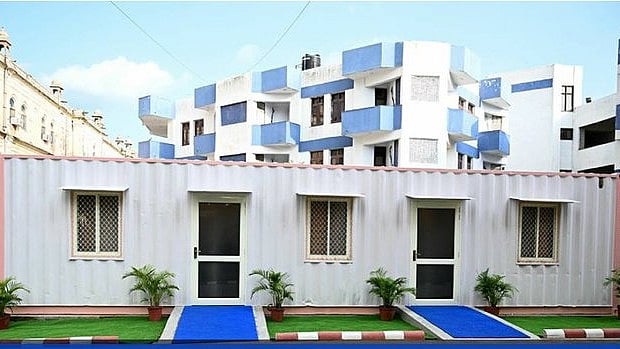
Patiala, Sep 4: The beds are a little over six feet long, the walls are close, and there is little room for anything beyond the essentials.
For some of India's athletes, however, spending a night inside a shipping container at the Netaji Subhas National Institute of Sports (NSNIS) here is less about discomfort and more about preparation for an unusual living arrangement awaiting them in Japan at the Asian Games.
With the Aichi-Nagoya Games beginning September 19 and no conventional athletes' village this time, Sports Authority of India (SAI) has set up makeshift container rooms at its centres in Patiala and Bengaluru to give its athletes a taste of what they can expect in Japan.
The idea is to make the unfamiliar familiar.
Preparing athletes for containers
Athletes are taking turns to spend a night inside the container, waking up the next morning and following their usual routine before heading to training.
By the time they reach Japan, the hope is that their accommodation will no longer be a distraction.
"Two years ago, when it was established that the accommodation at the Asian Games will be in a unique style -- containers, cruise etc. -- and not a village, at that time the Sports Minister's vision was that the players must be acclimatised in a similar way, like a simulator," Deputy Director General, SAI, Vineet Kumar told a select group of journalists at NSNIS, Patiala.
"And they don't feel claustrophobic or feel what sort of accommodation we have come in. So they don't feel shocked or get a setback and they go and play the Games without any pressure," Kumar, who is also the Senior Executive Director, NSNIS, Patiala, added.
For athletes, accustomed to sprawling rooms and dedicated spaces for their equipment, the compact surroundings can take some getting used to.
But two-time Asian Games champion shot putter Tajinderpal Singh Toor believes the advance preparation could make a difference.
"It looks small from outside but it's quite nice on the inside. All the facilities are here. This will be the first time that we stay in such a congested set-up but having stayed here it's good we are acclimatised," Toor told PTI.
"If we had directly gone to Japan, it would have stayed in our mind for one or two days," added the six feet four inches tall two-time Asian Games gold medallist.
Avoiding logistical distractions
That is precisely what SAI and the Ministry wanted to avoid.
"The psychology of the athlete is such that if a logistical issue like this is there, it affects him. So the Minister's vision was that such a thing doesn't happen and the players can focus on their game," Kumar said.
A Ministry-SAI team visited Japan on a recce trip before the two simulation rooms in Patiala -- one for men and one for women -- were prepared based on what Indian athletes are expected to encounter.
"We have made a roster and the athletes stay here turn by turn. They have to stay the night so that in the morning they know how to go about things," Kumar said.
The exercise began on August 28 and around eight athletes have so far spent time in the container.
Athletes adjust to new setup
For Commonwealth Games bronze medallist discus thrower Seema Kaliramna, the experience took some adjustment.
"I stayed here for two nights. It was a bit difficult to adjust because throwers take a little more space and this is quite small. The second day was good, I was able to sleep properly. The life of an athlete has a lot of adjustment, then only they win something," she said.
The simulation has removed an element of uncertainty, according to her.
"Staying here will help as we won't feel claustrophobia. I am thankful to SAI for doing this. Now the fear of not knowing how the accommodation will be in Japan is gone. I feel better as we won't be thinking how it will be there and how we will feel," she said.

Designing a functional space
SAI has nevertheless tried to make the limited space as functional as possible.
The roughly 13-metre-long and three-metre-wide unit has two twin-sharing bedroom quarters at either end, linked by a narrow central passage.
There are two split air-conditioners, a small laundry area with a washing machine and a compact kitchenette with a refrigerator and sink. The bathroom is divided into separate spaces for the wash basin, toilet and shower.
Four cabinets provide storage, while the space underneath the beds can accommodate heavy kit bags -- an important consideration for athletes travelling with bulky equipment.
"The athletes have given a positive feedback. They feel like 'yeh jungle mei mangal kaise ho gaya'," Kumar said.
Also Watch:
Containers find new purpose
There is also a sustainability element to the experiment.
The two containers were already available at the NSNIS, having been used during the COVID-19 pandemic to store equipment for weightlifting and athletics.
Their sporting purpose will end after the Asian Games simulation, but the containers themselves will remain in use. They are planned to be converted into guest houses, with two beds removed to create twin-sharing rooms.
(Except for the headline, this article has not been edited by FPJ's editorial team and is auto-generated from an agency feed.)

