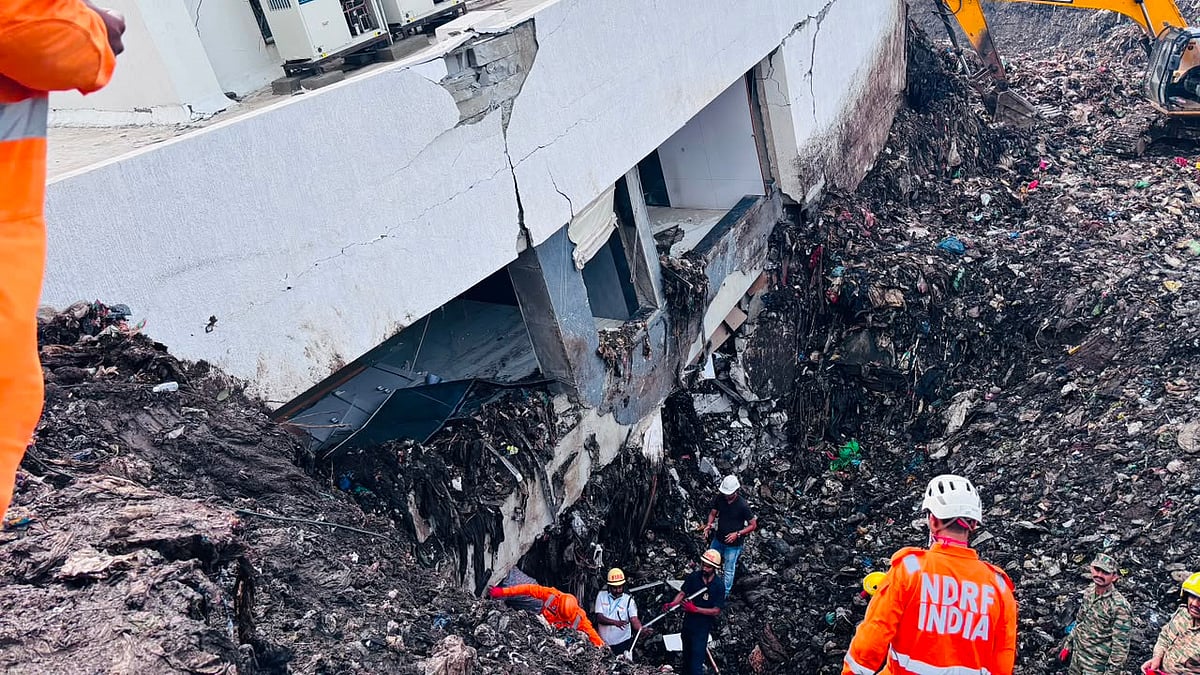
Pimpri-Chinchwad: More than 72 hours after the Moshi garbage depot disaster, the fate of eight missing people remains unknown as rescue teams continue to battle dangerous conditions at the site. Of the 23 people trapped when a massive heap of legacy waste crashed onto an under-construction building on Wednesday, 14 were rescued within the first 24 hours, while one dead body has been recovered so far.
With three days having passed since the accident, the chances of finding survivors have become extremely slim. Rescue officials have not ruled out the possibility of finding people alive, but they admit the operation has become increasingly difficult because of the unstable structure, huge piles of garbage and toxic gases trapped inside the debris.
Rescue Efforts Continue…
The Pimpri-Chinchwad Municipal Corporation (PCMC), the National Disaster Response Force (NDRF), the fire brigade and other agencies continued the search on Saturday. Another demolition excavator has been deployed to speed up the operation. Teams are carefully removing garbage and concrete while trying to prevent further collapse of the damaged building.
Maharashtra Chief Minister Devendra Fadnavis reviewed the rescue operation and directed the administration to provide all necessary assistance to the families affected by the tragedy. He also instructed officials to immediately speed up the bio-mining of legacy waste at the Moshi depot and establish an effective system to process the nearly 100 tonnes of untreated garbage generated every day. Senior officials, including local public representatives and police and civic officers, attended the review meeting.
PCMC’s Efforts…
PCMC Commissioner Dr Vijay Suryawanshi said the administration's immediate priority is to complete the rescue operation. He said modern techniques are being used to remove the garbage around the collapsed structure and that officials are in constant touch with the families of the missing persons. Responding to criticism over the pace of the operation, he said the NDRF is the country's most highly trained rescue force and that every step is being taken with the aim of saving lives.
He also said responsibility for the incident would be determined after a detailed investigation, adding that the disaster should not be viewed as a man-made incident until the probe is completed.
Slow Pace Of Rescue Operations?
The rescue operation has been slowed by several technical and natural challenges. Methane gas generated from the garbage, low oxygen levels and a strong foul smell have made it difficult for rescuers to work for long periods. The damaged building has tilted to one side and remains unstable, raising fears of another collapse. Narrow access, blocked staircases, darkness and concrete beams trapping the victims have further complicated the operation.
Relatives of the missing have expressed anger over the slow progress and demanded that rescue work continue round the clock with additional manpower and equipment. Civic officials also had to arrange smaller excavation machines after larger equipment proved unsuitable for the delicate rescue work.
According to preliminary information, the accident occurred after a massive heap of legacy waste collapsed. Water had accumulated on top of the garbage mound, creating pressure that caused the waste to slide downhill. The nearly 50-metre-long garbage heap crossed an 18-metre-wide road and another seven-metre stretch before crashing into the building, trapping workers inside.

