The political scenario of West Bengal was radically rewritten in May 2026. After 15 years of uninterrupted rule, Mamata Banerjee and her Trinamool Congress (TMC) suffered a crushing defeat in the state Assembly elections. The BJP scripted history by capturing 207 seats, leaving the TMC with a meagre 80 seats.
For a leader whose entire political identity is built on street-fighter credentials and an indomitable will, this electoral rout poses an existential crisis. To prevent her party from disintegrating and to keep herself politically relevant, Banerjee has shifted her battleground from the political rally to the judiciary. By personally appearing before the Calcutta High Court to argue a Public Interest Litigation (PIL) on post-poll violence, Banerjee is attempting to pivot from a defeated ruler to an embattled protector.
What is happening in West Bengal right now?
Following the declaration of the 2026 election results, widespread reports of arson, vandalism,and targeted attacks began emerging from Kolkata, Howrah and several district towns. The TMC alleges that its party workers and offices are being systematically targeted by the victorious BJP.
In response, accordding to a LiveLaw report, advocate Sirsanya Banerjee, a TMC candidate and son of senior party leader Kalyan Bandopadhyay, filed a PIL in the Calcutta High Court. The petition seeks urgent judicial intervention, protection for affected party workers and a proper investigation into the clashes. During the proceedings, senior advocate Kalyan Banerjee argued that the current scale of violence surpasses even the infamous post-poll clashes of 2021.
TMC scale of defeat
The May 2026 West Bengal Assembly election results marked the definitive, historic end of an era. The BJP executed a massive political takeover, securing a commanding supermajority of 207 seats in the 294-member assembly—a massive surge from the 77 seats it held in 2021. In stark contrast, the TMC was reduced to just 80 seats, a catastrophic drop from the 215 seats it won in the previous election. The political shift was reflected by a steep decline in the TMC's vote share, which plummeted from 48.2 per cent to 40.8per cent, while the BJP's share surged to 45.8per cent.
This turnover did more than just strip the TMC of state power after a decade and a half. it shattered the aura of political invincibility surrounding Mamata Banerjee. In a double shock for the party, Banerjee suffered a humiliating personal defeat in her own traditional stronghold of Bhabanipur, where she was convincingly beaten by her former lieutenant turned BJP leader, Suvendu Adhikari, by a margin of 15,105 votes. Because Banerjee had explicitly proclaimed during the campaign that she was the face contesting in all 294 seats, the verdict stands as a direct, personal rejection of her leadership.
Who is leading the fight and how is it being fought?
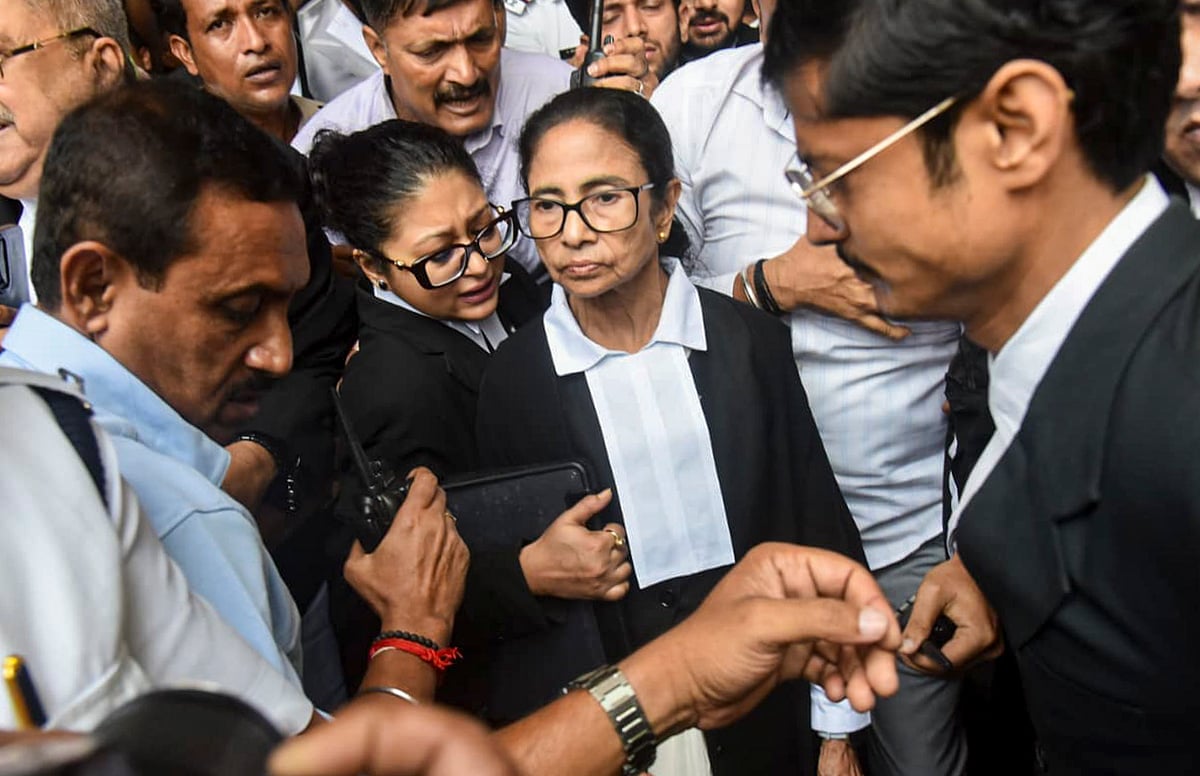
In a highly unusual move, Mamata Banerjee chose to personally represent her party's cause in front of a division bench comprising Chief Justice Sujoy Paul and Justice Parthasarathi Sen. Utilising her 1982 law degree from Jogesh Chandra College of Law, Banerjee stated that this was her very first time appearing as a lawyer in the high court.
By donning the lawyer's robes, Banerjee is strategically reshaping her public image. According to reports from LiveLaw, she urged the court to "please protect the people of Bengal," adding, "This is not a bulldozer state." By physically standing in the courtroom, Banerjee is attempting to demonstrate to her remaining base that she has not abandoned them in defeat.
Why does Mamata Banerjee need this case to stay politically relevant?
An overwhelming electoral defeat can easily lead to internal desertions, as regional parties often fracture when stripped of state power. For Banerjee, who no longer holds a legislative seat, championing the post-poll violence narrative is a vital survival strategy for three distinct reasons.
First, it allows her to shift the public narrative away from her administration's failures and the scale of her personal electoral loss. By focusing on alleged atrocities committed against her workers, she repositions the TMC as the victim rather than the vanquished.
Second, it acts as a cohesive force for her demoralised party workers. By claiming that "out of ten dead, six are Hindus" and alleging that local law enforcement is refusing to register FIRs, she is signalling to her grassroots cadre that she will use every tool at her disposal—including her legal background—to defend them.
Third, it provides a platform to aggressively critique the new BJP government from day one. Labelling West Bengal as a potential "bulldozer state" is a direct attempt to paint the new administration as authoritarian, thereby setting up an immediate counter-narrative for the future.
When and where is this battle taking place?
The legal drama unfolded on Thursday at the Calcutta High Court, just days after the BJP secured its historic mandate. The clashes and subsequent legal actions are concentrated across key volatile zones in the state, including Kolkata and neighbouring Howrah, where both parties continue to trade heavy allegations.
By framing her legal battle as a defence of Bengal's democratic fabric, Mamata Banerjee is attempting to prove that while she may have lost the state Assembly, she has no intention of losing her voice.

