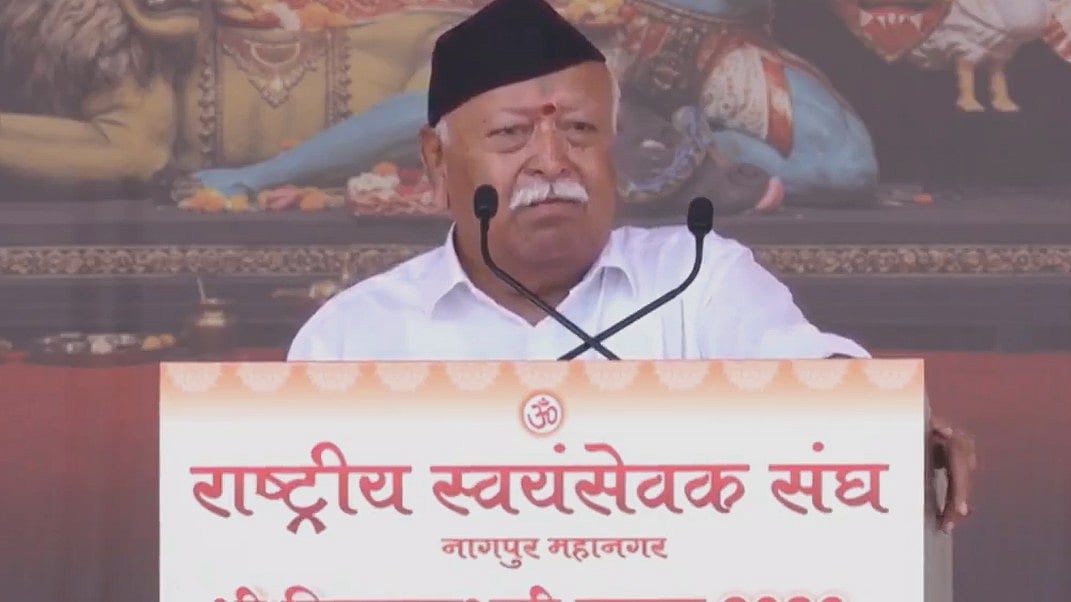
Rashtriya Swayamsevak Sangh (RSS) chief Mohan Bhagwat on Tuesday, said the organisation had played a crucial role in preserving Hindu dharma and credited its discipline and organisational strength for the Bharatiya Janata Party's (BJP) success.
Addressing the RSS's annual Vijayadashami Utsav at Reshimbagh ground in Nagpur, Bhagwat said sustained cultural and organisational efforts had helped Hindu dharma remain resilient over centuries, particularly in the aftermath of Islamic invasions.
The event marked the conclusion of the RSS's centenary-year programmes, commemorating 100 years since the organisation was founded by Dr Keshav Baliram Hedgewar on Vijayadashami in 1925.
Bhagwat Links RSS's Organisational Strength To BJP's Success
During his address, Bhagwat highlighted the RSS's discipline and organisational structure, saying these had contributed significantly to the BJP's success. He also underscored the Sangh's role in preserving Hindu religious and cultural traditions.
The RSS chief said the organisation's century-long work had focused on strengthening India's cultural identity and fostering a sense of collective belonging.
'India's Diversity Must Be Accepted And Protected'
Bhagwat emphasised India's diversity, saying the country's traditional character had been shaped by its ability to accept and protect differences in faith, language, caste, region, food habits and customs.
He said the country needed a shared foundational principle that could accommodate these differences while maintaining national unity.
Referring to the idea of sva, or self-awareness and identity, Bhagwat linked it to the Constitution's Preamble, which begins with the words, "We, the people of India."
He said this emotional bond had historically helped India remain united despite its diversity. Bhagwat also argued that forgetting this collective identity had weakened society and contributed to periods of division and colonial subjugation.
According to him, India needed to strengthen this sense of belonging while organising society around mutual cooperation and self-reliance.
Calls For Balance Between Development, Ecology And Ethics
Bhagwat also spoke about the need for a balanced development model, arguing that economic growth should be considered alongside environmental protection and ethical values.
He referred to the consequences of one-sided development in the Himalayan region, which he said had contributed to disasters affecting neighbouring states and areas extending from Nepal to Tibet.
He stressed that development should account for its wider impact on the environment and communities rather than focus solely on economic progress.
Bhagwat Flags Drug Addiction, Calls For OTT Regulation
The RSS chief raised concerns about drug addiction, describing it as a serious national problem with consequences for individuals, families and society.
He called for greater awareness among young people and said parents, the government, the administration and society all had a role in preventing substance abuse.
Bhagwat said the RSS would work on the issue and also called for regulation of over-the-top (OTT) content and a ban on drugs and narcotics.
He further emphasised the need for wisdom and responsible decision-making in the use of technology, arguing that technological progress must be accompanied by an understanding of its consequences.
Remembers Sant Ravidas, Swami Laxmanananda Saraswati And Jyotirao Phule
Bhagwat also recalled the contributions of several historical and religious figures while highlighting themes of faith, social harmony and cultural awareness.
Referring to the 650th birth anniversary of Sant Ravidas, he said the saint had spread messages of devotion, steadfastness in one's faith and social harmony during a period marked by foreign invasions and persecution.
He also referred to the birth centenary of Swami Laxmanananda Saraswati, who worked among tribal communities in Odisha, and the commencement of the 200th birth anniversary year of social reformer Mahatma Jyotirao Phule.
Bhagwat also highlighted the legacy of Swami Shraddhanand and Bengal's Shrimad Rajnarayan Basu, linking their contributions to the broader themes of social reform, faith and self-awareness.
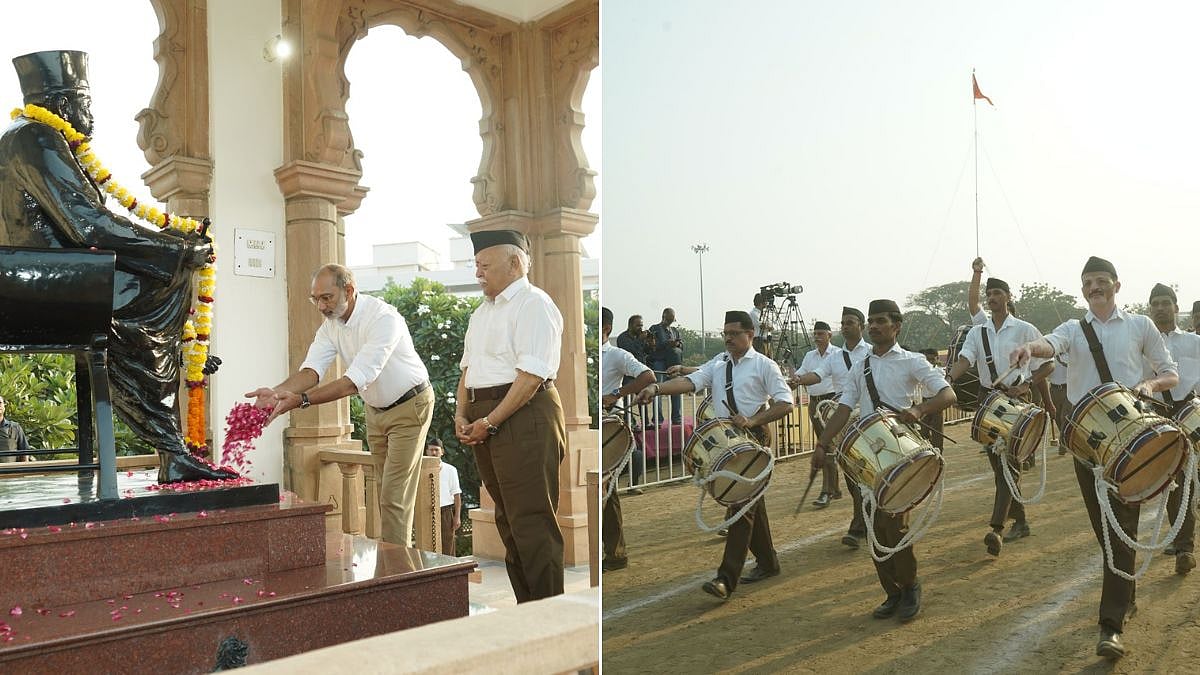
Shastra Puja Marks Annual Vijayadashami Utsav
Earlier, Bhagwat performed the traditional Shastra Puja, or weapons worship, and paid floral tributes to RSS founder Dr Keshav Baliram Hedgewar at Smriti Mandir in Nagpur.
The gathering was attended by Dainik Jagran Editor-in-Chief Sanjay Gupta, who was the chief guest, former Vice President Jagdeep Dhankhar, Maharashtra Chief Minister Devendra Fadnavis and Union Minister Nitin Gadkari, among others.
The annual Vijayadashami address, delivered as the RSS concluded its centenary-year celebrations, focused on cultural preservation, national unity, social organisation and self-reliance, alongside contemporary concerns such as addiction, environmental challenges and responsible technology use.

