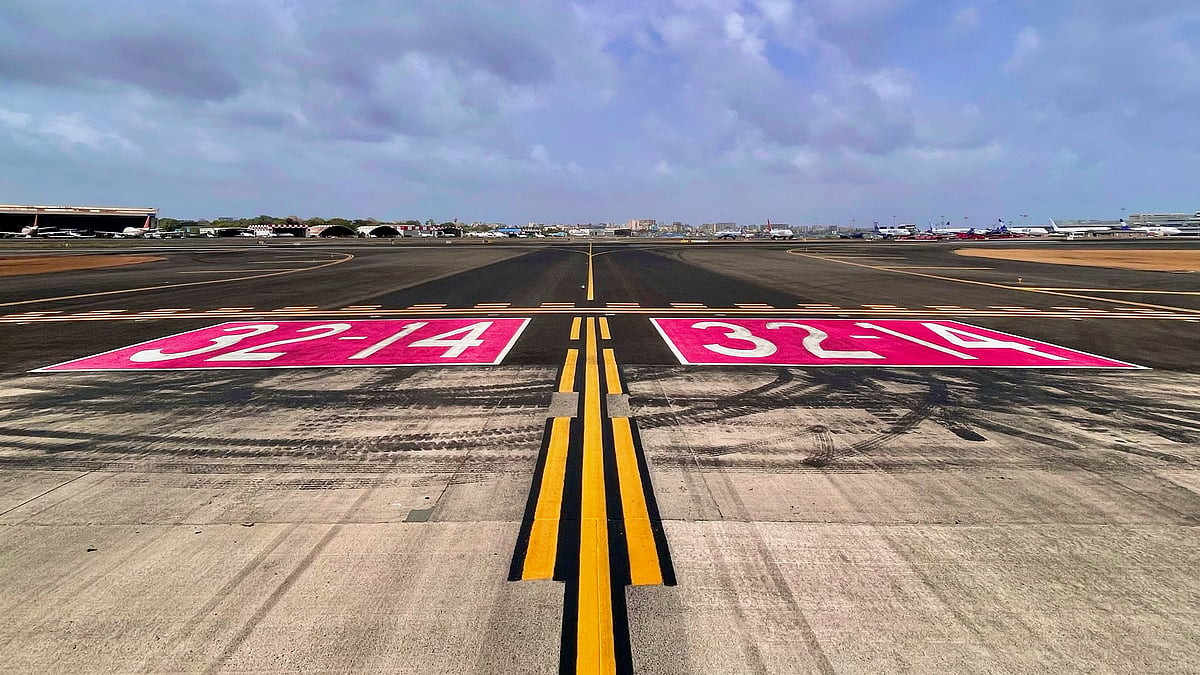
Nearmisses are tales of terrifying lapses and yet fortunate enough to not end in catastrophic consequences. Mumbai's Chhatrapati Shivaji Maharaj International Airport (CSMIA) had one such experience again narrowly averting a major aviation disaster when two aircraft from the same parent group ended up on Runway 27 at the same time.
At approximately 9:40 PM on Tuesday, Air India flight AI816, a Boeing 777-300ER bound for Delhi, commenced its take-off roll on Runway 27 while Air India Express flight AIX1547, a Boeing 737 MAX 8 from Siliguri, was still vacating the same strip. Air Traffic Control spotted the simultaneous occupancy and ordered the departing wide-body aircraft to abort its take-off, bringing the plane to a safe halt with no reported injuries or structural damage.
Infrastructure constraint
The incident has once again highlighted the intense operational pressures governing Mumbai’s aviation hub, which functions effectively as a single-runway airport due to its intersecting runway design. To maximise capacity and process up to 46 movements per hour, controllers routinely deploy reduced separation protocols. This system permits a departure to begin rolling while a landed aircraft is still clear of the centreline but not yet entirely off the runway, leaving an exceptionally narrow margin for operational variance.
Monsoon factor
Weather conditions during the July monsoon heavily compound these baseline structural risks. Wet tarmac reduces braking friction, while poor visibility forces pilots to taxi at lower speeds when looking for exit taxiways. When an arriving aircraft delays its exit by even 15 seconds, the pre-calculated safety buffer utilised by air traffic controllers is eliminated, frequently forcing high-speed aborts or late go-arounds.
Historical separation failures
This week's event closely mirrors a major near-miss on June 8, 2024, when an IndiGo flight touched down on Runway 27 just as an Air India jet lifted off, resulting in the immediate suspension of the duty controller. Similar heavy-rain runway excursions occurred in July 2025 with an Air India Airbus A320 and in July 2019 with a SpiceJet Boeing 737, both of which skidded off the active strip, highlighting how moisture drastically alters Mumbai's tight runway timing.
Global yardstick
When looked at through the safety rules used by the US Federal Aviation Administration (FAA), which sets the global benchmark for air safety, the Mumbai incident broke the standard rulebook for commercial passenger jets. For large jets like the Boeing 777 and Boeing 737 involved here, the rule is simple is a departing plane cannot legally start its take-off run until the landing plane ahead of it is completely off the runway.
The FAA does not allow any exceptions or "close-enough" distances when dealing with two massive passenger liners, making the simultaneous presence of both jets on Runway 27 a direct breach of standard safety boundaries.
Flaw in guessing the timing
International rules do let controllers use something called 'anticipated separation', essentially, giving a take-off clearance based on the expectation that the landing plane will exit the runway just in time. However, the rule states that if that expectation misses the mark by even a second, the controller must cancel the clearance before the departing plane starts moving. In Mumbai, this predictive timing perhaps failed as the landing Air India Express flight didn't exit as fast as expected.
Night and rain restrictions
Finally, global safety agencies put strict limits on playing with these tight timing margins when conditions are bad. The FAA explicitly states that one must abandon compressed timing sequences if the runway is wet or if it is night time.
Only a proper probe, which the Directorate General of Civial Aviation has already ordered, will find out if the fundamental safety baselines that international regulators enforce to prevent catastrophic runway incursions were violated.

