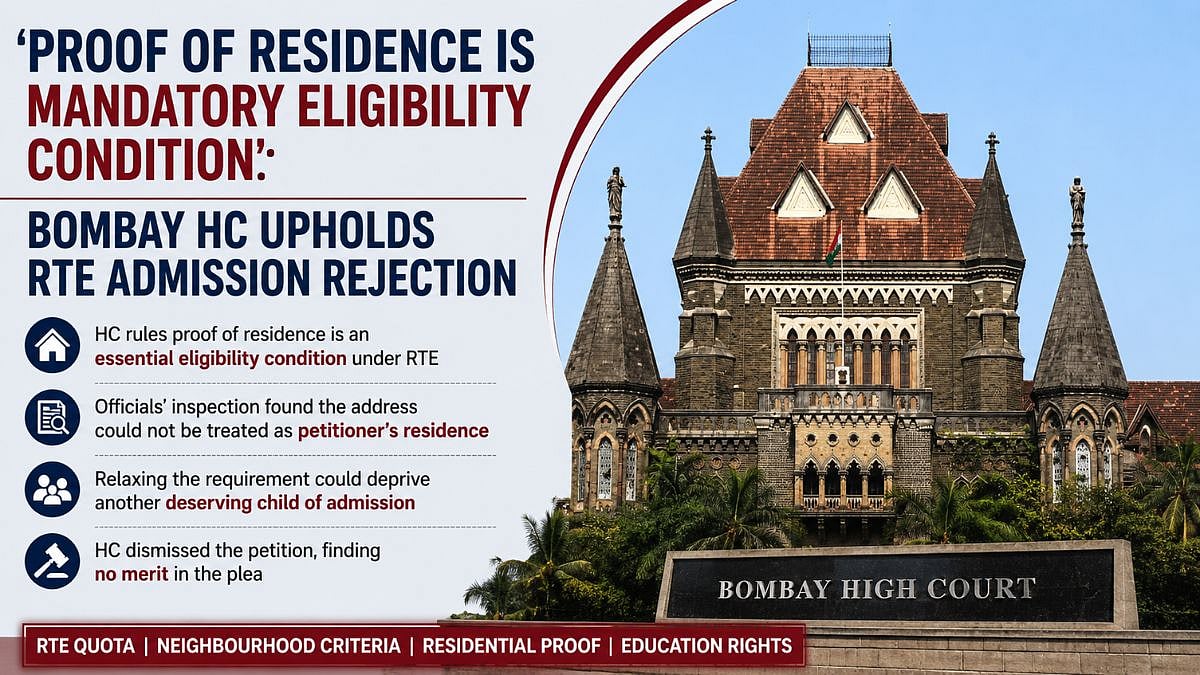
Mumbai, June 26: The Bombay High Court has upheld the rejection of a minor student's admission under the Right to Education (RTE) quota, observing that proof of residence is an essential eligibility condition and cannot be relaxed without satisfactory evidence.
The court said overlooking the requirement could result in another genuinely eligible child losing an opportunity for admission under the neighbourhood quota.
A bench of Acting Chief Justice Ravindra Ghuge and Justice Gautam Ankhad dismissed the petition filed by the minor through his father challenging the rejection of his application for admission for the academic year 2026–27.
Residence Claim Examined
According to the petition, the family had been residing since August 6, 2025, in a flat at Kharadi, Pune, taken on leave and licence from the child's grandmother.
The petitioner claimed that the residence was around 950 metres from the school, making him eligible for admission under the neighbourhood criteria prescribed under the Right of Children to Free and Compulsory Education Act, 2009.
The student's online application was rejected on May 2, 2026, after the authorities found the proof of residence to be invalid. The petitioner argued that the rejection was based on an auto-generated Google Maps error in the online application and requested the authorities to physically verify the address. However, both the Education Officer and the Deputy Director of Education rejected the claim, prompting the family to approach the High Court.
During the hearing, the High Court directed the education authorities to personally inspect the address "to resolve this controversy."
Inspection Supports Authorities
Pursuant to the court's directions, officials visited the premises on June 19 and 20. Based on the inspection, the State informed the court that the address could not be treated as the petitioner's residence.
The report stated that the first floor had only one bed, while the ground floor housed a small eating establishment run by the petitioner's mother.
The authorities also pointed out inconsistencies between the address mentioned in the admission form and that in the father's voter identity card.
After examining the inspection reports and interacting with the petitioner's father in court, the bench observed that "the premises could not be found to be the Petitioner's residence."
The court further said, "The burden of establishing residential eligibility squarely rests upon the Petitioner. Mere assertions regarding errors in the auto-generated Google address cannot substitute proof of actual residence."
Also Watch:

Court Upholds Rejection
Holding that the residential requirement is an essential eligibility condition under the RTE quota, the court said relaxing it without satisfactory proof could deprive another deserving child of admission. Finding no merit in the plea, the bench dismissed the petition without imposing costs.
To get details on exclusive and budget-friendly property deals in Mumbai & surrounding regions, do visit: https://budgetproperties.in/

