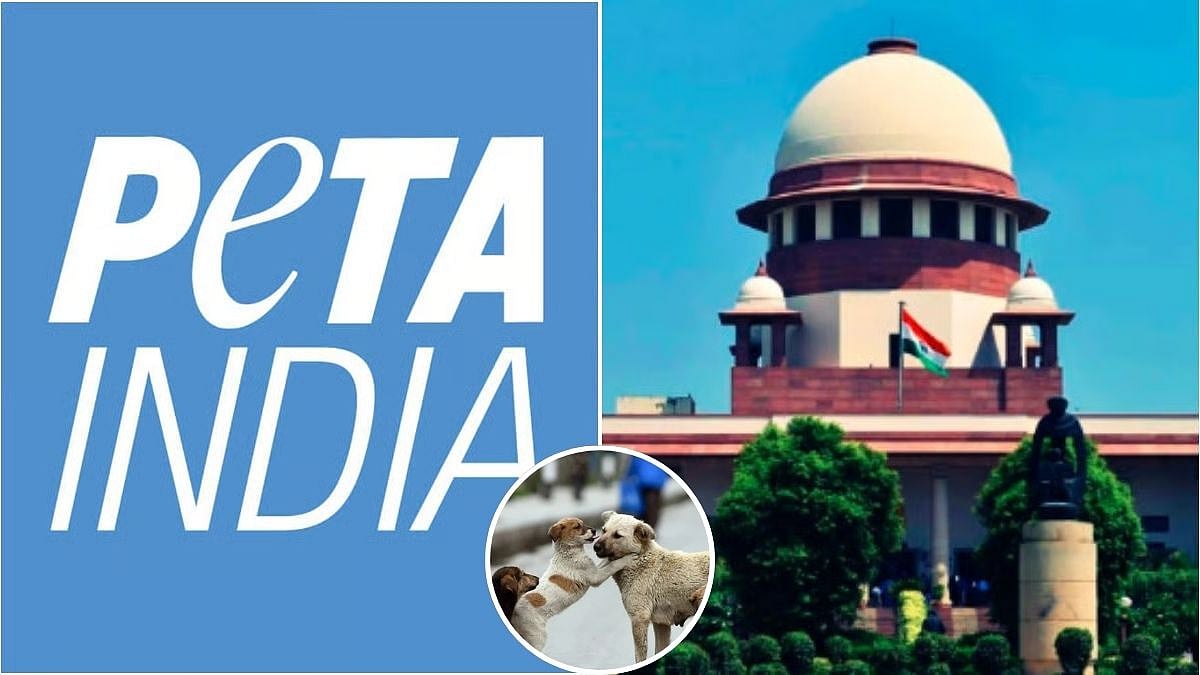
Mumbai, Jan 06: People for the Ethical Treatment of Animals India (PETA India) has filed an application before the Supreme Court, urging it to issue directions for the humane, lawful and scientifically grounded management of community animals.
Application filed in suo motu petition
The animal welfare NGO filed the application in the suo motu petition ‘City hounded by strays, kids pay price’, which directed civic bodies to relocate stray dogs from public and institutional areas to shelter homes. In its application, PETA India cautioned the court against the warehousing of dogs and cows for life in cramped and underfunded facilities.
Concerns over shelters and SOPs
Calling such measures cruel and unscientific, PETA India warned the court that these approaches are unworkable at scale, pose major public health risks and would divert public resources away from real solutions, including the implementation of the Animal Birth Control (ABC) Rules, and ultimately worsen human–animal conflict.
The NGO also urged the court to stay the implementation of the Animal Welfare Board of India’s SOP, which recommends large-scale shelters that allot a mere 20 square feet per dog, roughly the size of a traditional funeral pyre.
Focus urged on ABC Rules
Among other recommendations, PETA India urged the apex court to reaffirm and strengthen the implementation of the ABC Rules rather than focus on punitive, knee-jerk displacement measures that have repeatedly failed wherever they have been attempted.
PETA India submitted two comprehensive, expert-driven roadmaps for the court’s consideration, which have also been sent to the Prime Minister, states and Union Territories, and the AWBI.
Roadmaps rooted in ahimsa
PETA India claimed that the roadmaps are grounded in the principles of ahimsa and Vasudhaiva Kutumbakam and provide preventive, evidence-based and legally sound solutions that address root causes, including illegal pet shops and breeders, abandonment of dogs by impulse-buyers, and the abandonment of male calves and cows by the dairy sector when milk production wanes.
Suggestions for stray dogs and cattle
The roadmap suggests a time-bound, area-wide implementation of the ABC Rules for community dogs, expansion through smaller-scale sterilisation and rabies-vaccination capacity, closure of illegal breeders and pet shops, prohibition of foreign dog breeds bred for illegal dogfights, protection of community feeders, and strong government incentives for adoption.
For stray cattle, it suggested stronger penalties against abandonment, closure of illegal dairies, traceability and accountability mechanisms linked to dairies, regulation of gaushalas to prevent breeding, and food policies promoting plant-based milk production to reduce dependency on cattle milk and eventually reduce cattle numbers.
PETA India criticises relocation approach
Shaurya Agrawal, Policy Associate at PETA India, said, “The lifelong incarceration of dogs in spaces the size of a funeral pyre and the relocation of stray cattle into already overcrowded and underfunded gaushalas is not population management; it is cruelty dressed up as policy. India already has lawful, science-based frameworks to address stray dog and cow populations that need to be implemented in a time-bound manner.”
Infrastructure inadequate for confinement
With an estimated 62 million free-roaming dogs and 5 million stray cattle in India, there is no infrastructure, funding or administrative capacity to confine even a fraction of the population without triggering enormous suffering and mass disease outbreaks, PETA India stated.
Also Watch:

Through the application, it has urged the apex court to ensure that any directions issued in the matter uphold constitutional values, existing animal-protection laws and India’s long-standing commitment to compassionate coexistence.
To get details on exclusive and budget-friendly property deals in Mumbai & surrounding regions, do visit: https://budgetproperties.in/

