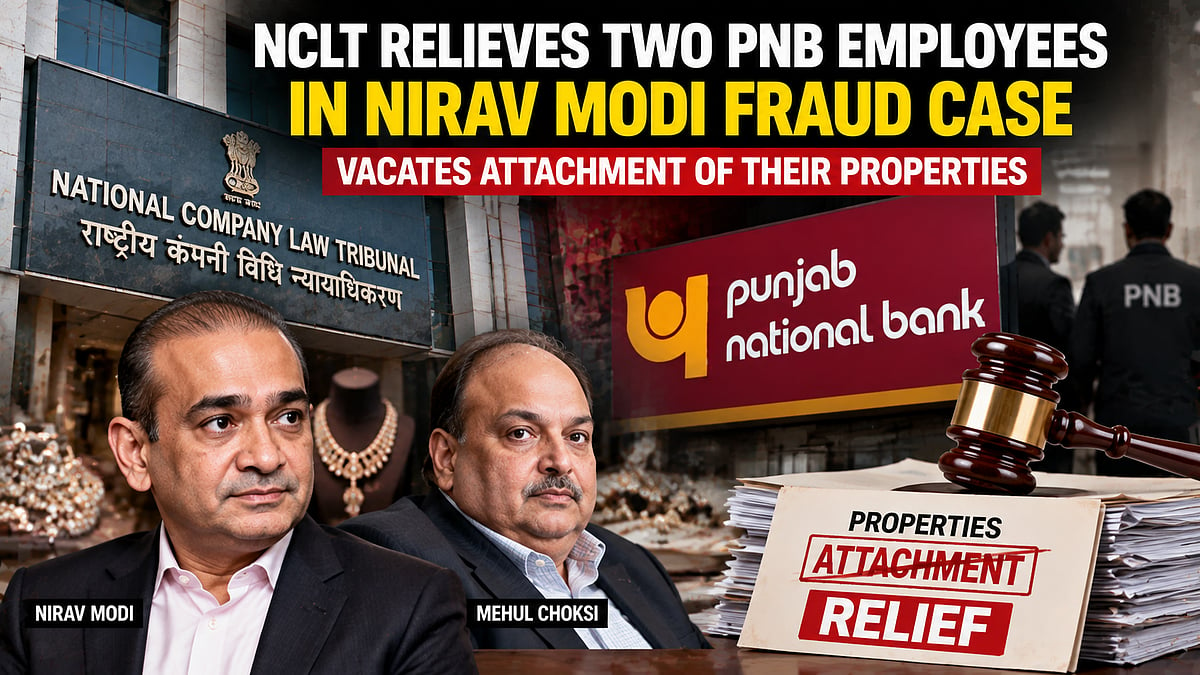
Mumbai: The National Company Law Tribunal (NCLT) has granted relief to two employees of the Punjab National Bank (PNB), Prafull Sawant and Becchu Tiwari, whose properties were attached by the tribunal in 2019 after they were named as accused for their alleged roles in the multi-crore bank fraud allegedly committed by the Nirav Modi and Mehul Choksi Group. In orders passed by the tribunal on September 24, the NCLT held that the case against Sawant and Tiwari was primarily based on circumstantial inferences and that the investigating agencies had not brought anything on record that could prove their involvement in the alleged fraud, warranting the vacation of the attachment of their properties.
Tribunal Finds No Direct Evidence Against Officers
The tribunal said that the mere fact that they were employees of the creditor bank could not, by itself, be sufficient to fasten liability upon them. It noted that the case against them was primarily based on circumstantial inferences, while the Serious Fraud Investigation Office (SFIO) had not brought on record any incriminating or adverse evidence against them and PNB's internal inquiry had found no involvement on their part in the perpetration of the fraud.
SFIO Probe Examined Fraudulent LOUs
The orders passed by the tribunal held, “The Applicants have placed reliance upon their respective positions as officers of Punjab National Bank and the fact that the Bank was a creditor of the company concerned. However, at this stage, the question whether the Applicants had any knowledge of the alleged fraudulent conduct or whether they participated in, facilitated or assisted any such fraudulent activity requires examination in the light of the material and evidence available on record. The mere fact that the Applicants were employees of the creditor bank cannot, by itself, be treated as sufficient to fasten liability upon them under Section 339; ….we are of the considered view that the issue of the Applicants’ liability under Section 339 cannot be determined merely on the basis of their designation or employment with Punjab National Bank. Their individual role, knowledge and alleged participation, if any, in the fraudulent conduct are required to be examined on the basis of the evidence on record. Accordingly, the prayer for dismissal of the Company Petition against the Applicants cannot be allowed at this stage. However, as is noted above that the case against the Applicants is primarily based on circumstantial inferences, Serious Fraud Investigation Office (SFIO) has not brought on record any incriminating or adverse evidence against the applicants and PNB has found no involvement of them in the perpetration of the fraud in their internal inquiry, we consider it appropriate to vacate the attachment of properties of the applicants by modifying the order dated 04.02.2019 read with the earlier order dated 23.02.2018 attachment to exclude the Applicants herein from the ambit thereof.”
Fraud Facilitation Or Negligence Yet To Be Determined
The proceedings were initiated by the Union of India, Ministry of Corporate Affairs, against Gitanjali Gems Ltd and others under Sections 221, 222, 241, 242 and 339 of the Companies Act, 2013. Sawant and Tiwari were officers of PNB, which was itself a creditor of the companies concerned.
The applicants relied on a 2020 judgment of the Supreme Court in Usha Ananthasubramanian v. Union of India, contending that Sections 337 and 339 of the Companies Act could not be invoked against employees of a creditor bank in relation to alleged mismanagement or fraudulent conduct in the borrowing companies. They also relied on an NCLAT order in which the attachment of properties belonging to the then Executive Director of PNB had been set aside.
The NCLT, however, noted that the company petition arose from allegations concerning the fraud involving the Nirav Modi group and that the SFIO had investigated 107 companies and seven LLPs to identify persons and entities financially interested in, or exercising control or influence over, the entities involved, as well as the movement of funds and the role of various persons in the alleged fraud.
Property Attachment Order Modified
The tribunal referred to investigation material concerning fraudulent Letters of Understanding (LOUs) and Letters of Credit, including allegations that such transactions were not entered into the PNB's Core Banking System (CBS). It also noted that the bank's investigation reports had not specifically named Sawant and Tiwari.
The SFIO report, which was accepted by the Central Government, alleged that documents relating to fraudulent LOUs were not maintained at the branch, the LOUs were issued without margin or security, were not recorded in the CBS, and that SWIFT messages were not integrated with the CBS, resulting in a gap between the messages and the corresponding liabilities recorded in the banking system.
According to the tribunal, the SFIO report alleged that the non-generation and non-reconciliation of SWIFT logs, despite an internal bank circular mandating the process, helped in the perpetration of the fraud. It specifically alleged that Tiwari was responsible for the foreign exchange business of the branch and had failed to ensure the generation and reconciliation of the daily SWIFT log. Similar allegations were made against Sawant, who had been assigned the task of generating and reconciling the daily SWIFT log.

The tribunal also noted that the bank had discharged the two from the investigation conducted in the internal inquiry by the bank. “ …The question whether an outsider, including an officer or employee of such third party, had knowledge of the alleged fraud and participated in or facilitated the same is required to be determined on the basis of the evidence and allegations concerning his or her individual role. Indubitably, the Applicants herein were posted in Foreign Exchange Division at the relevant time and were responsible for the activities concerning SWIFT Messages and CBS recording / reconciliation, which if had been carried out in accordance with the bank circular could have prevented perpetration of fraud at the first instance itself. However, whether such failure was intentional to further the perpetration of fraud or was only an act of negligence oversight without any knowledge of fraud having been perpetrated through exploitation of a loophole in the system (non-integration of SWIFT messages with CBS) is yet to be decided. It is further contended that the internal inquiry by the Bank against the Applicants had discharged them. It is also noted that there is no specific material, except circumstantial inferences, to prove the allegation of the Union that the Applicants had intentionally failed to carry out their duties in accordance with the Bank circular in this relation,” the orders read.
The NCLT held that their liability under Section 339 could not be determined merely on the basis of their designation or employment with PNB. Their individual role, knowledge and alleged participation, if any, would have to be examined on the basis of the evidence on record.
To get details on exclusive and budget-friendly property deals in Mumbai & surrounding regions, do visit: https://budgetproperties.in/

