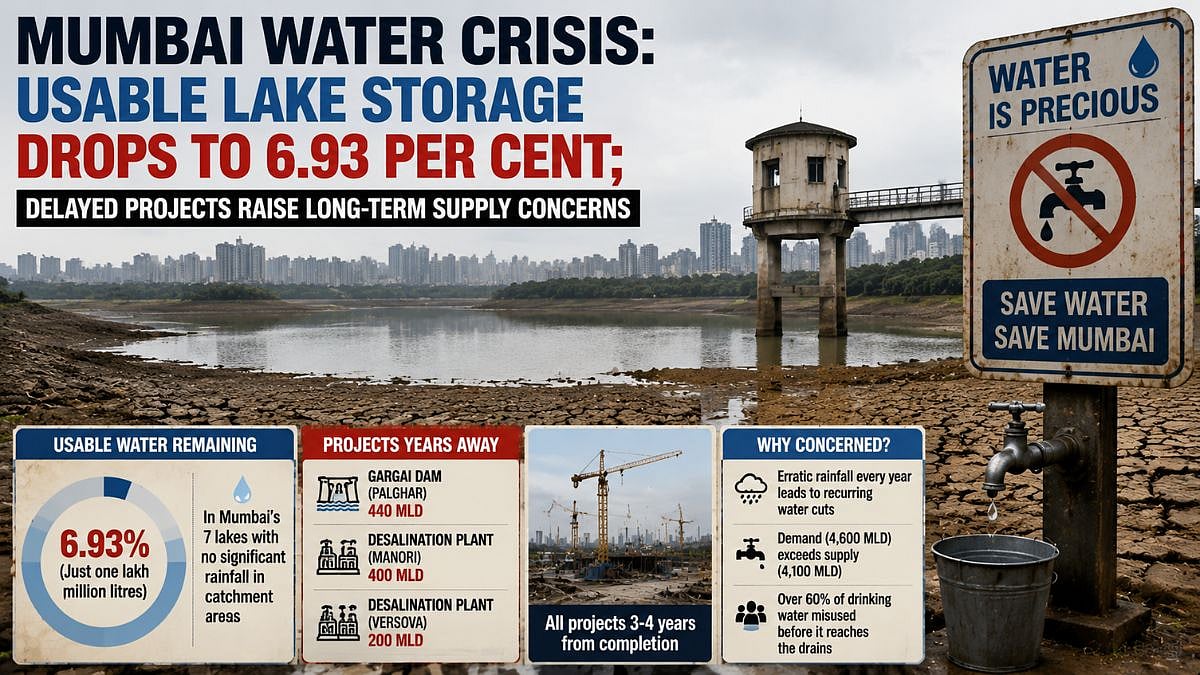
Mumbai, June 29: Mumbai is staring at one of its gravest water crises in recent years. With barely one lakh million litres, just 6.93 per cent of usable water, remaining in its seven lakes and little to no rainfall in the catchment areas, the city's water security is hanging by a thread.
Yet, despite the looming threat, there is no robust contingency plan to tackle a prolonged dry spell. With alternate water source projects still three to four years from completion, Mumbai will remain heavily dependent on the monsoon and vulnerable to recurring water crises if erratic rainfall patterns persist.
Year after year, erratic rainfall has exposed Mumbai's fragile water security, triggering water cuts in 2014, 2015, 2020, 2022 and 2023. Yet, the city continues to rely almost entirely on the monsoon for its year-round water supply.
The BMC draws 4,100 million litres per day (MLD) from seven rain-fed reservoirs—Modak Sagar, Upper Vaitarna, Bhatsa, Tansa, Middle Vaitarna, Vihar and Tulsi, the last commissioned in 2014.
Meanwhile, the city's daily water demand has climbed to nearly 4,600 MLD, widening the demand-supply gap. Twelve years after its last reservoir was commissioned, Mumbai still has no new water source, leaving it dangerously exposed if the monsoon underperforms.
Emergency Measures Fall Short
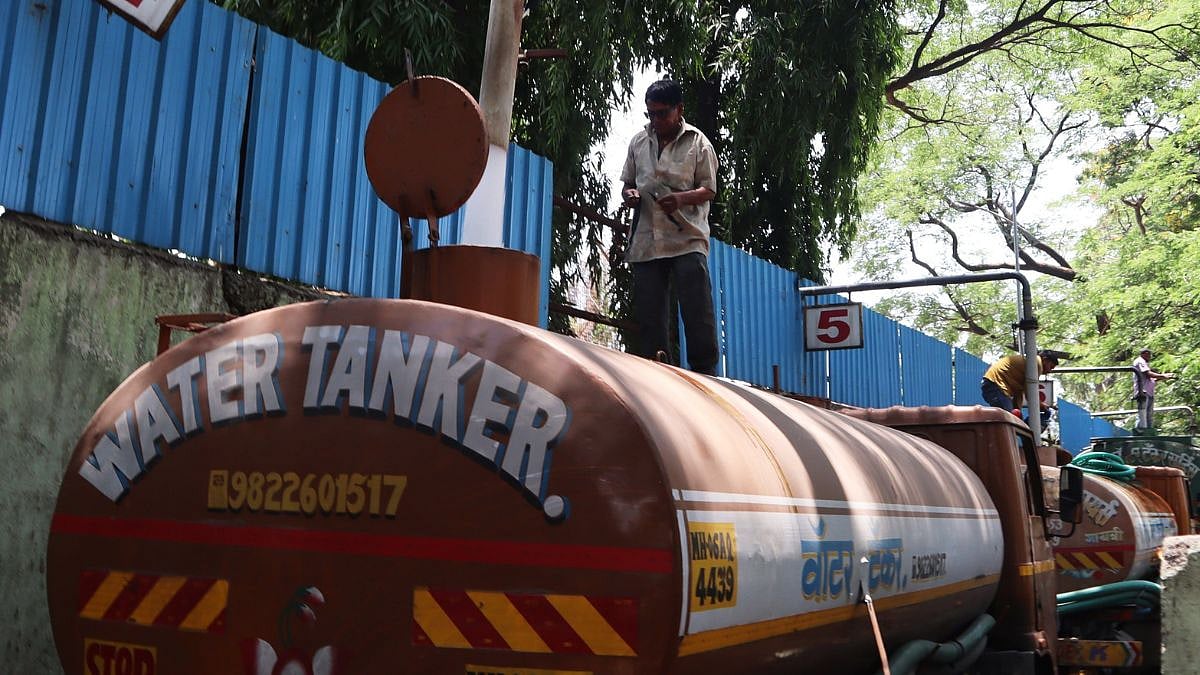
As the crisis deepens, the BMC's response appears to begin and end with water cuts. After imposing a 10 per cent supply reduction on May 15, the civic body suspended water supply to construction sites and swimming pools, froze new water connections and curtailed commercial consumption.
Beyond these emergency measures, Mumbai has little defence against a prolonged rainfall deficit. More worrying, while the city has received intermittent showers, the catchment areas feeding its lakes in Thane and Palghar have remained largely dry, leaving lake levels virtually unchanged and further intensifying the crisis.
Long-Term Projects Delayed
The BMC's long-term solution to Mumbai's water woes remains years away. The proposed Gargai Dam in Palghar (440 MLD) and desalination plants at Manori (400 MLD) and Versova (200 MLD) are expected to add 1,040 MLD to the city's water supply. However, work on these projects is yet to begin, and completion is at least three to four years away.
The civic body is also upgrading seven sewage treatment plants to treat 2,464 MLD of wastewater daily, with 1,232 MLD to be reused for non-potable purposes. However, these projects are also unlikely to be commissioned before 2028, leaving Mumbai with no immediate long-term solution to its recurring water crisis.
Concerns Over Water Management
The city's available water stock is projected to last only until August 20, yet there is little change in consumption patterns. Nearly 60 per cent of the drinking water supplied to households is used for washing, bathing, flushing and gardening before ending up in drains.
MLA Rais Shaikh said, "Mumbai and MMR have failed to plan their water supply system. We are building new cities with no water supply management. Gargai Dam was planned to be commissioned by now and we have not even started the work. Same is the situation in Thane and MMR. Now both Mumbai and MMR will approach the government for a reserve quota, which has its own constraints."
Also Watch:
BJP Mumbai President and MLA Ameet Satam said, "The BMC must reduce the city's near-total dependence on monsoon rainfall by rejuvenating natural ponds, lakes and reservoirs and harnessing their water through reverse osmosis (RO) treatment plants. With climate change making rainfall increasingly erratic, it is imperative to diversify Mumbai's water sources instead of relying almost entirely on the monsoon," he said.
Satam also called for a distribution network to supply treated water to nearby areas and urged the BMC to scale up its planned desalination capacity to 1,000 MLD to meet future demand.
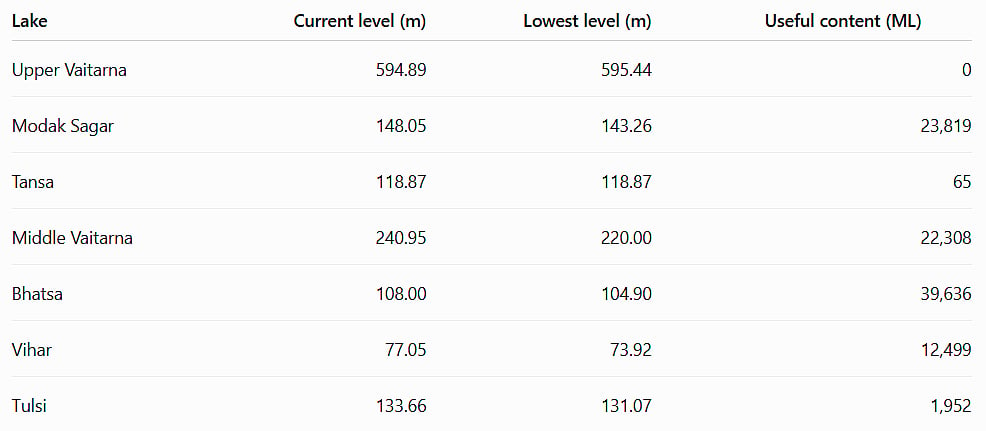
Water Stock As On June 29
To get details on exclusive and budget-friendly property deals in Mumbai & surrounding regions, do visit: https://budgetproperties.in/

