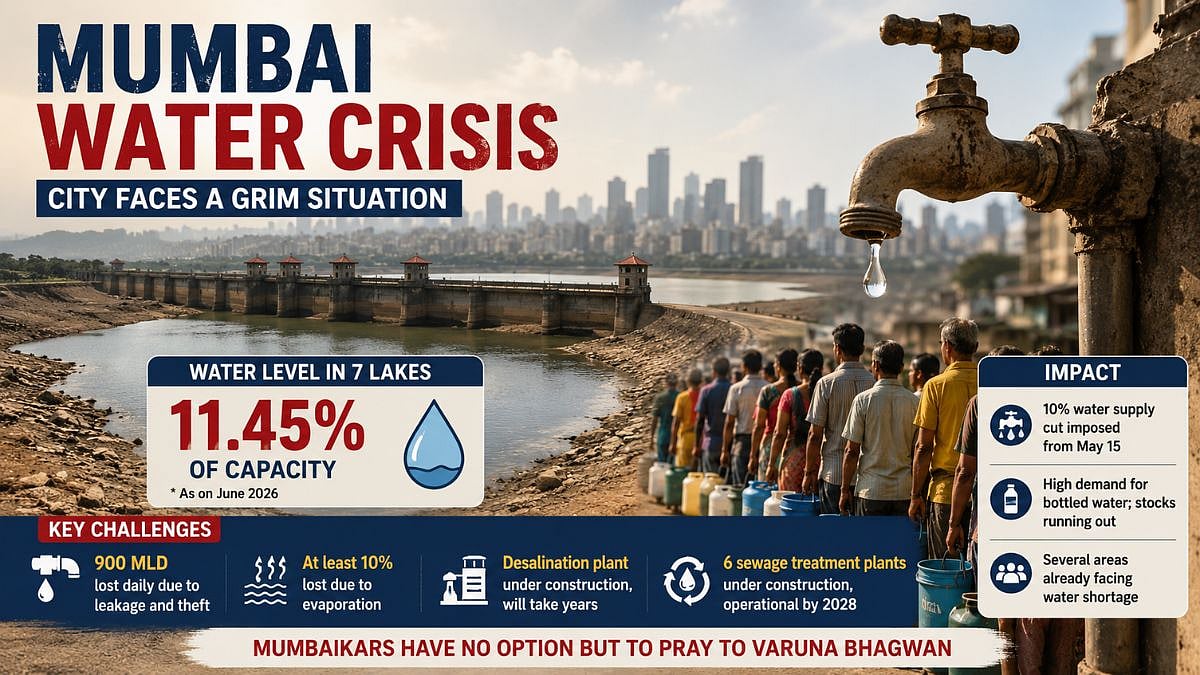
Mumbai, June 13: With the seven lakes supplying water to Mumbai having only 11.45 per cent of water and the southwest monsoon playing truant, the metropolis is staring at a grim future.
The BrihanMumbai Municipal Corporation (BMC) supplies 3,850 million litres daily (MLD) of water. It has been doing a commendable job of supplying water to over 15 million people, sourcing water from as far as 160 km. But the quintessential fault line in its strategy to quench the thirst of Mumbaikars is its dependence on the rains.
And this year, the rain god just does not seem to be in a mood to indulge the chief hydraulic engineer. Even the pre-monsoon showers witnessed a few days ago were extremely scanty.
Normally, by June 10, the southwest monsoon sweeps up from Kerala and pours over the metropolis like an overturned bucket. This time around, there is no sign of the rain-bearing clouds even though the monsoon has entered Kerala.
Early Signs of Water Shortage
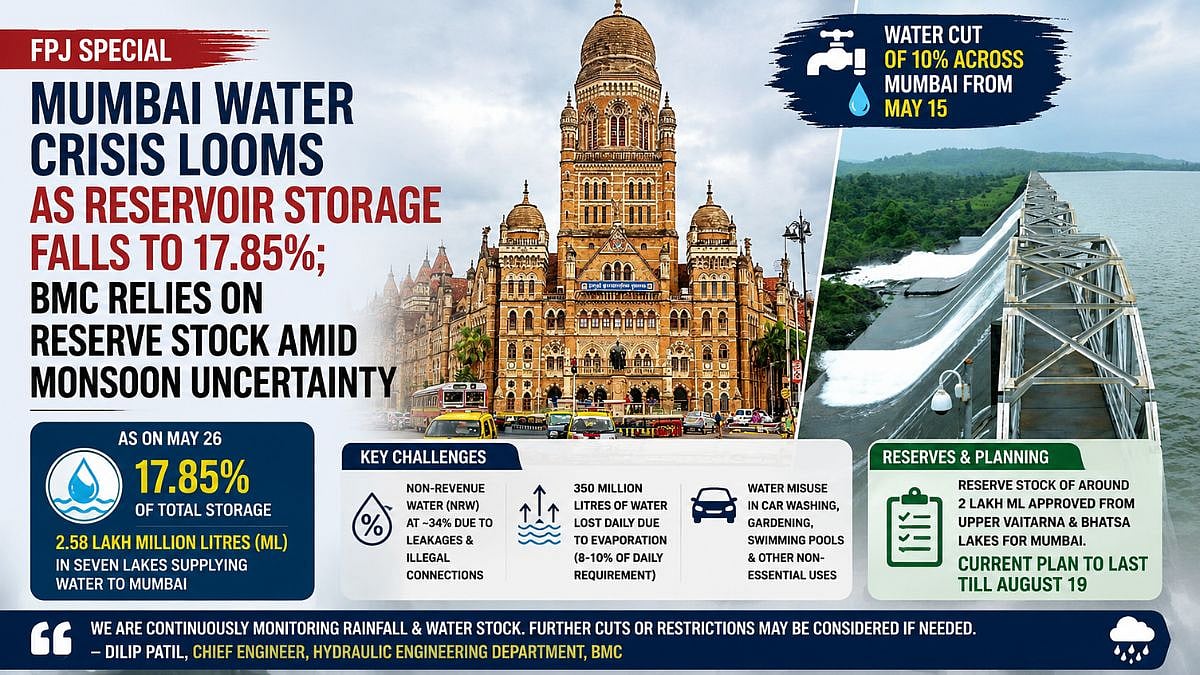
Foreseeing a crisis, the BMC imposed a 10 per cent cut in water supply on May 15. But that was only tinkering with the problem. Several areas in the metropolis are already facing water shortage. The demand for bottled water has shot up significantly.
In fact, two delivery platforms accessed by The Free Press Journal on Saturday said they have no stock of bottled water. Grocers are also reporting high demand for bottled water, with stocks vanishing within hours of being delivered by distributors. Queries to the BMC went unanswered.
Systemic Losses and Infrastructure Gaps
Even though Mumbai has been heavily dependent on the rains, little seems to have been done to frame a long-term plan to face the situation. The shocking reality is that about 900 million litres is lost daily due to leakage and theft, and precious little appears to have been done to plug this. Apart from this, at least 10 per cent is lost due to evaporation, and in this area too the civic administration has not had much success.
The civic body has only now started work on a desalination plant, but it will take a few years to be completed. In any case, it will be able to meet only a fraction of the city's requirement.
Also Watch:
Calls for Recycling and Long-Term Planning
An obvious solution to alleviate the situation was to go in for massive recycling of water. Ravi Raja, an ex-corporator and experienced hand, said, “Work has started on six sewage treatment plants, but it will not be before 2028 these will become operational.” He said these plants should have been commissioned several years ago.
As of now, Mumbaikars have no option but to pray to Varuna Bhagwan.
To get details on exclusive and budget-friendly property deals in Mumbai & surrounding regions, do visit: https://budgetproperties.in/

