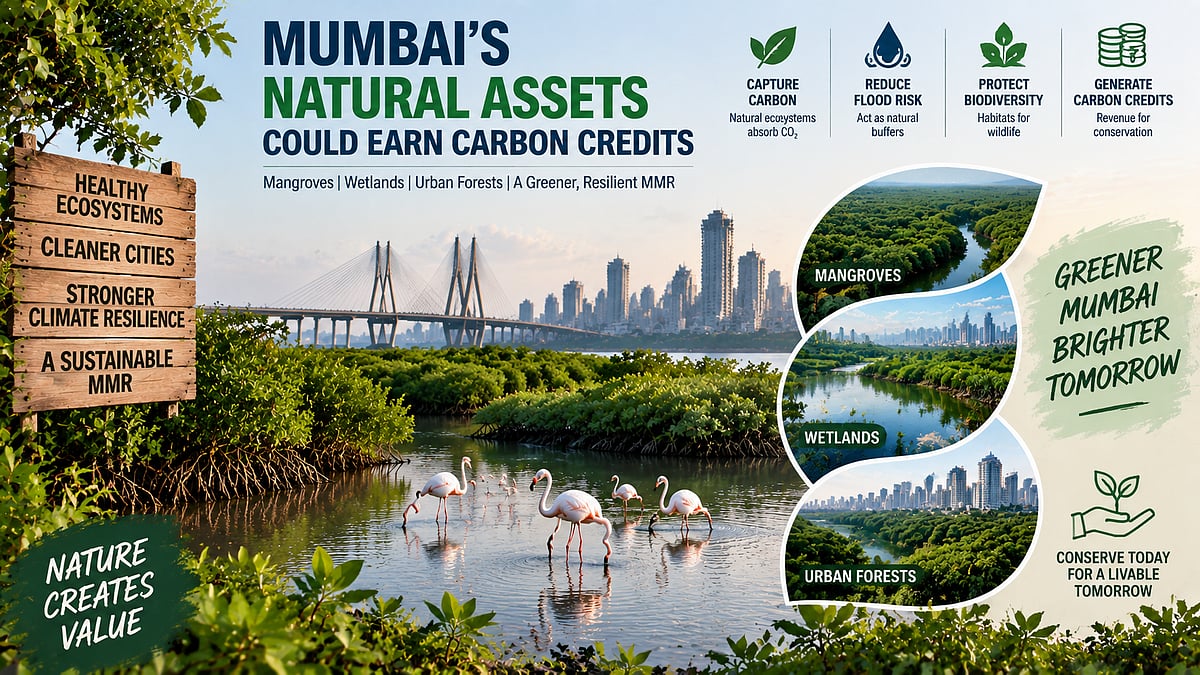
A proposal to develop Mumbai Metropolitan Region’s (MMR) mangroves, wetlands, urban forests and other ecosystems as a potential source of carbon credits is gaining momentum, with international carbon-market experts and environmental professionals backing the idea.
The proposal by NatConnect Foundation seeks to establish a Green-Blue Carbon Bank for MMR, under which the carbon stored by natural ecosystems could be scientifically assessed, certified and potentially converted into carbon credits. The revenue generated could then be channelled towards conservation.
The proposal has been featured by Carbon Pulse, a London-based publication specialising in carbon markets, greenhouse-gas pricing and climate policy. The publication described MMR as a potential test bed for the concept.
The proposal gained traction following the valuation of the 12-hectare DPS Flamingo Lake in Navi Mumbai at around Rs 3,600 crore by a government-owned urban development agency. The wetland has long been the focus of conservation efforts by environmentalists.
NatConnect director B N Kumar said the valuation raised a larger question about how natural ecosystems are valued in urban planning.
“If a wetland can be assigned a market value for development, its larger economic value in carbon storage, flood mitigation, biodiversity and climate resilience should also be quantified,” Kumar said.
NatConnect has taken the proposal to the Prime Minister’s Office and the Union Ministry of Environment, Forest and Climate Change. The proposal was subsequently referred to the Maharashtra environment department, with a request for an action-taken report, according to the organisation.
The initiative also follows years of efforts to protect Navi Mumbai's mangroves and wetlands, including concerns over flamingo deaths, legal interventions and the stalled proposal for a conservation reserve.
Carbon markets offer new conservation model
Climate and sustainability professional Sachhin Patra, who specialises in carbon markets, said existing blue-carbon methodologies could potentially be used to assess carbon sequestration by mangroves and wetlands.
“Can a city's wetlands be run as an asset class that pays for its own survival?” Patra said.
“Coastal wetlands store carbon at rates per hectare that far exceed most terrestrial forests, so the underlying science is on our side,” he said.
The proposal comes amid growing international focus on carbon pricing and its implications for trade. The European Union's Carbon Border Adjustment Mechanism (CBAM) has entered its definitive phase, while the UK is preparing to introduce its own carbon border mechanism from January 2027. The UK has also recognised India's Carbon Credit Trading Scheme among the carbon-pricing schemes that could qualify under its proposed border regime.
Pasha Patel, executive chairman of the Maharashtra Chief Minister's Environment Sustainable Development Task Force, has backed the concept and taken it up with Maharashtra Chief Minister Devendra Fadnavis, while highlighting the potential implications of international carbon pricing for Indian industries and exports.
Kumar said the proposal was not intended to commercialise nature but to ensure that the economic value of natural ecosystems was reflected in conservation and urban planning.
NatConnect has proposed a six-month multidisciplinary exercise involving ecologists, carbon-accounting specialists, remote-sensing experts, lawyers, financial professionals and carbon-market practitioners. The exercise would examine whether the carbon stored in MMR's ecosystems can be measured, verified and translated into credible carbon assets.
The concept is also being examined through an ongoing academic research project at a private university, with Kumar as a co-author.
Patra said a successful pilot in Mumbai could provide a framework that may subsequently be adapted by other coastal states in India and potentially by other countries seeking nature-based approaches to climate finance.
To get details on exclusive and budget-friendly property deals in Mumbai & surrounding regions, do visit: https://budgetproperties.in/

