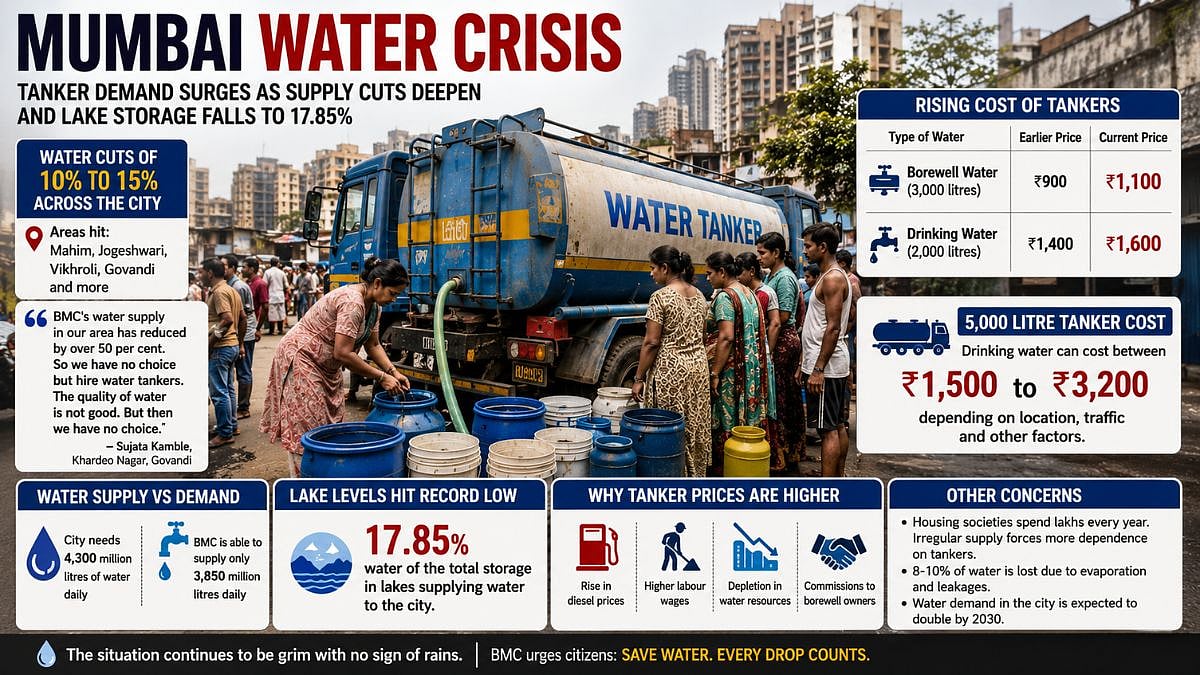
Mumbai: A 10 to 15 per cent water cut imposed in Mumbai has triggered a sharp spike in demand for private water tankers across the city, with residents in several areas struggling to cope with irregular supply over the past few days. Localities such as Mahim, Jogeshwari, Vikhroli and Govandi are among the worst affected, as citizens increasingly depend on tanker services for daily water requirements.
According to an report by Mumbailive, With the Brihanmumbai Municipal Corporation (BMC) unable to maintain consistent supply in several pockets, private tanker operators are witnessing a surge in bookings. The sudden increase in demand has also resulted in a steep rise in tanker prices, placing an additional financial burden on housing societies and residents.
According to suppliers, a 3,000-litre water tanker that earlier cost approximately INR 900 is now being sold for nearly Rs 1,100. Similarly, the price of a 2,000-litre drinking water tanker has risen by around Rs 200 from its earlier rate of Rs 1,400. A 5,000-litre drinking water tanker currently costs anywhere between Rs 1,500 and Rs 3,200 depending on the area, travel distance, availability and transportation conditions.
Despite the growing demand, tanker availability has become increasingly limited across Mumbai. Several suppliers have admitted that they are struggling to secure enough water to fulfil orders. A water supplier from Kalbadevi said the shortage of available water sources has made it difficult to cater to the rising number of requests being received daily, reported Mumbailive.
Most private water tankers operating in Mumbai source water either through borewells or from municipal supply systems. However, tanker operators claim that multiple factors have contributed to the increase in rates, including rising diesel prices, labour costs, transportation expenses, commissions paid to borewell owners and falling groundwater levels in many areas.
The ongoing water crisis comes at a time when Mumbai’s lake levels remain critically low. Civic data shows that the city’s seven lakes currently hold only around 17.85 per cent of their total water storage capacity. Mumbai requires nearly 4,300 million litres of water every day, while the BMC is presently able to supply only around 3,850 million litres daily.
The shortage has forced many housing societies to spend heavily on tanker water every year, particularly in areas where municipal supply remains inconsistent. In several parts of the city, residents reportedly receive water for barely over an hour a day, making dependence on private tankers almost unavoidable.
Experts and residents have also pointed towards water wastage during road and drain cleaning operations, along with leakage from ageing pipelines, as major reasons contributing to the pressure on Mumbai’s already strained water supply system. The combination of reduced lake storage, uneven supply and rising tanker dependency has further intensified concerns over the city’s water management ahead of the peak summer period.
To get details on exclusive and budget-friendly property deals in Mumbai & surrounding regions, do visit: https://budgetproperties.in/

