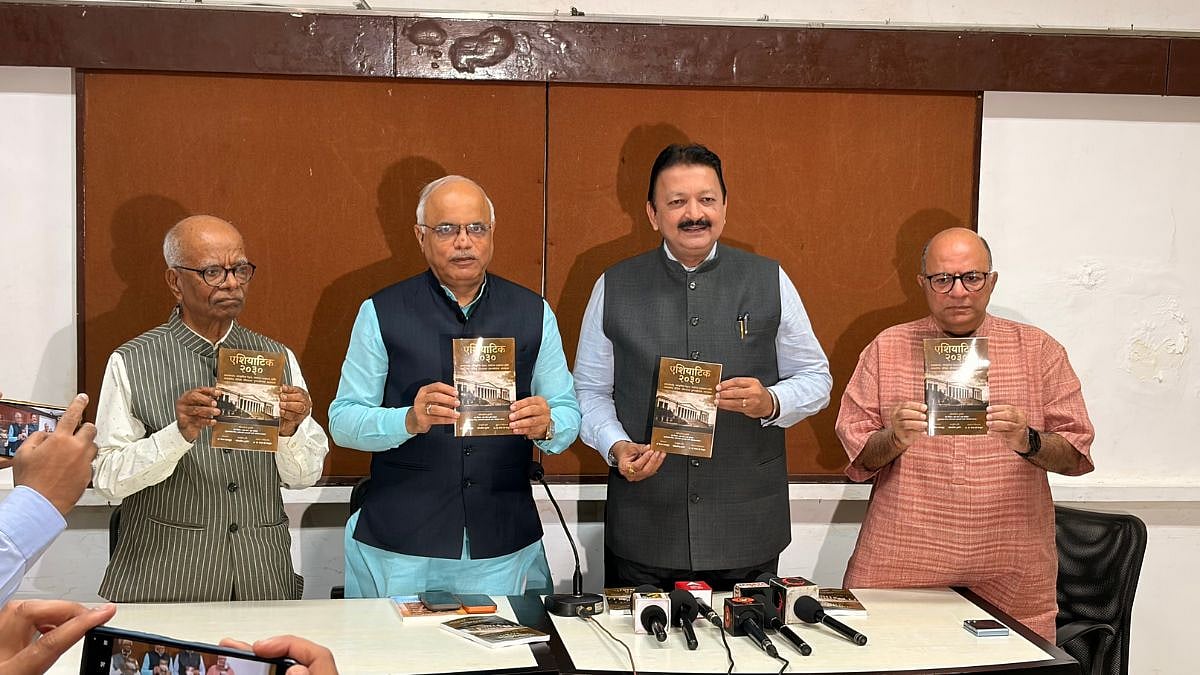
Mumbai, June 29: Ahead of the July 4 elections to the Asiatic Society of Mumbai, the Asiatic Tomorrow panel on Monday unveiled an ambitious roadmap titled 'Asiatic 2030', promising financial reforms, digitisation of rare collections, wider public outreach and institutional revival, while pledging to transform the 220-year-old institution into a globally recognised centre of knowledge.
Addressing a press conference, presidential candidate Dr Vinay Sahasrabuddhe, along with vice-presidential candidates Dr Chandraprakash Dwivedi, Dr Sanjay Deshmukh and Ramesh Patange, said the panel aims to democratise access to the historic institution, restore its financial stability and revive its intellectual legacy. The election, scheduled for July 4, will be contested by nearly 2,500 eligible voters.
Sahasrabuddhe said the Society’s reach should extend beyond South Mumbai and become accessible to people across the city. “The Asiatic Society is a repository of immense knowledge, and it should not remain confined to a particular section of society. Every Mumbaikar should have access to it,” he said.
Panel Promises Institutional Revival
He noted that the election, originally scheduled last year, was delayed due to litigation initiated by certain groups. “The Charity Commissioner’s order was ultimately upheld by the Bombay High Court, and therefore the elections are finally taking place. I am confident that we will succeed,” Sahasrabuddhe added.
Dr Chandraprakash Dwivedi, filmmaker, actor and screenwriter, recalled his own experience of finding it difficult to access the library as an ordinary citizen. “Knowledge should be open to everyone and made available for all,” he said.
The panel’s four-point programme prioritises financial discipline and administrative reforms, including mobilising corporate social responsibility (CSR) funds and seeking grants from the Union Ministry of Culture and the Maharashtra government. It also promised to address employee grievances within the existing legal framework.
Focus On Outreach And Digitisation
Another major focus is expanding the Society’s presence beyond South Mumbai through outreach programmes in suburbs such as Borivali and Thane in collaboration with local libraries. The panel said this would enable wider public access to the Society’s vast collection and encourage regional cultural and academic events.
The panel also proposed heritage initiatives recognising communities that played a significant role in shaping Mumbai, including Parsis, Pathare Prabhus, Kolis and the police force.
Youth engagement and digital transformation form another key pillar of the manifesto. The panel proposed dedicated student memberships, guided archival tours, digitisation of manuscripts and 19th-century maps, and a comprehensive overhaul of the Society’s digital platforms. It also stressed that the institution should remain free from ideological bias and promote an inclusive environment for scholarly research.
Vision Document Released
Vice-presidential candidate Dr Sanjay Deshmukh said the panel’s priorities include digital transformation, institutional excellence, global partnerships and financial sustainability, which he described as essential for the Society’s long-term revival.
As part of its campaign, the panel also released its vision document, 'Asiatic 2030', which it described as a long-term blueprint rather than a conventional election manifesto. The document envisages the preservation of rare books and manuscripts, world-class digitisation, research excellence and a renewed focus on Indian knowledge traditions.
It further calls for the responsible use of artificial intelligence, greater participation of youth and women researchers, stronger governance practices, financial self-reliance and collaborations with international heritage institutions to position Mumbai as a global hub for Asian knowledge and research.
Also Watch:

Presenting the roadmap, Sahasrabuddhe said the revival of the Asiatic Society would require active participation from both members and the public, with the objective of transforming the historic institution into a model knowledge centre of global significance.
To get details on exclusive and budget-friendly property deals in Mumbai & surrounding regions, do visit: https://budgetproperties.in/

