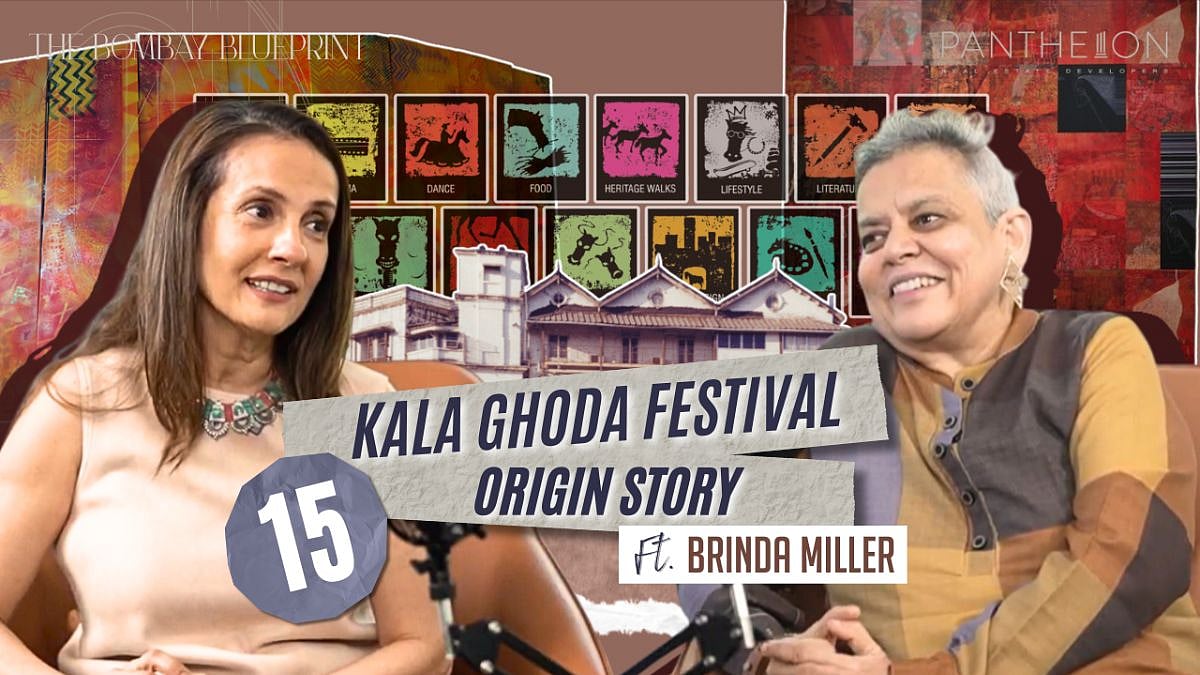
When cities grow at the speed Mumbai does, they often forget to pause and look at themselves. Yet for over two decades, one woman has insisted that Mumbai slow down, just long enough to notice its art, architecture, and cultural memory.
On a recent episode of The Bombay Blueprint, host Sosan Bukhari Govani sat down with Brinda Miller, artist, cultural catalyst, and Chairperson of the Kala Ghoda Arts Festival, to trace how a modest heritage initiative grew into India’s most influential public arts movement.
From Pavements to a Cultural Phenomenon
When the Kala Ghoda Arts Festival began in 1999, it was never meant to become a spectacle. The original intent was quietly radical: draw attention to Mumbai’s Victorian and Indo-Saracenic architecture, create awareness around heritage conservation, and fund small restoration efforts in the historic Kala Ghoda precinct. What emerged instead was a festival that now defines the city’s cultural calendar.
“Back then, it was just art on the pavements,” Miller recalls. “No one imagined it would become this large or this loved.”
Twenty-six years later, the festival spans from Cross Maidan to Cooperage, activating museums, libraries, gardens, and streets with visual art, literature, cinema, architecture, design, and performance.
Often described as the tail that wags the dog, the festival itself became the catalyst transforming Kala Ghoda into India’s most recognisable arts district and reshaping how Mumbai engages with public space.
Creative Management as Civic Practice
Miller refers to her role not as administration, but as creative management. A fine artist by training, she sees the festival as a living artwork one that requires collaboration, adaptability, and enormous emotional labour.
What began as a few months of work now occupies most of her year. Funding remains a persistent challenge, particularly in a post-pandemic cultural economy. “The permissions used to be the hardest part,” Miller notes. “Now, the city understands the value of what this festival gives back.”
Making Art Democratic and Demanding
One of Kala Ghoda’s most defining characteristics is its openness. Emerging artists, students, and independent performers can apply to exhibit alongside established names. Yet the bar remains uncompromising.
“We look at everything,” Miller says. “Concept, execution, intention. Public art has to respect the city it inhabits.”
Each year, nearly a hundred installations take over the streets many self-funded, some crowd-supported making Kala Ghoda one of the few platforms where young, unrepresented artists can be seen at scale.
When Airports Became Museums
Miller’s influence on Mumbai’s visual identity extends well beyond South Bombay. Her early work curating art for Mumbai’s airport terminals helped establish a now-familiar idea: that airports can function as cultural gateways, not just transit points.
Long before art-led infrastructure became policy language, Miller and her collaborators were embedding local craft, narrative, and materiality into spaces seen by millions of travellers annually.
“Art is often the first introduction someone has to a city,” she says. “Why shouldn’t it tell a story?”
A Blueprint for Cultural Cities
Today, Kala Ghoda is cited as a model for urban cultural districts across India. While Miller is cautious about replication, she believes cities must invest in cultural activation not just preservation.
She imagines future festivals in overlooked districts, places that feel “quiet, dull, forgotten” spaces waiting to be re-imagined through art. “Culture doesn’t belong behind glass,” she says. “It belongs on the street.”
Why It Matters
In a time when cities are increasingly shaped by speed, scale, and spectacle, the Kala Ghoda Arts Festival stands as a reminder: culture is not an accessory to urban life, it is its infrastructure.
As Mumbai continues to negotiate its past and future, Brinda Miller’s work offers a compelling lesson: when a city is encouraged to look at itself, it begins to care.
And that, perhaps, is the most enduring art of all.

