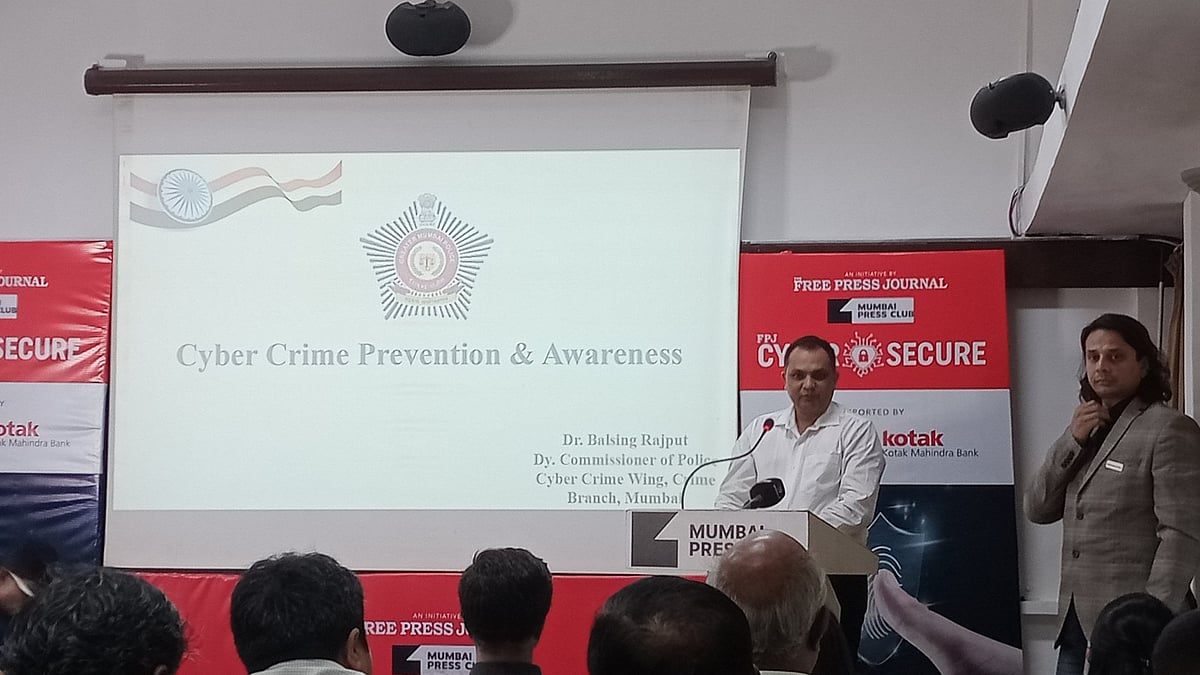
Lottery fraud is India’s longest running fraud (also online now) and job related ones are the most happening cybercrimes today, said Deputy Commissioner of Police (cybercrime) Dr Balsing Rajput. He was speaking at the launch of ‘FPJ Cyber Secure’, a cybercrime awareness campaign launched by the Free Press Journal in association with the Mumbai Press Club and supported by the Mumbai Police and Kotak Mahindra Bank. The campaign and its logo were launched at the Mumbai Press Club on Friday.
150 FIRs filed recently in job-related cases
“Recently, 150 FIRs were filed in job related cases where people lost Rs15 crore. Fifty of these saw people lose more than Rs10 lakh each,” said Dr Rajput, emphasising that people should be careful about cybercrimes as India tops in digital transactions across the world.
“Greed” and “stupidity” are the reasons for people to get duped in cybercrimes, he said to a packed audience to which he gave a detailed presentation, which included information about Mumbai police’s cyber cell units across the city to tackle crimes, hot spots in the country based on different frauds like cheating in the name of customer, ATM, fake links, social media and video calling, motives behind the crimes and types of crimes.
DCP Rajput explains common cyber frauds
“Post pandemic, people started believing in whatever SMS they would get. Online delivery of liquor was a rampant fraud that happened despite the government telling it is banned. People clicked on links and lost money. The others were threat messages that electricity will be disconnected or to link Aadhaar and Pan card for bank accounts,” said Dr Rajput. In case of gift and matrimonials, gullible people have lost crores when they were promised a gift, which never got cleared at the Customs and they just went on paying for its clearance.
Dr Rajput said that money is the main motive behind all cybercrimes that stand at 80% and the remaining fall in revenge and fun, among others. “I conducted a study of such cases between 2002 and 2018; it revealed that 60% were only of illegal or financial crimes, 30% against women and children and 10% were of technical nature. Cost benefit ratio is the big draw for financial crimes as with less effort one makes more money,” he observed.
Bank officials being involved in cybercrimes is a rarity: DCP Rajput
Rajput said that bank officials being involved in cybercrimes is a rarity, though he pointed out cases where banks refused to share details of leaked data to ensure that prospective crimes are stopped. “Such data is not leaked at the bank’s end but by the third party which collects or has it with them,” he said. He cautioned people against using apps and said “only 2%” know how a mobile functions and how apps collect data.
Highlighting the importance of the awareness campaign, Shilpi Mishra, president and head (process, controls, risk containment and functional training), Kotak Mahindra Bank, said, “It is important to stay alert to ever increasing strategies of fraudsters. They are using all kinds of psychological warfare. These involve false promises, high returns, and part time jobs. We strongly urge consumers to reflect before responding. We should follow simple rules and safeguard ourselves.”
Gurbir Singh, the Mumbai Press Club chairman said, “One-fourth of our crimes are digital and in cyber space. The extent of their occurrence needs much more attention and anything done to create awareness about it is short of what needs to be done.”

