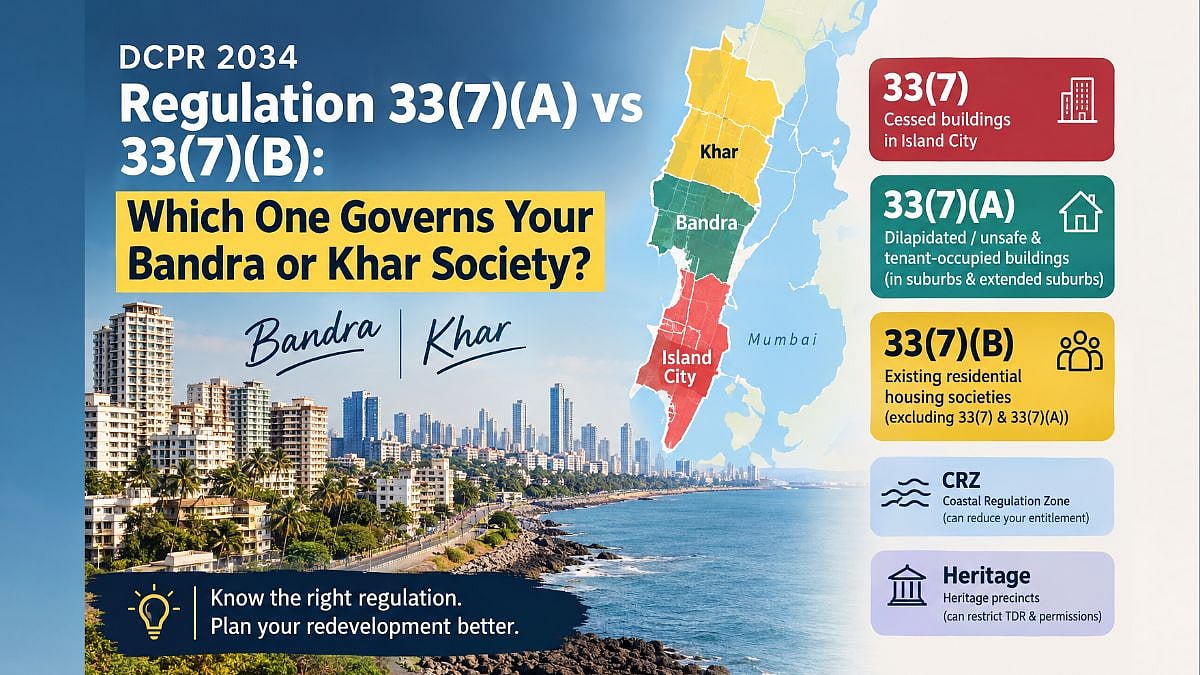
Almost every article on Mumbai society redevelopment opens with Regulation 33(7). That regulation applies only to cessed buildings in the Island City. If your building is in Bandra West or Khar West, 33(7) does not apply to you. The result is a common and costly mismatch. Societies are told they can access an FSI of 3.0 under 33(7). When the architect checks the plot, the entitlement is usually the lower incentive available under Regulation 33(7)(B), and even that incentive can only be used within the permissible FSI the road width already allows.
Here is the correct map for Bandra and Khar.
The three regulations, and where each applies
Regulation 33(7) governs redevelopment of cessed buildings in the Island City by co-operative housing societies or landlords. Cessed buildings are a specific category, tied to the repair cess under the MHADA framework, and the stock sits in the Island City. Bandra and Khar are suburbs. This regulation is not the route.
Regulation 33(7)(A) governs redevelopment of dilapidated or unsafe existing authorised tenant-occupied buildings in the suburbs and extended suburbs, along with existing authorised non-cessed tenant-occupied buildings in Mumbai City. This provision was introduced to extend benefits broadly in line with 33(7) to suburban stock that had no comparable route.
The operative words are “dilapidated or unsafe” and “tenant-occupied”. Both have to hold. A structurally sound co-operative housing society where members are owners rather than tenants does not fall here.
Regulation 33(7)(B) provides additional FSI for redevelopment of existing residential housing societies, excluding buildings already covered under 33(7) and 33(7)(A).
This is where the large majority of Bandra West and Khar West co-operative housing societies sit.
What 33(7)(B) actually gives
Societies older than thirty years are entitled to additional area as incentive FSI, calculated as the higher of ten square metres per member or fifteen per cent of the authorised built-up area.
Then comes the clause that decides whether any of it is usable.
That incentive FSI must be consumed within the limit of the permissible FSI.
Read that twice. The incentive is not additive on top of the permissible FSI. It has to fit inside it. If your plot’s permissible FSI is already being approached by the rehabilitation component, the incentive exists on paper and cannot be built.
This is why two societies of the same age and the same member count, three hundred metres apart, can receive completely different offers. The difference is usually road width, which drives permissible FSI, and plot geometry, which drives how much of it is buildable after setbacks and open space.
Why unauthorised area does not help you
Under 33(7)(B) the calculation runs off authorised built-up area. Enclosed balconies, covered terraces, and additions made over decades without sanction do not count toward the fifteen per cent, and in the cessed-building context the regulations expressly exclude unauthorised construction from the computation of existing FSI.
Societies routinely and sincerely overstate their entitlement because they are measuring what they occupy rather than what was sanctioned. Pull the sanctioned plan before you form a view.
The other routes, briefly
Two more can apply in this geography.
Regulation 33(5) governs development and redevelopment of notified MHADA layouts. Parts of Bandra East, including MHADA colonies, fall here. Confirm against the notified layout list rather than assuming from the address.
Regulation 33(9) governs urban renewal and cluster redevelopment. This becomes relevant where multiple adjoining plots combine. In Bandra and Khar the plot pattern is fragmented and privately held, which makes assembly hard, but joint redevelopment of adjoining societies is a live conversation in several pockets.
The two Bandra-Khar overlays that override everything above
Whatever your regulation gives you, two local overlays can reduce it.
The first is the Coastal Regulation Zone. Sea-facing Bandra West and the Khar Danda belt sit within CRZ. Notably, the MHADA redevelopment incentives under the 1999 gazette notification do not apply to areas affected by the CRZ notification. TDR consumption is also restricted on plots in eco-sensitive zones.
The second is heritage. Bandra contains notified heritage precincts, Pali Hill among them. TDR cannot be consumed on plots in heritage precincts, and heritage grading brings its own permission regime.
Neither of these appears in generic Mumbai redevelopment content. Both are decisive here.
The practical sequence
1. Establish the ward and the plot’s CTS number.
2. Pull the sanctioned plan and establish authorised built-up area.
3. Establish the age of the building from the occupation certificate.
4. Establish whether members are owners or tenants, and whether the structure has been declared unsafe.
5. Establish road width at the abutting road, measured, not assumed.
6. Check the CZMP map for CRZ classification.
7. Check the heritage list for grade or precinct status.
8. Only then compute entitlement.
FAQ’s
Does Regulation 33(7) apply to Bandra West? No. 33(7) covers cessed buildings in the Island City. Bandra West is a suburb.
My society is 35 years old. What am I entitled to under 33(7)(B)? The higher of ten square metres per member or fifteen per cent of the authorised built-up area, as incentive FSI, consumable only within the permissible FSI limit for your plot.
Can enclosed balconies be counted in the fifteen per cent? Only if they were authorised. The calculation runs off authorised built-up area.
What if my building has been declared unsafe? Then 33(7)(A) may become relevant, provided the building is authorised and tenant-occupied. Have this assessed rather than assumed.
This article is part of Pantheion Real Estate’s Insights on Mumbai Redevelopment series. Pantheion specialises in society and luxury redevelopment projects in Bandra West and Khar West, with a focus on design-led, neighbourhood-sensitive development. References to projects such as Palmera (Bandra West) and Luminaara (Khar West) are for context only and do not constitute a recommendation or guarantee of any tax outcome.
This article is for general information only and is not tax, legal or accounting advice. The positions described here reflect the law and prevailing practice as of the date of publication.

