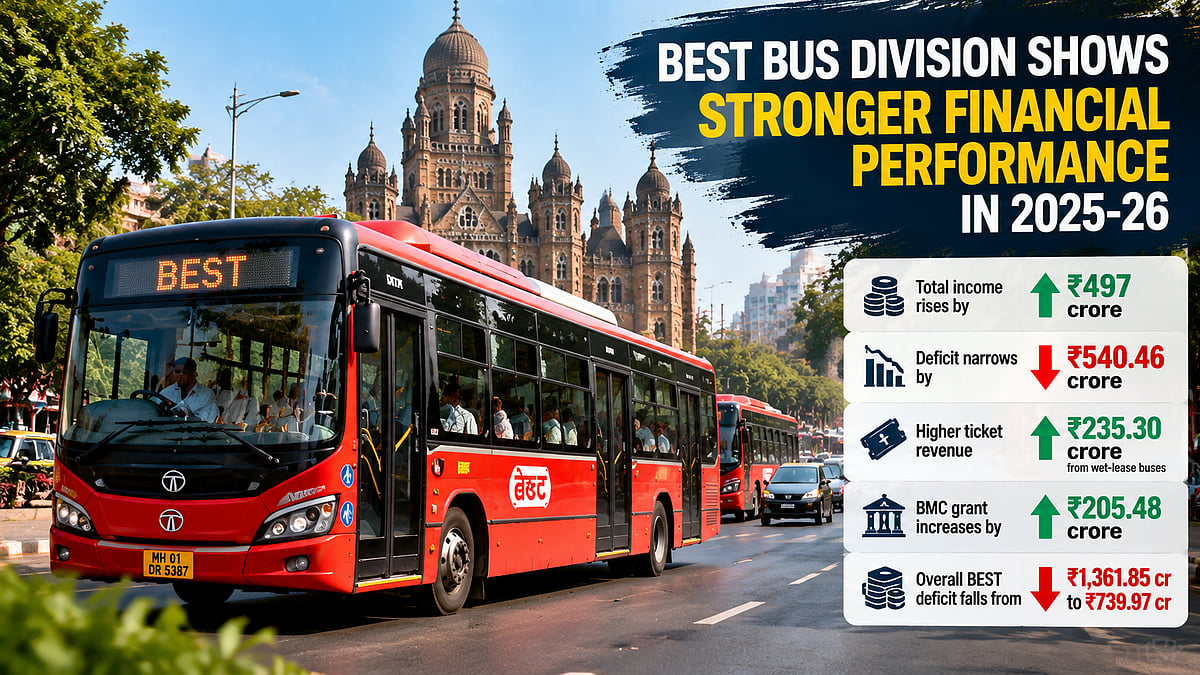
Mumbai: The BEST Bus Division’s financial position improved significantly in 2025-26, with its total income rising by nearly ₹497 crore to ₹2,136.46 crore, compared with ₹1,640.21 crore in 2024-25. The division’s deficit also narrowed by ₹540.46 crore, even as it continued to remain the biggest financial burden on the undertaking, according to the final accounts placed before the BEST Committee.
Wet-Lease Buses Drive Revenue Growth
The increase in income was driven mainly by higher revenue from wet-lease bus operations, increased financial support from the Brihanmumbai Municipal Corporation (BMC), the fare revision implemented in May 2025 and growth in other income. Revenue from wet-lease bus ticket sales alone increased by ₹235.30 crore during the year. In comparison, ticket revenue from BEST’s own buses declined by ₹6.31 crore. Revenue from reserved bus services rose by ₹2.65 crore, while monthly bus-pass income increased marginally by ₹0.42 crore.
Fare Revision Boosts Ticket Revenue
The May 9, 2025 fare revision also contributed to higher ticket income. BEST doubled the minimum non-AC fare from ₹5 to ₹10 and the minimum AC fare from ₹6 to ₹12. The daily unlimited pass was increased from ₹60 to ₹75, while the 30-day unlimited pass was doubled from ₹900 to ₹1,800. Weekly passes started at ₹140, while the monthly 60-trip pass started at ₹500. The student monthly 60-trip pass remained unchanged at ₹200. BEST had estimated that the fare revision would generate around ₹590 crore in additional annual ticket revenue. Since the revision came midway through the financial year, its full impact is expected to be visible in subsequent accounts.
The BMC’s financial support to the Bus Division also increased substantially. The civic body’s grant rose from ₹794.52 crore in 2024-25 to ₹1,000 crore in 2025-26, adding ₹205.48 crore to the division’s income. However, with the Bus Division continuing to run a deficit, BEST has also sought an additional grant of around ₹350 crore from the BMC to meet its financial requirements and support its bus operations.
Advertising And Traffic Revenue Show Growth
Other revenue streams also recorded gains. Advertising income increased by ₹6.65 crore, while income under the traffic department rose by ₹46.01 crore. Engineering-related miscellaneous income increased by ₹2.66 crore. However, income from land and building rent fell by ₹6.77 crore.
Despite the higher income, the Bus Division recorded a deficit of ₹1,182.87 crore in 2025-26, compared with ₹1,723.33 crore in the previous year. Its expenditure also fell by ₹43.21 crore, from ₹3,363.54 crore to ₹3,320.33 crore.
The accounts show that even without the BMC grant, the division’s deficit improved from ₹2,517.85 crore to ₹2,182.87 crore, indicating an improvement in its underlying finances.
Overall, BEST’s annual deficit fell from ₹1,361.85 crore to ₹739.97 crore. The improvement was supported by the reduced Bus Division deficit and a ₹442.90 crore surplus in the Electric Supply Division.
To get details on exclusive and budget-friendly property deals in Mumbai & surrounding regions, do visit: https://budgetproperties.in/

