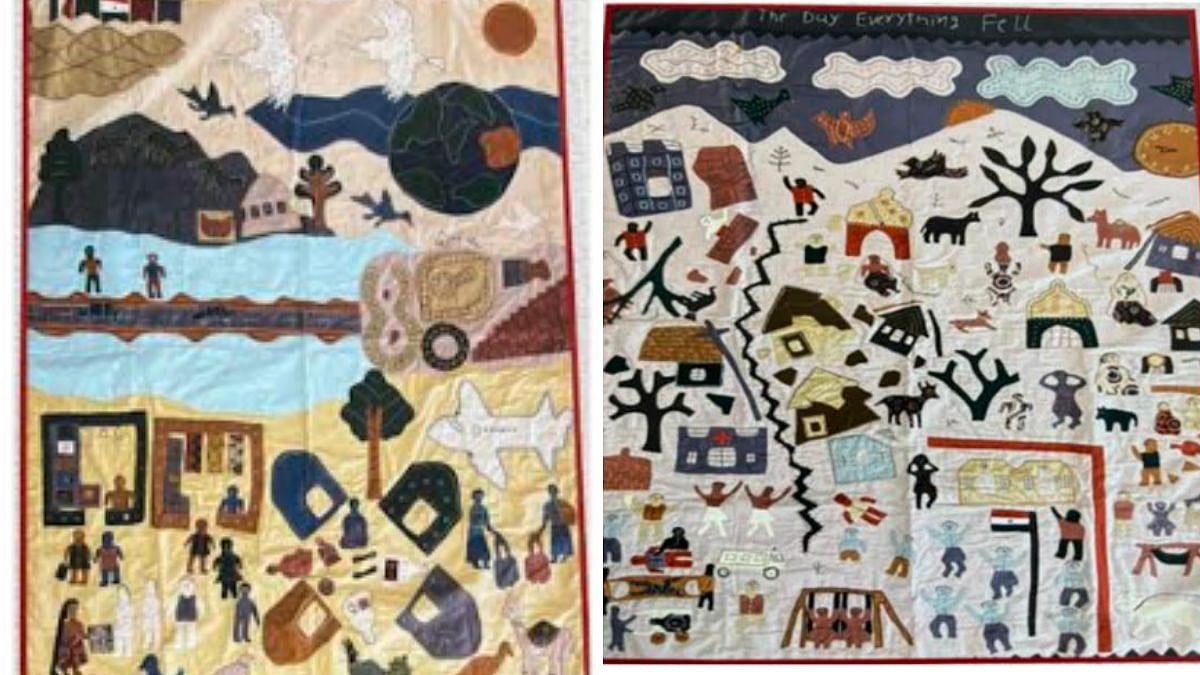
Mumbai: For the 25th anniversary of the 2001 Kutch earthquake, Mumbai's Chhatrapati Shivaji Maharaj Vastu Sangrahalaya (CSMVS) — formerly the Prince of Wales Museum — has dedicated a section of its textile gallery to honour artisans who rebuilt their lives and trade after the disaster devastated their lives and livelihood.
Exhibition Weaves Story of Loss, Recovery, and Rebirth
The exhibition uses traditional textile and artwork to stitch together the narrative of the loss, recovery and rebuilding of livelihood in 25 years. Kutch, an arid region economically dependent on its textile and crafts traditions, was devastated by the earthquake which destroyed key centres such as Bhujodi, Dhamadka, Anjar, and Khavda.
Nilanjana Som, Curator (Art), CSMVS, who oversees costumes and textiles, jewellery, arms and armour, decorative arts, and the museum’s numismatic collection, said that the museum developed textiles with artisans who participated in ‘Resurgence 2001 – Stories of an Earthquake, Survival and Art’, an exhibition in 2007-2008 when 22 textiles were made part of the museum's collection.
Artists Narrate Their Journey Through Art, Pride, and Memory
“These artworks were developed with the support of Bank of America under the project ‘Promotion of Folk and Tribal Art’. Three artists — Dr Ismail Khatri, Arjan Valji, and Kala Raksha artisans — were asked to show their journey since the Bhuj earthquake of 2001. The artists have uniquely narrated their journeys, taking pride in their art, while rooting their stories deeply in the history of the region, their communities, and the nation,” said Som.
The exhibition in 2007-2008 was created by independent curator Carole Douglas in collaboration with Kutch textile groups and the Manly Art Gallery and Museum, Australia.
'The Day Everything Fell' — A Clock Stops Time as Earth Shook
The two panels — 'The Day Everything Fell' and 'The New Kutch' — created using applique, patchwork and embroidery on cotton by artists Taraben, Babraben, Champaben, Neelaben, Nirmalaben, Kesharben, Gauriben and Ilaben under Kala Raksha from Kutch, describe January 26, 2001 unfolding as any day: the children were at school for the Republic Day celebration and the towns and villages were stirring to life. The panel shows the chaos created by the sudden shaking of the earth, with buildings collapsing and debris covering everything. The artisans have added a large clock in the artwork to show the exact moment when everything changed, dividing their lives into ‘before’ and ‘after’.
“The New Kutch” exhibit celebrates the rebuilding of their lives, the recognition of the Dholavira archaeological ruins as a UNESCO World Heritage Site and the growing tourist trade that has helped the textile trade.
A third exhibit 'Ruins to Resurgence' uses Ajrakh hand-block prints with natural colours on cotton by Dr Ismail Mohamed Khatri, Dhamadka Village. The artist states that this work shows how the community’s traditional craft of Ajrakh block printing has survived natural disasters, and the evolution of civilisation beginning with the 5,000-year-old Sindhu-Sarasvati (Harappan) Civilisation of which Dholavira is a part, to the modern-day industrial civilisation.
From Ruins to Runways: Ajrakh’s Journey Across 5,000 Years Using 100 Hand-Blocks
The earthquake crippled the craft, which was struggling to maintain its relevance in modern times. However, the resilient spirit of the artisans remained unbroken; they expanded to a new village and introduced their craft to contemporary markets. Through old block designs found in the excavated Dholavira, traditional Ajrakh block designs used for local communities, and new block designs developed for the contemporary fashion markets, Dr Ismail has captured these changes. The creation, hand-block-printed using more than one hundred blocks on both sides of the fabric, reflects the journey of Ajrakh through 5,000 years.
The museum has another exhibition 'Networks of the Past: A Study Gallery of India and the Ancient World' where similar motifs are used on pottery and other media. The museum also has a town model of Dholavira from the Harappan period.
To get details on exclusive and budget-friendly property deals in Mumbai & surrounding regions, do visit: https://budgetproperties.in/

