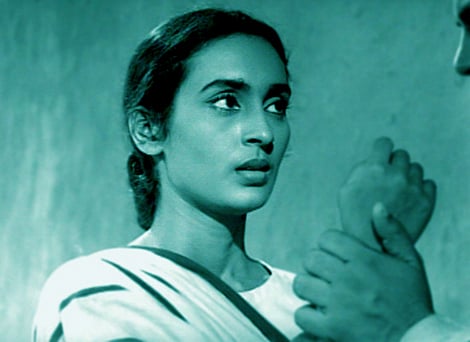
Shoma A. Chatterji pay a tribute to Bimal Roy and Nutan.
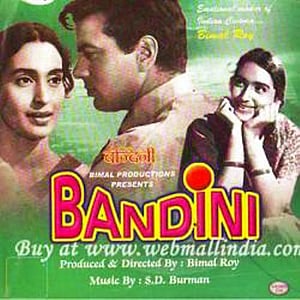
Bandini (1963) based on Tamasi, a Bengali novel by Jarasandha is seen as the culmination of Bimal Roy’s command over the language of cinema and his artistic mastery. Jarasandha’s career began as a jailor in the northern parts of Bengal and culminated when he retired as jail superintendent. He began writing on his experiences as jailor, creating a completely new genre in Bengali literature where the characters, most of them criminals, were behind bars.
In Bandini, Kalyani is serving a life term for having poisoned her lover’s wife. The film follows a telescopic structure, moving backwards and forwards into and through time, tracing the strange emotional bonds Kalyani develops with the two men in her life, one, as a young maiden smitten by a revolutionary Bikash, (Ashok Kumar) and the other as the silent, reserved prisoner who the young prison doctor Devendra (Dharmendra) falls in love with and decides to rescue from a life in prison.
Bandini offers glimpse into the lives of women prisoners grinding wheat on the grinding stone, fighting among themselves, or recalling days of a happy past when one of them sings ab ke baras bhejo bhaiya ko babul rendered to music by S.D. Burman and sung beautifully by Asha Bhonsale. The sympathetic warden of the female ward, portrayed subtly by Chandrima Bhaduri, offers a soft counterpoint to the harsh ground reality of the jail. The architectural design of the prison highlights the alienated lives of the inmates visibly dwarfed by the high, forbidding walls, the large rooms, the long corridors, thrown in relief by some lush green plants in the compound.
The imaginative and aesthetic use of sound and imagery through Black-and-White frames to express the loneliness, the sense of alienation, and the total lack of guilt Kalyani experiences within the prison is unforgettable. Standing all alone in a corner of the jail compound facing the prison’s high wall, Kalyani can hear the hoofs of the horse on the soundtrack pulling the horse carriage carrying Devendra away.
Just before she is to kill Bikash’s wife, Kalyani sits with her back to a grilled window, her face in relief against backlighting, the sounds of a welding machine somewhere in the neighbourhood hammering nails of sound into the sinister ambience of the evening. Her hands tremble a bit when she pours the poison from the bottle, but her eyes burn with the determination of something terrible she has decided to do.
Later, it appears as if she committed the act in a kind of trance. Incidents building up towards this murder are built up to establish her psyche. The friend, whose husband had helped her get the job in the hospital, calls her up to inform her that her father has met with an accident in the city. He had come searching for Kalyani. Kalyani rushes out. When she reaches the hospital, her father is dead. She walks back, silent. The recalcitrant patient screams out to her.
Bandini marks several ‘firsts’ in Hindi cinema. It is the first film to place a woman prisoner as the central figure. It is the only Hindi film adapted from a novel by Jarasandha who was a jail superintendent in West Bengal in real life. It also marks the debut of Gulzar as lyricist. Gulzar’s entry happened when music director S.D. Burman had a tiff with lyricist Shailendra and the latter walked out of the film. Someone persuaded Roy to take Gulzar but Burman did not want him because he felt Gulzar, who wrote in Urdu would not be able to write the lyrics of a vaishnava song extolling the love of Radha and Krishna. But the song – – mora gora ang lai le gave Burman Dada no reason to complain. But after this son, Burman and Shailendra patched up and Gulzar was out!
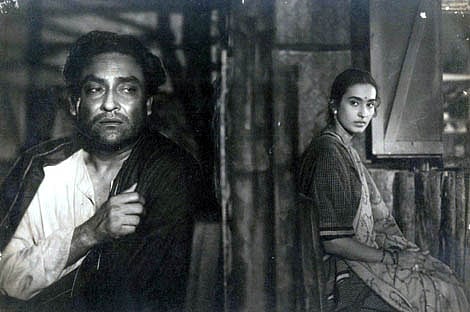
Kalyani is one of Hindi cinema’s first celluloid women who lived life on her own terms and did not compromise to social and filial pressures. She is feminine, soft and gentle, even apparently submissive. But beneath this soft exterior, lies a mind made of steel that can make decisions even at critical moments of her life and throw away the certainty of a secure future in favour of surrendering to her emotions and offer succour to the only man she ever fell in love with.
Every frame is carefully designed, well orchestrated and spilling over with layers of meaning. Kalyani and Devesh are constantly shown together in their early meetings without any barrier between them. But when Deven proposes, we see a door between them. Kalyani turns down his proposal without having to look at him. The door could be read as a signifier of the barrier Kalyani feels exists between the honest, respectable, kind and committed prison doctor and herself, a prisoner committed for life for murder.
The call of the prison guard announcing Sab Theek Hai (everything is fine) spells out the opposite – nothing is fine. This spells out the irony behind the walls of a prison where prisoners, stripped of their human identity, are mere numbers; where life is reduced to an eternity of waiting either to go out to an unkind world that will not accept them, or to die inside. The prison guard’s call is used three times in the film. The first time it happens, we see a freedom fighter being taken into the prison. The second time, Deven has resigned and is going back home. The last time the guard calls out sab theek hai, the freedom fighter is being put to the gallows. These function as subtle and underplayed counterpoints in the film.
In Bandini, Nutan communicates with her eyes. Nutan stripped Kalyani of any highly charged emotion or theatrics. She underplayed the character, fleshing Kalyani out as a quiet but determined woman with a dignity that belied her prison backdrop and her criminal status. Her mental state is expressed through a flood of fleeting emotions on her face, especially in the scenes leading up to the murder and afterwards. When the body is discovered the next morning, she pulls at her hair, her sari falling off her chest, screaming out that she is the one who has killed the woman.
Bandini won the National Award for the Best Feature Film (Hindi) in 1964. It won almost all the major Filmfare Awards– Best Film, Best director, Best Actress (Nutan), Best Cinematographer (Kamal Bose), Best Sound Design (D. Billimoria) and Best Story (Jarasandha). It was a big commercial success. The film starred the smashingly handsome Dharmendra and Ashok Kumar as the two men in Kalyani’s life.
