
Some of my happiest childhood memories are associated with chess. My father taught me the game. He used to be extremely busy doing two jobs to support our family of six. But despite that, he would always find time to play a game with me when he came home, often while he was having his dinner.
In 1972, when I was nine years old, Bobby Fischer, the American genius, played Boris Spassky for the World Chess Championship. This was at the height of the Cold War, and the battle was front-page news worldwide, including in India. For perhaps the first time, the daily newspapers reported not only the outcomes of each game but also the moves the two competitors had made. When Dada came home at night, we would sit late trying to analyse the games.
I carried on with my love for chess, competing in local tournaments and even in the Maharashtra State Junior-level selections. But I wasn’t good enough, and soon life intervened, and I gave up competitive chess. It remains a hobby.
But if you want to know what it takes to rise to very pinnacle of global chess, Interregnum: Inside the Grueling and Glamorous Battle to Become the Next King of Chess by Jordan Himelfarb is the book to read.
Himelfarb is the Opinion Editor of the Toronto Star and head of its Editorial Board. He is not a professional chess player but a hobbyist like millions of others. And that is what makes the book extremely interesting. It is not a technical treatise on chess moves, which would have made it beyond the ken of lay readers. The book tells the very human stories of extraordinary chess players, the so-called Super Grandmasters, and what it takes to rise to the top.
Interregnum is a Latin word. It means the interval between two kings. That is exactly where the Chess world stood in 2024, when Himelfarb started writing the book. In 2022, Magnus Carlsen, the five-time world champion and arguably the greatest player of all time had refused to defend his title.
The winner of the Candidates tournament (who traditionally gets to challenge the world champion), Ian Nepomniachtchi, and China’s Ding Liren, the runner-up, fought for the world title, which Liren won.
Himelfarb takes up the story of how the eight competitors for the next Candidates tournament were chosen. The runner-up in the previous world championship cycle, Nepo in this case, got an automatic entry. Three other spots were decided by a knockout tournament called the FIDE World Cup. (FIDE is the global chess governing body). One spot went to a player who had the highest cumulative scores from various FIDE-rated events during the year preceding the World Championship cycle. The final slot went to the player with the highest FIDE rating in January of the year of the Candidates tournament.
The process is brutal, and Himelfarb, through a series of interactions with the players, brings out what it takes out of this most cerebral of sports’ competitors. We meet an unforgettable cast of characters. There is a dreamer in Wesley So, a Filipino American Grandmaster. There is Hikaru Nakamura, an internet sensation who believes his online success has secured his legacy, with or without the world title. The book also introduces us to Anish Giri, the Dutch super grandmaster, whose expressions, Himelfarb says, are always obscured by a fog of irony, and to Fabiano Caruana, whom he describes as a scientist.
Then there are the two contestants who finally vie for the crown. Ding Liren, who went into a depression following his title win two years ago, and the Zen-like 18-year-old prodigy from India, D Gukesh. All of us in India, of course, know how the story ends, and we have celebrated when this boy from Chennai became the youngest ever World Champion in a last-game thriller.
But knowing the outcome doesn’t make the book any less riveting. (I finished reading it in a day). Himelfarb’s genius is that he doesn’t tie his book up in chess strategies like Ruy Lopez, Sicilian Defence and Giuoco Piano, which would be incomprehensible to most readers. Instead, he focuses on the very human stories of these elite players and what it takes out of them to compete at the highest level.
The author also delves quite a bit into the dichotomy between the austere classical tradition and the chaos of streaming, social media, and internet celebrity. Once an elite intellectual pursuit, chess has, today, become a spectacle, especially online.
The other aspect he explores is the power of computers and artificial intelligence. Ever since Deep Blue, IBM’s computer, defeated the then-reigning world champion, Gary Kasparov, in 1997, it has been accepted in the chess world that humans will not be able to beat raw computing power. Today, grandmasters train with engines far stronger than any human champion. Has classical chess, then, become just a memory test, as Carlsen says? Should it be sped up so that players compete on instinct rather than what they remember?
In the end, the book succeeds because it treats chess not as an obscure intellectual curiosity but as a profoundly human arena of conflict. Jordan Himelfarb writes with curiosity, empathy, and narrative flair, turning elite chess into a story about the sacrifices people make in pursuit of immortality. Whether one follows chess obsessively or barely knows the rules, the book offers an absorbing portrait of brilliance under pressure and of a kingdom suddenly left without a king.
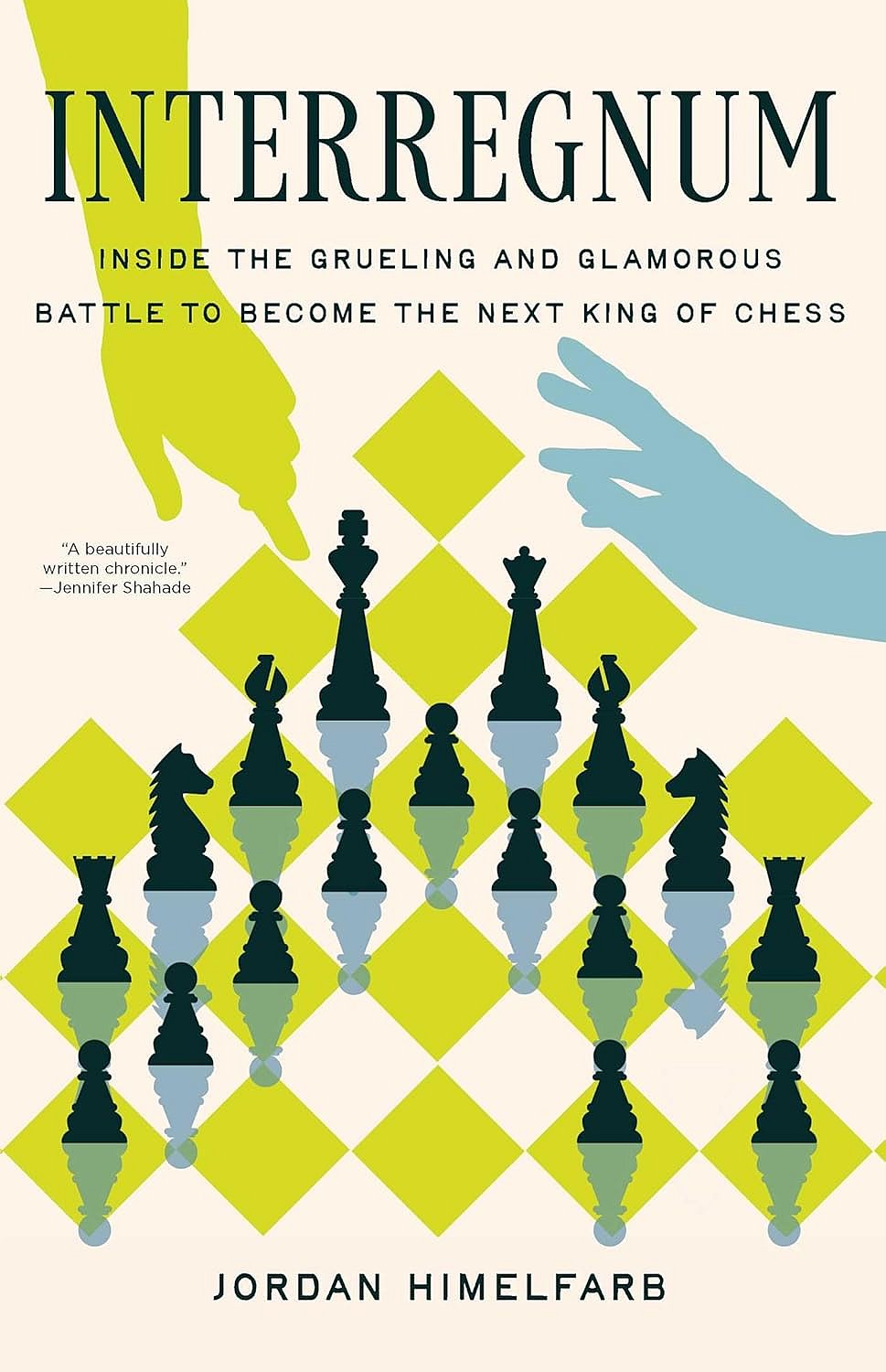
Book: Interregnum: Inside the Gruelling and Glamorous Battle to Become the Next King of Chess
Author: Jordan Himelfarb
Publisher: Pegasus Books
Price: Rs 2520
Pages: 240

