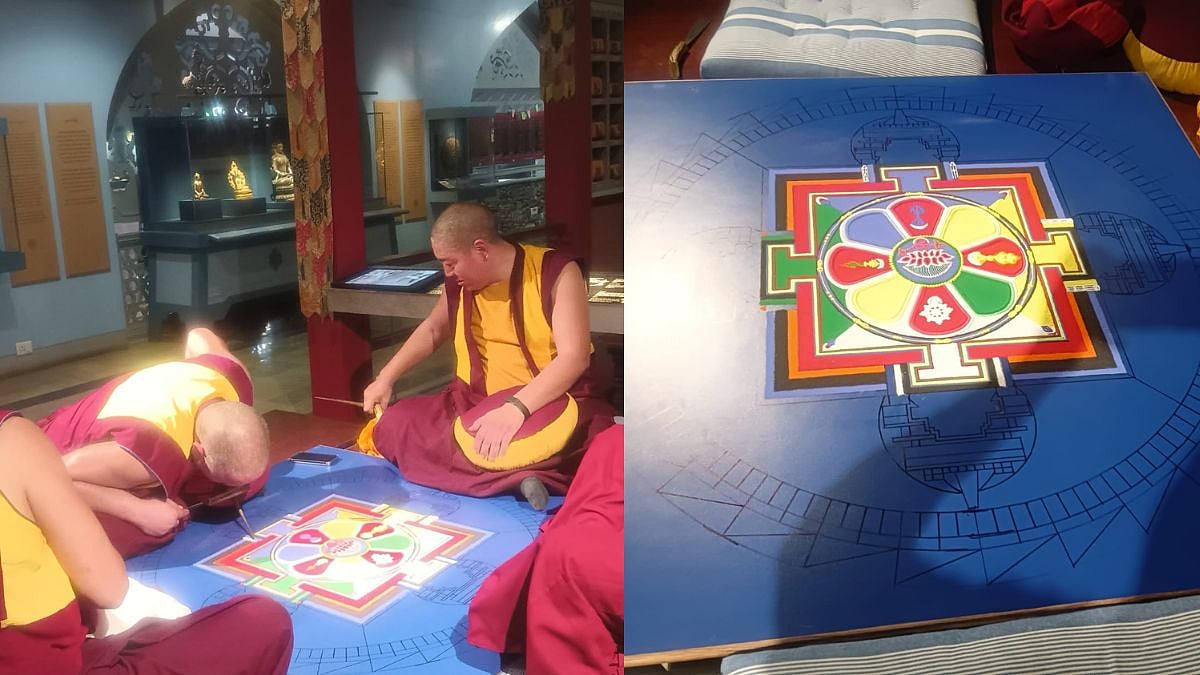
At Mumbai’s iconic Kala Ghoda Arts Festival, amid bustling crowds, music, and installations, a quiet, almost meditative spectacle is drawing visitors in. Inside the Himalayan Art Gallery at the Chhatrapati Shivaji Maharaj Vastu Sangrahalaya (CSMVS), Tibetan monks sit cross-legged for hours, pouring grains of coloured sand with extraordinary precision, without sketches, blueprints, or visual references. It's all the mastery of memory that comes with years of meditation practices. This is the sacred creation of a sand mandala, an ancient Tibetan Buddhist ritual.
In an exclusive interaction with The Free Press Journal, members of the Tibetan cultural delegation explained the deep spiritual, cultural, and political significance behind the sacred Sand Mandala, an ancient Buddhist art form that is meant not to endure, but to be dismantled.
A cultural mission beyond art
Tenzin Lekshay, the official spokesperson of the Tibet Administration, talks about their representation in the Kala Ghoda Arts Festival's 26th edition. He says, "The Tibetan cultural delegation's presence at Kala Ghoda this year is deeply symbolic. According to the delegation's representative, the participation serves two important purposes. "One is to help Indians understand that Tibet has a vibrant, living, and unique culture. The second is to show that even in exile we are preserving this culture under the leadership of His Holiness The Dalai Lama.”
He further says, "The delegation's participation coincides with a significant global observance, the Year of Compassion, marking the 90th birthday of His Holiness The Dalai Lama. Celebrated from July 2025 to July 2026, the year-long tribute reflects his teachings, wisdom, and legacy of compassion."
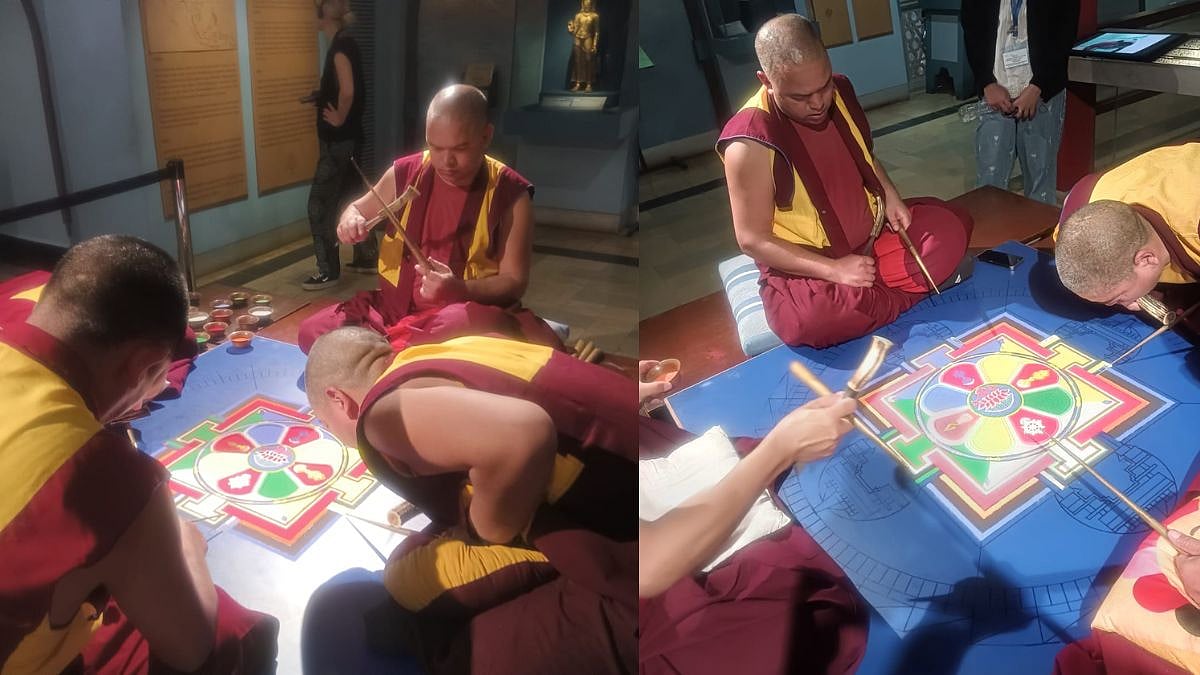
Sand Mandala Art by Tibetan monks | FPJ/ Sunanda Singh
The sand mandala, its significance and meaning
The sand mandala being created at Kala Ghoda Arts Festival represents the abode of Avalokiteshvara, the Bodhisattva of compassion. In Tibetan belief, His Holiness The Dalai Lama is considered a manifestation of Avalokiteśvara.
The process of the sand mandala is as rigorous as it is sacred. "On the first day, we draw the outline of the mandala," explains a monk. “Everything is based on precise geometry and mathematical proportions. You cannot modernise or alter it." What astonishes most visitors is that the monks work entirely from memory.
"They don’t refer to images or diagrams. Years of meditation and training allow them to visualise every detail internally," he adds.
Even small details like the absence of fans in the room are intentional, as a single gust could scatter hours of work. Each grain of sand is placed with a metal funnel called a chak-pur, producing a soft, rhythmic sound that adds to the meditative atmosphere.
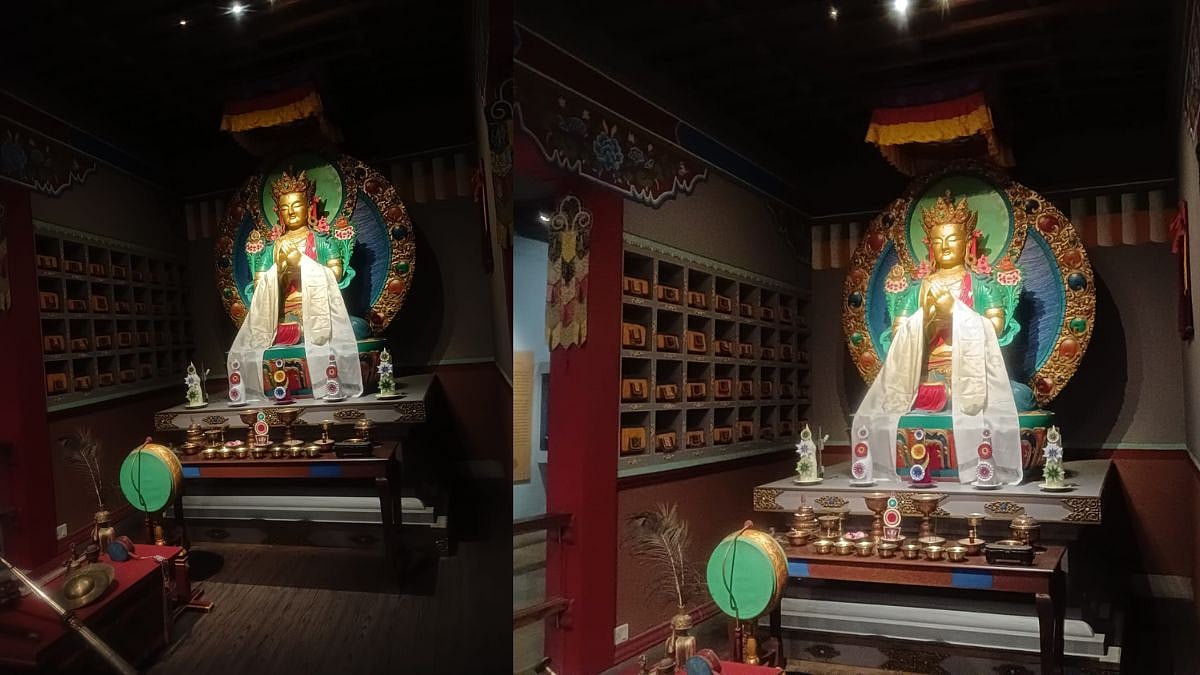
Statue of Buddha inside the Himalayan Arts Gallery | FPJ/ Sunanda Singh
"It takes days to create something so intricate," one of the monks says. "And yet, in the end, it will be dismantled."
Talking about the concept of attachment and detachment, he says, "This deliberate destruction reflects the Buddhist understanding that attachment leads to suffering. At the heart of the mandala are five deities, each representing aspects of human consciousness and the five sensory faculties. These symbols guide practitioners during meditation, helping them transcend ignorance, hatred, and attachment; the three root causes of suffering in Buddhism."
“The colours, the gates, the symbols; nothing is random," he explains. “Every colour represents a deity. Every element follows exact religious instructions."
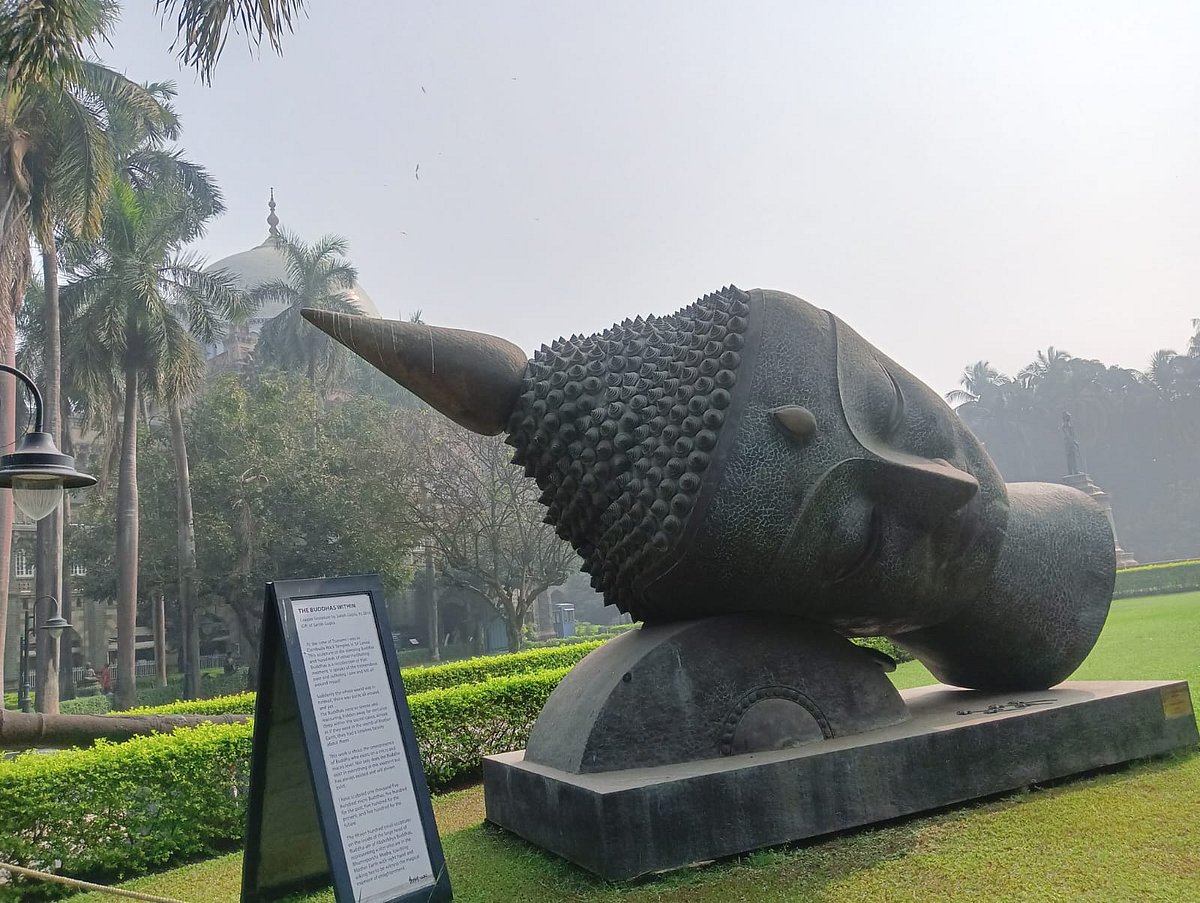
An artifact at Chhatrapati Shivaji Maharaj Vastu Sangrahalaya (CSMVS) | FPJ/Sunanda Singh
Safeguarding Buddhism in India
After the completion of the sand mandala art, it will be dismantled. "This teaches detachment," says another monk. "Even the most beautiful things are temporary. The sand is often collected and dispersed into flowing water, symbolising the spread of compassion into the world."
For the Tibetan monks, India is not just a place of exile. It is a spiritual homeland. "Buddhism originated in India," he explains. "Lord Buddha's teachings were later carried to Tibet in the 7th Century. We have preserved these traditions for centuries. Buddhism connects India to countries across Asia, Sri Lanka, Thailand, Japan, Korea, and Nepal. Preserving this tradition benefits the world."
The Tibetan delegation also showed their gratitude towards India, saying, "Because of the government and people of India, Tibetan culture has survived and thrived. In our homeland, our culture faces extinction. In India, we have found refuge, dignity, and freedom."
Meditation and inner peace
Meditation is central to Buddhism, and here's what Tenzin has to say about it. "One must understand the preciousness of human life, everything we consume, from food to clothing, comes from others."
"Meditation cultivates gratitude, compassion, and awareness. When compassion grows, the mind finds peace. Without it, misunderstandings and suffering arise, even where none was intended," he explains.
Everything has a beginning and an end
At the Kala Ghoda Arts Festival 2026, the monks work in solitude, surrounded by the festivities and celebrations. Without a sketch or guide, they create beautiful art using just the power of their memory, along with their discipline and devotion to the craft.
Their sand mandala is proof that nothing lasts forever; everything comes with an expiry day, and that's what makes their art so meaningful and poignant.

