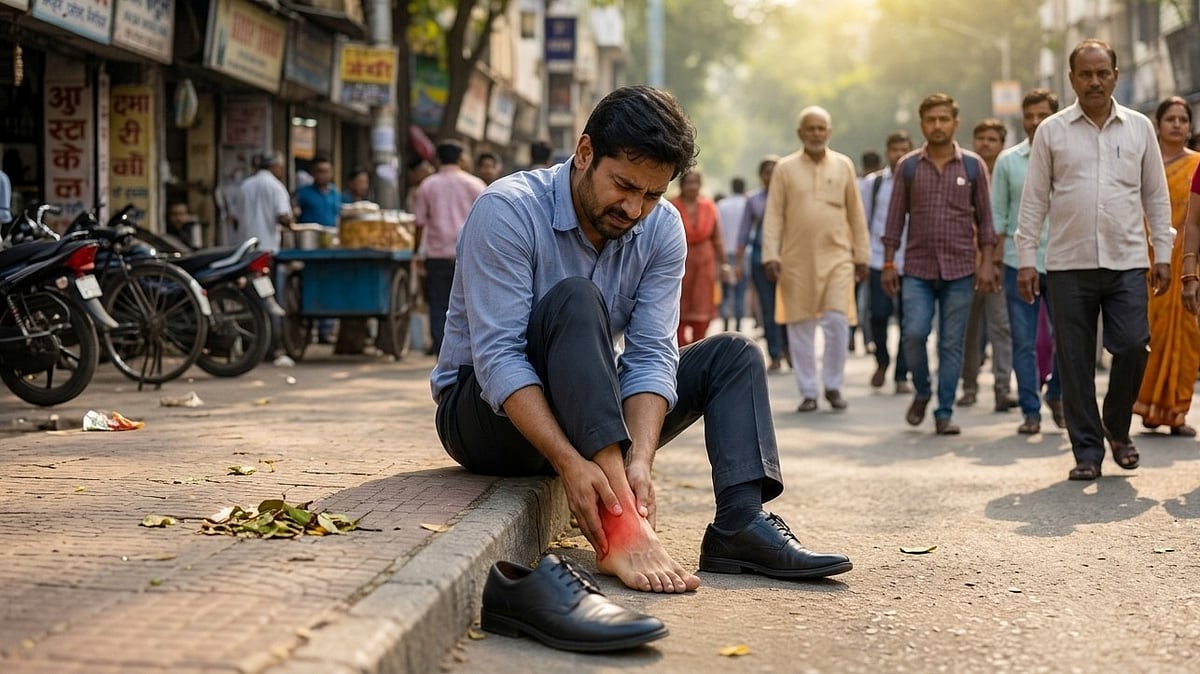
For years, India’s conversations around everyday health have focused on posture, sedentary work, obesity, and exercise, but one of the most constant interfaces between the body and the ground has escaped the same scrutiny – footwear that we use.
In a country where millions of people spend long hours walking, standing, commuting, and working on unforgiving surfaces, footwear cannot remain a category judged mainly on price, durability, or style. What is most often dismissed as normal foot pain, tiredness, heel soreness, or slow loss of mobility may actually be the result of shoes and slippers that were never designed for Indian feet or Indian lifestyles.
Research says
The Central Leather Research Institute has noted that the sizing system used in India is an adopted one, while a CSIR-CLRI national sizing initiative, based on 1.25 lakh samples across 79 districts, has called for a system that accounts for width as well as length. Because Indian foot size varies in width as well. Eg. Foot with a smaller length can be wider than someone with a longer foot. If a market as large as India needs to rethink how shoes are sized, then the problem is not just discomfort, but a deeper design mismatch within the category itself.
In a CSIR-CLRI stakeholder and clinicians report, researchers noted that Indian feet are flatter, with the forepart, ball, and waist portions wider and lower than European feet. They reiterated that footwear built on European shoe lasts does not fit Indian feet properly.
A 2025 study on 936 street vendors in Delhi found that 46.1% reported heel pain, linked to prolonged standing, foot dysfunction, and non-ergonomic footwear. And street vendors are only one part of a much larger workforce that spends long hours on its feet. Once pain at that scale becomes normal, it becomes a public health issue.
Design challenges
Poor footwear design is often discussed as if it were about soft cushioning alone, but the deeper issue is fit, shape, pressure distribution, and the freedom a foot has to function naturally. When people repeatedly buy footwear that is too long to compensate for narrowness, too flat for arch needs, too rigid in the wrong places, or too unstable for long standing hours, the body adapts. And when the body adapts, discomfort slowly becomes biomechanics.
CLRI’s own work on gait analysis and healthcare footwear suggests, footwear influences stability, stance, locomotion, and the risk of slips and falls, especially in populations such as the elderly, people with fallen arches, and those with obesity or deformities. This is a useful reminder that shoes do not merely protect the foot from the road. They shape the way the body moves over time. So, the real question is not whether a pair feels acceptable for ten minutes inside a store. It is whether the design supports natural movement, distributes load sensibly, and respects the demands of the user’s day. That is a much higher bar than the Indian market has traditionally set for itself.
The public health stakes rise further when one considers chronic disease. According to the ICMR-INDIAB data, India has 10.1 crore people living with diabetes. That matters because foot health in such a context cannot be treated as a minor wellness theme. A community-based study from Mumbai notes that foot ulcers are among the most common causes of hospitalisation among people with diabetes, and found that 15.29% of patients with diabetic foot ulcers in its sample required amputation during the study period. In vulnerable populations, footwear can become gateways to disability, hospitalisation, and a much heavier burden on families and health systems.
Way Forward
Encouragingly, India’s standards and research ecosystem has begun to recognise this. In late 2025, BIS and FDDI discussed a draft Indian standard for therapeutic footwear aimed at people with diabetes, neuropathy, at-risk feet, and those vulnerable to foot ulcers. That may sound specialised, but it reflects a broader shift in how the category is being understood. Footwear is slowly being seen not just as apparel or fashion, but as a product with direct implications for health, safety, and long-term mobility.
Parallelly, some new-age footwear companies are beginning to respond to this gap. Instead of designing for a broad global average, they are paying closer attention to Indian feet and everyday usage patterns through wider fits, roomier toe boxes, softer cushioning, and better support for long hours on hard surfaces.

Which brings us to the real opportunity. India does not just need more footwear, but better footwear designed around Indian foot geometry, everyday use cases, and public health realities. That means taking width seriously, designing for long hours on one’s feet, and creating products that support women, seniors, and people with chronic conditions. If India is serious about preventive health, foot health can no longer stay on the margins.
(Arif Khan, Co-founder and COO at Frido)

