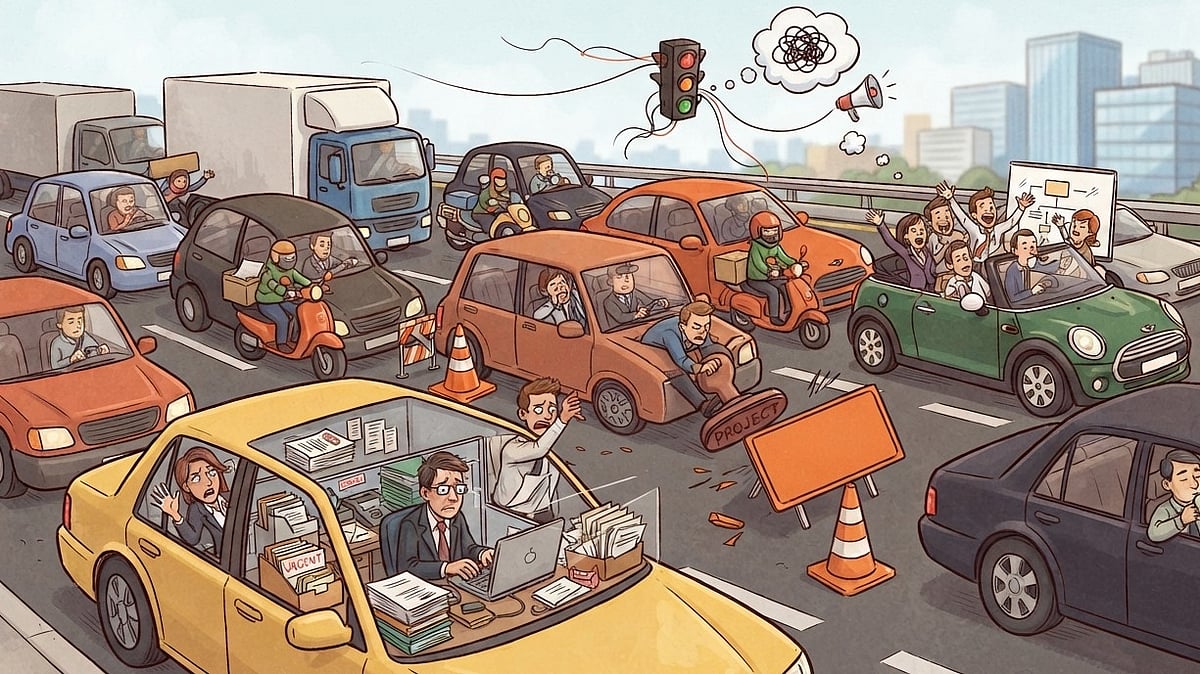
Stuck in a jam thanks to water clogging? Wondering why the hell is it jammed on this side of road today at this time of the day? Ranting because you have been stopped at a signal for almost half an hour because some politician is travelling?
Traffic jams have a special talent for exposing human behaviour. Someone is honking like it will magically create a new lane. Someone is aggressively changing lanes every 20 seconds. Someone has stopped exactly where they shouldn’t…. all these are classic examples of human impatience.
What we forget is that these traffic jams have an uncanny ability to teach us some great management lessons along with human behaviour patterns.
Here are a few management lessons you can learn while waiting for the traffic to move.
Find the bottleneck first
When traffic stops moving, the obvious reaction is to blame the cars ahead. But often, the real problem is somewhere else — a narrow road, an accident or a vehicle blocking a lane, road work.
The same is true in organisations. When a project is delayed, it is tempting to blame the person who appears to be holding things up. Look deep. Figure out where the bottle neck is and what’s the stopper?
Maybe the designer is waiting for content. The content team is waiting for data. The data team is waiting for approval. And the person who needs to approve it is sitting in another meeting. Congratulations. You have found your workplace traffic jam.
A good manager doesn't just push people to work faster. They identify what's creating the blockage.
“Before asking people to work faster, find what is actually slowing them down,” suggests management consultant Vriddhi Chawla. “You may discover the invisible bottleneck that needs to be cleared first.”
More people ≠ more speed
Ever watched a traffic jam get worse because everyone tries to squeeze into the same tiny gap?
Exactly. Adding more people to a struggling project can sometimes create the workplace equivalent of five cars trying to enter one parking spot.
Suddenly there are more opinions, more meetings, more messages and more people asking for updates. Before adding more people, ask whether the existing team needs more resources—or simply clearer priorities.
Riddhima Baweja, HR consultant, says, “Too many persons cramped in one space or one project can take away the focus and in turn pull the goal in different directions. And that doesn't help. More persons don’t necessarily mean efficiency.”
Stop changing lanes every five seconds
One of the most amusing things about a traffic jam is watching people constantly switch lanes because they believe the other lane is moving faster. Sometimes it works. Often, they switch just before their original lane starts moving.
Managers can fall into the same trap. A new strategy is introduced, then abandoned a few weeks later. A process is changed, then changed again. A team is asked to prioritise one goal, only to be given another shortly afterwards. Constantly changing direction can leave everyone moving but nobody actually getting anywhere.
Not every slow phase requires a new strategy. Sometimes it requires patience.
Communication prevents chaos
Traffic works better when everyone understands the rules. Signals, lane markings, indicators and signs may seem basic, but they create a shared understanding of what everyone is supposed to do. Organisations need their own version of traffic signals.

Communication is important. And the medium of communication too.
“People should know who is responsible for what,” says Chawla. “And who has the final say and what happens when something goes wrong. Having a rule sheet that defines ways of communication, and its hierarchy will avoid jams in office.”
Sometimes the best move is to wait
This may be the hardest lesson of all. When traffic is stuck, there is an irresistible urge to do something. Change lanes. Take a shortcut. Find another route. Overtake someone.
But sometimes every available option is worse than simply waiting for the obstruction to clear. “Patience is a keyword for any situation, especially a traffic jam,” says psychologist Vijaya. “Same applies to a situation at office or at home. When things don’t move a desired pace, keeping a ‘wait n watch’ approach is the best.”
Management is full of moments when action feels more productive than patience. A good leader knows that not every problem needs an immediate intervention. Waiting is not always indecision. Sometimes it is strategy.
The takeaway
A traffic jam is frustrating because everyone wants the same thing: to get ahead. But the fastest route isn't always the most aggressive one. Good management works in much the same way. Find the bottleneck. Communicate clearly. Give people space. Avoid unnecessary changes. Think about the consequences of individual decisions. And, most importantly, understand that progress depends on the entire system—not just one person trying to get ahead.
The next time you find yourself stuck in traffic, you may still be annoyed. But at least you might come out of it with a management lesson or two. Start looking at the silver lining.

