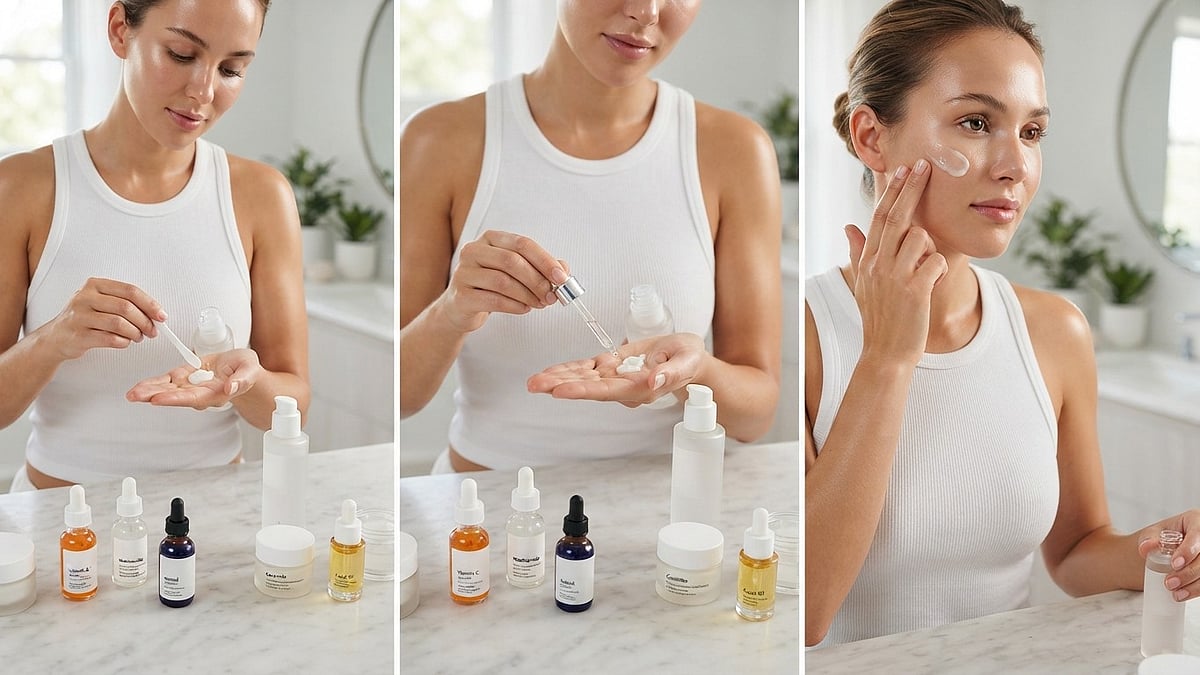
Today, the average skincare conversation is full of combinations. Can niacinamide be used with vitamin C? Should peptides come before or after retinol? Is glycolic acid too much on the same night as a retinoid? Most of us are looking for ways to combine them to create an optimal skin-care routine – welcome to the era of the ingredient cocktail or skincare cocktailing. But, when it comes to mixing active ingredients, it’s a fine line between cellular optimisation and barrier destruction.
Ingredient pairing matters
Ingredient cocktailing, at its best, is the deliberate pairing of ingredients that either enhance one another’s benefits or make an effective active easier for the skin to tolerate. “In skincare, ingredients enhance each other through three main mechanisms: antioxidant stabilisation, where certain ingredients prevent others from degrading; complementary cellular pathways, where different actives target the same concern through different mechanisms; and enhanced penetration, where certain ingredients help others penetrate the skin more effectively,” explains Dr Kiran Sethi, founder, Isya Aesthetics and Active Longevity, Delhi.
While ingredient cocktails can have a place in a regular skincare routine, Dr Geeta Grewal, cosmetic surgeon and founder of 9 Muses Wellness Clinics, recommends intentional layering over combining multiple potent actives at once. “A well-designed routine is inherently a ‘cocktail’, with each product contributing differently. Build it around one or two ‘hero’ actives suited to your concern, supported by barrier-friendly ingredients, rather than stacking five aggressive actives simultaneously.”
A good ingredient cocktail is not simply about maximising strength; often, it is about balancing efficacy with tolerability. “When DIY-layering five different single-molecule serums, you run the risk of pilling, altering the formulations’ intended pH, or inadvertently overloading the skin with penetrants, which can trigger barrier degradation and chronic inflammation - the absolute enemy of skin longevity,” warns Dr Sethi.
For beginners, introducing multiple active ingredients requires a slow and considered approach. Dr Grewal recommends introducing one active at a time and using it consistently for two to three weeks before adding another. “Start with lower concentrations and frequency, while keeping moisturisers, ceramides and SPF as the foundation before introducing stronger actives like retinoids or acids.” Adding too much too quickly can make it difficult to identify what is working - or what is causing irritation.
The key is to give the skin enough time to adjust before introducing multiple actives into the routine. “For beginners, I recommend following a micro-dosing and spacing approach: introduce one active at a time, waiting around two weeks before adding another, and begin potent actives like retinoids or exfoliating acids just twice a week. For retinol, the ‘sandwich’ technique - moisturiser, retinol, then moisturiser – can help buffer its absorption and improve tolerability,” suggests Dr Sethi.
What goes together, what doesn't
Knowing which ingredients work well together is only half the equation. The other half is understanding what goes on first, what can be paired, and which combinations are best kept apart to get the most out of your routine. Both experts agree that ingredient cocktails should be tailored according to skin type, age, or climate.
Climate, for instance, has a significant impact on what your skin needs. In hot, humid conditions, lighter gel-based hydrators with humectants like hyaluronic acid and oil-regulating ingredients such as niacinamide are often better suited than rich, occlusive creams, which can feel heavy or contribute to congestion. In colder, drier climates, however, the focus shifts to preventing transepidermal water loss (TEWL), making ceramides, fatty acids and richer barrier-repairing moisturisers more beneficial.
Age also influences ingredient choices. Dr Sethi shares, “In your 20s and 30s, focus on protection (antioxidants, SPF) and prevention. In your 40s and beyond, shift toward cellular repair (retinoids, growth factors, DNA repair enzymes) and barrier lipid replenishment (ceramides, fatty acids).” While Dr Grewal adds that combinations supporting both hydration and collagen production – such as peptides and ceramides – become increasingly relevant with age.
Perhaps the biggest deciding factor, however, is skin type. “Oily and acne-prone skin generally benefits from lightweight, oil-regulating combinations like niacinamide and salicylic acid, while dry or sensitive skin needs barrier-focused ingredients such as ceramides, cholesterol and fatty acids, without overloading it with stripping actives,” she explains.
While most ingredients can coexist in a well-formulated routine, a few combinations are best used with caution. “As a general rule, pair one strong active with gentle, barrier-supporting ingredients rather than stacking multiple potent actives together,” she adds.
How do you make it?
The golden rule of layering is simple: apply products from the thinnest to the thickest consistency, while also keeping pH in mind. The process is fairly simple: start with cleansing, then use a toner or essence if you use one. Next, apply your actives, starting with water-based formulas. Dr Sethi recommends applying low-pH, water-based actives first so they can function at their optimal pH. This includes ingredients such as L-ascorbic acid (vitamin C) and chemical exfoliants like AHAs and BHAs. These should then be followed by water-based, neutral pH serums such as hyaluronic acid, niacinamide and peptides.
Next come treatment products such as retinoids or thicker gel-based creams, followed by a moisturiser or facial oil to lock in hydration and support the skin barrier. In the morning, always finish with sunscreen as the final step to protect the skin from UV damage.
Dr Grewal also points out that not every active needs to be layered in the same routine. "Actives that can react with each other or increase irritation are usually better used on alternating nights rather than layered together. Pair one potent active with gentle, barrier-supporting ingredients rather than stacking several high-strength actives in a single routine." Stacking multiple exfoliating acids, such as glycolic, salicylic and lactic acid, in one routine can lead to over-exfoliation and weaken the skin barrier.

As ingredient-led skincare continues to evolve, ingredient cocktailing is proving that thoughtfully chosen combinations will always outperform an overcrowded routine - the right ingredients, in the right way, for the skin.
Best ingredient cocktails for your skin
Retinol + Peptides for anti-ageing and firmness
Vitamin C + Ferulic Acid for brightening and environmental protection
Niacinamide + Hyaluronic Acid for barrier repair, hydration, and soothing
Salicylic Acid (BHA) + Niacinamide for acne-prone, oily skin relief
Ceramides + fatty acids and cholesterol (the classic barrier-repair trio) to restore the skin barrier
Niacinamide + zinc for oily and acne-prone skin to calm inflammation and regulate oil production.
Ingredient Pairings to Avoid
Retinol + AHA/BHA (Glycolic, Salicylic, Lactic Acid) can cause peeling and redness.
The Fix: Alternate nights, or use your acids in the morning and retinoid at night.Vitamin C (L-Ascorbic Acid) + Retinol can neutralise the efficacy of both and cause severe irritation.
The Fix: Vitamin C in the morning, Retinol at night.Retinol + Benzoyl Peroxide can oxidise certain traditional forms of Retinol, rendering them useless.
The Fix: Use Benzoyl Peroxide in your morning wash and Retinol at night.

