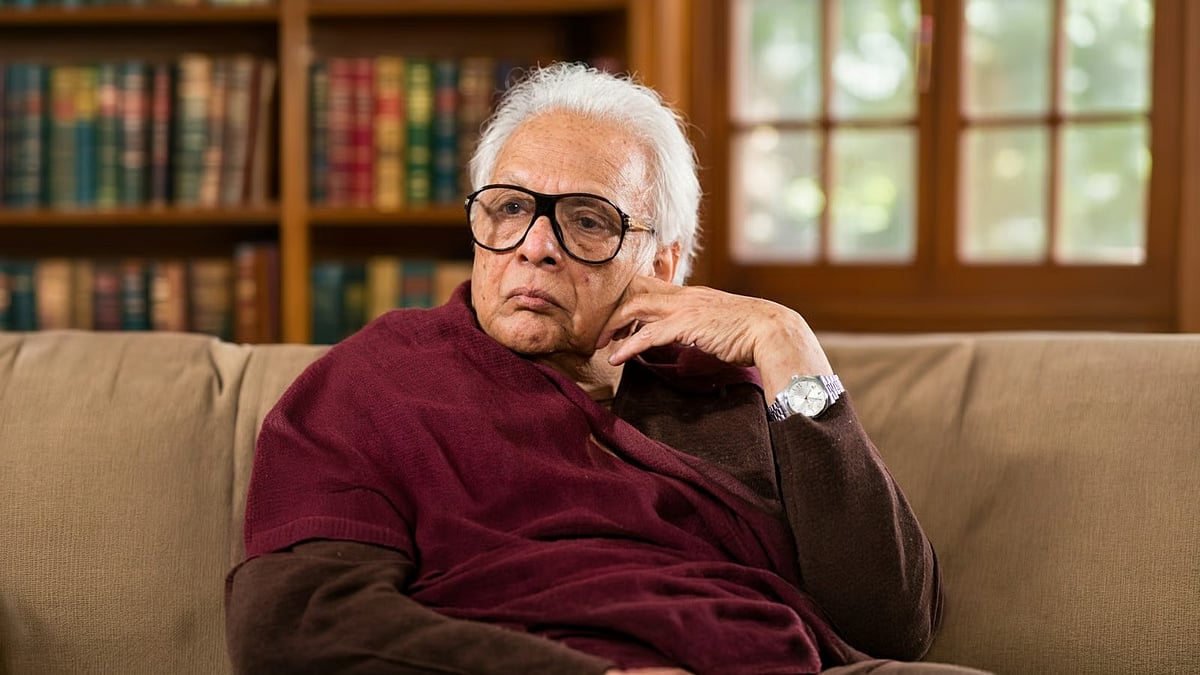
Mahabharat, that’s the first thought that comes to mind when you remember writer-poet-lyricist Dr Rahi Masoom Raza, who co-wrote BR Chopra’s epic series with Pandit Narendra Sharma. Puneet Issar, who became a household name as Duryodhan, recalls going for the audition and being recognised by the trio as the ‘Coolie boy’. His punch, during an action scene of Coolie, had seriously injured Amitabh Bachchan, derailed his career, and typecast him a 6-feet-3-inches, Black Belt fighter.
“They pointed out I would have to speak long dialogues and I told them that I had taken diction classes,” Puneet reminisces, adding that going by my height and build, he was offered Bheem’s role. But desperate to prove himself as an actor, he surprised them by requesting that he be cast as Duryodhan.
Raza, who collaborated with Puneet’s father, director Sudesh Issar, on Main Tulsi Tere Aangan Ki, which won him his first Filmfare Award for Best Dialogue, had heard him recite Jaydrath Vadh when he auditioned for Sunil Dutt’s Rocky. He urged the actor to recite something in Hindi. His rendition of Maithilisharan Gupt’s poem a second time bagged him the role of his choice in Mahabharat.
Filmmaker Kamal Amrohi’s son, Tajdar, remembers his father was an ardent fan of the Doordarshan show and its dialogues. “Raza saab idolized baba and was thrilled when he praised his writing despite not knowing Sanskrit. He insisted it was his biggest award and such was his magnanimity, he would say he was inspired by Kamal saab. When baba asked how that was possible, he would point out that he had simply translated ‘takhliya’, the Urdu word Kamal saab had used in Mughal-e-Azam to express Akbar’s need for privacy—to be alone—as ‘ekaant’ in Mahabharat,” Tajdar recounts.
While Raza’s name has become synonymous with the grandiose epic and intense dramas like Mili, Hum Paanch, Tawaif and Lamhe, he also wrote comedies like Gol Maal, the supernatural thriller Karz and the musical Disco Dancer.
B Subhash who collaborated with him on Disco Dancer, Kasam Paida Karne Wale Ki, Adventures of Tarzan, Dance Dance and Commando describes him “as an intelligent man, who in one sentence understood what you wanted, and could elevate any scene with the power of his words”. The filmmaker points to a scene in Disco Dancer where the mother, Geeta Kak, reprimands Mithun Chakraborty’s Anil for not eating with his own hands even though he’s grown up now. He tells her he wouldn’t enjoy the food as much if she didn’t feed him.
The smile disappears as he adds, “Jis din main duniya ka sabse bada aadmi ban jaunga aur hamara wohi badard shaher mujhe samman dega, uss din party mein tumhare haath se khana khoonga aur uss bedard shehar ko yaad dilaoonga ki main wohi bachcha hoon jiske samne usne uske maa ki tauheen ki thi. (The day I become a big man and am felicitated at a party, that day too I will eat from your hands and remind that heartless city I’m the same child before whom his mother was insulted).”
She urges him to forget how Om Shivpuri’s PN Oberoi had assaulted her and wrongly accused him of theft, a crime for which she goes to jail after which they are maligned and forced to leave the city. He asserts the memory will remain with him forever, a festering wound on his soul, and promises to avenge the humiliation, saying he will make hone his music and make it “talwar ki tarah tez aur shehar ke seene mein utar doonga (as sharp as a sword and plunge it into the heart of the city)”.

“Dialogues like this, reiterated for greater impact, gave Disco Dancer its emotional depth. He even gave Kasam Paida Karne Wale Ki its title with Smita Patil’s enraged vow in the police station, her Aarti telling her husband’s murderer Amrish Puri, “Udaybhan Singh main tumhe zinda nahin chodoongi; main maa banne wali hoon, haan main apne bachche ko janam doongi, bees saal tak uske ragon mein tere liye zeher bharoongi, taki woh apne baap ki maut aur apne maa ki zillat ka gin gin ke hisaab le (Udaybhan Singh, I won’t spare your life; I am pregnant and I will give birth to this child, and for 20 years, I fill his veins with poison against you so that he can avenge his father’s murder and his mother’s humiliation).” Rahi saab was one of the greatest writers I was fortunate to work with. I miss him every day,” the producer-director says emotionally.
Puneet shares that, despite his laughing objection, he always addressed his mentor as Pandit Rahi Masoom Raza. “Pandit means ‘vidwaan’ which can be translated as ‘one who is knowledgeable’. And that he was. Respect to the great soul,” he signs off.

