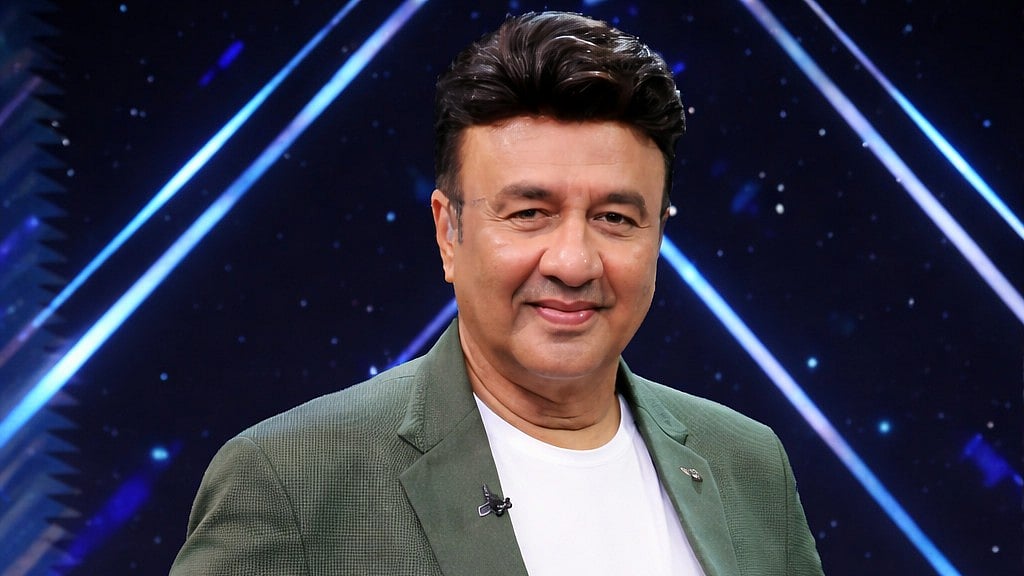
He has probably nothing left to prove. The detractors who dismissed Anu Malik for every possible reason are left befuddled, as time and again, the composer has emerged and re-emerged as a fighter nonpareil.
After composing just one song in his late father, composer Sardar Malik’s Hunterwali 77 (1978), he has scored music, beginning with Poonam (1981), for over 240 films, and also several TV serials and mini-series, besides scoring for albums, including the English Eyes, and over a dozen music videos. Anu has also proved himself as a unique singer and has also occasionally written lyrics.
His constant credo: Keep at making melodies. Keep fighting. Keep challenging yourself. And above all, match the competition across generations: it’s been 45 years in the profession after all.
And so now, Anu is composing music for a play, Jaane Pehchaane Anjane…, featuring (and presented by) Anupam Kher and Swaroop Sampat and directed and written by Gajendra Ahire, the Marathi film, theatre and television stalwart. In a late night chat, we discover why he will never give up.
Excerpts from the interview:
You are reuniting with Anupam Kher as producer after working with him as a director in Om Jai Jagadish 23 years ago. That must feel good...
It feels very, very good, as I respect Anupam-ji not just as a filmmaker but also as an actor and above all as a human being, and he approached me. I have never done a stage play before, but when I heard the script, I was bowled over. It is one of the most emotional plays I have ever come across. He also asked me if I could do it as he thought that I was the right man for the job, so I took it up as a challenge! And something new is always exciting. Besides, Anupam himself is an inspiration in the way he works on his music and performances.
Why do you think he chose you?
I feel he wanted something very melodic that can take the play forward in terms of music and also in creativity. And the fact that he gave me the respect and approached me made a major difference, because a man of his level of talent wanted someone like me, who he thought had the talent. I felt very nice when he said such beautiful words.
How do you look at the difference between composing for a film and for the stage?
Look, in 1993 I was approached by (Mahesh) Bhatt-saab for a film he said would be made for TV. That film, Phir Teri Kahani Yaad Ayee, marked the renaissance of Anu Malik! I think that time has come again in the form of a stage play. And my goal remains the same: the urge within me to create songs for a new medium that can be hummed is there again.
Music is music, it is creation, and stage as a medium is a bigger challenge as those who are watching the play and hearing your song should be interested in what you have done. In a play, the crowd is right there, watching it. If your song is not melodic it will not hold them. In films, there is choreography, there are great sets or locations, and sometimes there is action also going on during a song to also crave for attention. Over here, it is only the song, minus any props, that has to stay back and linger in the heart of a viewer. There are no second chances! Either a song is good, or not good. I have to ensure that you will hum the melody after it is over.
Since it is said to be a ‘musical’, how many songs are there?
There are four songs. It is an intense play with a beautiful message and the idea is to give music of a different kind that holds attention.
A musical with only four songs is very unusual!
One song is quite long and is like almost four songs in one.
Who is your lyricist here?
Anupam-ji had Kausar Munir on board even when he approached me. She is a very talented and sensitive writer and I have worked with her in Begum Jaan.
And who have you chosen as your singers?
There are Shaan, Sukhwinder Singh and Anandi Joshi. Shaan, I always thought, has a different, beautiful tenor. I have given Sukhwinder a funny, funky song that comes at a crucial point. And Anandi Joshi is a young Marathi singer who is classically-groomed and has a soft voice. I have also used her in Mahesh Bhatt’s Tu Meri Poori Kahani, and I adore her voice.
You have recently also released a spate of singles as music videos.
Yes. But I am also doing some films that will be announced soon.
How do you look back, and ahead, after 45 years of doing music?
I am grateful to God for everything. I have never taken it easy. One has to change—and keep changing—with time. There are so many composers who have taken a backseat. But I believe that one must keep fighting and reinventing! This is new-age cinema now, and the world keeps changing. I must keep respecting these changes and the change-makers. I must be right there at the forefront understanding what all is happening and also making a mark.
Look at the recent Border 2. Four of my songs, Sandese aate hain, Hamen jab se mohabbat, Ae jaate hue lamhon and Hindustan Hindustan, have had people going crazy over their re-creations! What does this prove? A good song is a good song! The young generation is experimenting with new sound and singers. It’s like ‘Let’s try new cuisines.’ But ultimately, it’s the hummable melody to which you really relate.

Do you still compose on the harmonium?
Yes, most of the time. But I also use the piano and the keyboard. For me, a song is always born out of a situation. The script comes first and I have to hear the story, the film title and the situation for a song to come out. That is how my music for every film has been created, whether it is Munna Bhai MBBS, Asoka—The Great, Refugee, Baazigar, Main Hoon Na or any other film.

