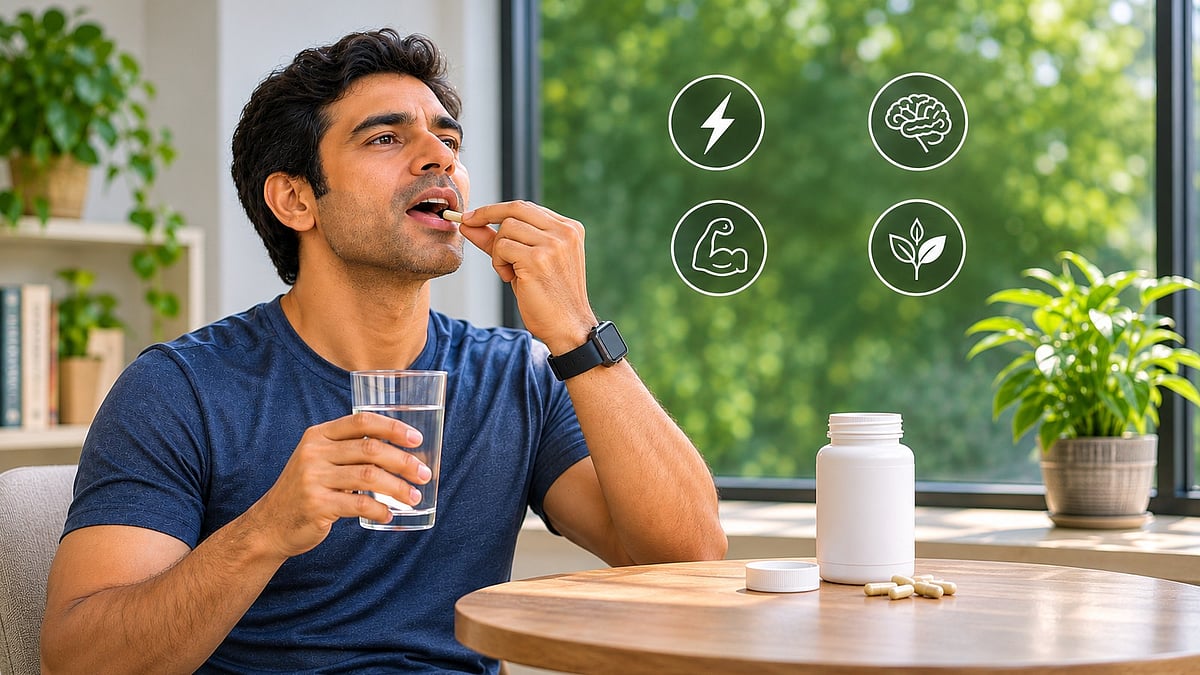
Early last year, Vivan Brar felt he could no longer keep going on coffee and carbs. Getting out of bed had become an ordeal. Everyday niggles refused to budge. His moods swung and focus slipped all too often. The Gurugram-based automotive professional in his late thirties wondered whether it was the calendar or the cholesterol. Either way, what he feared more than turning 40 was looking and feeling that age.
Weeks later, he chanced upon an Instagram reel of a popular actress endorsing a nutraceutical brand, claiming the NMN in one of its supplements could slow ageing, boost energy, keep one sharp, and “support the body’s ability to recover and perform at its peak”. He thought it was exactly what he needed.
Brar is among a growing number of Indians fuelling the country’s “buy-now-age-later” boom. And it is easy to see why NMN, or nicotinamide mononucleotide, long studied in laboratories to understand how cells age, has emerged as a tempting proposition.
Promising, Not Proven
“NMN is a naturally occurring molecule synthesised by the human body,” explains Nikita Garg, nutritionist and founder of Entech Wellness. “It is naturally produced from vitamin B3 and phosphoribosyl pyrophosphate, generated from glucose.” What makes NMN significant is its role as a building block of NAD+ (nicotinamide adenine dinucleotide), a vital compound that enables cells to extract energy from the food we eat and carry out chemical reactions critical to their own maintenance and repair.
According to a 2023 review in Advances in Nutrition, NAD+ concentrations in human skin, blood, liver, muscle and brain are thought to fall with age. This could contribute to the gradual erosion of physical and cognitive capacity.
Studies have found that NMN supplementation can increase NAD+ levels in the blood. The hope that this may, in turn, help mitigate age-related problems such as cell damage, DNA damage, brain-cell decline and inflammation is why NMN is hard to miss nowadays in India’s fast-growing wellness market as a healthy-ageing supplement.
Researchers, though, are still trying to establish whether higher levels of NAD+ automatically translate into measurable and lasting health benefits. “The idea that supplementing offsets age-related NAD+ decline is plausible, but unconfirmed,” says Renu Puri, co-founder and head dietitian at Niwi.ai.
A study published in Cell Metabolism in 2011 found NMN to improve diet- and age-related metabolic problems in mice. In 2021, Science published the findings of a small, placebo-controlled trial involving 25 postmenopausal, overweight or obese women with prediabetes. The 13 who took 250 mg of NMN daily for 10 weeks, showed better muscle response to insulin.
However, no human study has yet shown that NMN slows ageing or extends lifespan, says Dr. Melvin George, professor at the Centre for Clinical Pharmacology, SRM Medical College Hospital and Research Centre, Chennai. “The clinical benefits seen so far are small and inconsistent,” he notes.
In late 2024, for example, Current Diabetes Reports published an analysis of eight randomised controlled trials involving 342 mostly non-diabetic middle-aged and older adults, randomly assigned to take NMN doses ranging from 250 mg to 2,000 mg daily for 14 days to 12 weeks. The studies found no significant benefits from NMN in reliably improving blood sugar control, insulin resistance, or cholesterol and triglyceride levels.
A 2025 analysis in Journal of Cachexia, Sarcopenia and Muscle found no notable improvement from NMN in muscle mass, handgrip strength, gait speed or other measures in adults with a mean age of over 60.
A recent review of NMN supplementation found that while oral NMN reliably increased markers related to NAD+ and was generally well tolerated over weeks to months, its effects on measures of how well the human body functions as it ages—such as strength, blood sugar control and blood-vessel health—were mixed or null.
Handle With Care
The right dose of NMN is another aspect science hasn’t settled on. “The supposed ‘optimal’ dose of 600 mg per day comes from a trial of 80 adults, which primarily measured blood NAD+ levels,” says Dr. Melvin. He adds that while common doses of about 250 mg to 1 g a day probably raise NAD+, the available trials using doses from 250 mg to 2,000 mg have not shown consistent clinical benefit. “The trials so far have been small, short and mostly industry-funded,” he points out. “The evidence is weak.”
Even so, many are turning to supplements because food alone can provide very little NMN. “NMN occurs in small amounts in everyday foods like edamame, avocado, broccoli, cucumber, cabbage and tomato,” says Puri. “However, none of these foods — not even edamame, which has the highest natural concentration of NMN, at around 0.47–1.88 mg per 100 g — can match the trial amounts of NMN in the supplements that result in higher blood NAD+.”
Experts say a healthy person may not require NMN supplementation. Garg recommends starting with the basics: “A balanced diet that prioritises protein intake and accounts for essential fatty acids and micronutrients, regular strength training, sunlight, stress management and good sleep offer a more established approach to healthy ageing.”
But how strong is the evidence for these habits? “Regular exercise to improve aerobic fitness, resistance training and abstaining from smoking have the strongest body of evidence for healthy longevity,” says Dr. Melvin. He adds that there is some early evidence from human studies that suggests possible effects of calorie restriction, omega-3 and rapamycin on indirect signs of aging, such as biological-age tests and body composition. But these effects were measured over months, not in terms of actual lifespan.

The Food Safety and Standards Authority of India (FSSAI) recently clarified that NMN is not yet an approved ingredient for food supplements in India and that companies are required to seek approval under the non-specified food and food ingredients category before they can legally sell NMN-containing supplements. In July, FSSAI reportedly sent notices to two companies over an NMN product sold through leading e-commerce platforms. Caution, therefore, is key. “Anyone considering supplements should consult a doctor first, especially if they have medical conditions, take medications or are pregnant,” says Puri. “Supplements should not be considered a shortcut to healthy ageing,” warns Garg. That’s a lure the likes of Brar must learn to resist.
How to choose a product?
Avoid self-prescribing and ask a doctor first, particularly if you take medicines, are pregnant or breastfeeding, have cancer or a history of cancer, liver or kidney disease.
Start only with a low dose only if a qualified professional considers supplementation appropriate.
Choose a brand that clearly states the NMN amount per serving.
Avoid sellers and products that make dramatic before-and-after claims.
Check for manufacturer details, FSSAI licence number, third-party testing, and a transparent ingredient list.

