There is a particular kind of exhaustion that modern men carry quietly. Not the good tiredness that follows a hard day's work, but a deeper, more persistent depletion. The kind that lingers through weekends, numbs ambition, and makes recovery feel increasingly out of reach.
It is not weakness. It is the predictable outcome of a lifestyle that never truly stops.
Long hours, chronic digital overstimulation, fragmented sleep, irregular meals, and compounding stress have become so normalized that most men don't recognize them as health threats — until the body makes itself impossible to ignore.
The question is not whether men’s health is under pressure. The data answers that clearly. The question is what a more intelligent, more preventive and restorative approach to men’s wellness actually looks like. This is where the convergence of modern medicine and Ayurvedic wisdom offers something genuinely valuable.
Numbers behind the silence
India’s men’s health data is indicating a quiet emergency. Nearly one in four Indian men is estimated to have hypertension (Springer Public Health, 2024). Diabetes affects close to 8% of Indian men nationally, while obesity has risen sharply across urban populations over the last two decades (NCBI, 2018). Metabolic liver disease, once considered uncommon, now affects a significant proportion of Indian adults, driven largely by sedentary lifestyles, dietary patterns, and chronic stress.
These conditions may appear unrelated. But they share common upstream causes: poor sleep, chronic stress, nutritional gaps, and inadequate recovery. The body does not function in silos, and neither does its decline. Stress affects sleep. Sleep influences hormones. Digestion impacts nutrient absorption. When one system falters, the whole ecosystem suffers.
This systems-based reality is precisely where Ayurveda has always offered a distinctive perspective.
Two systems, one goal
Modern medicine has transformed healthcare through diagnostics, precision interventions, and emergency care. It excels at identifying and managing disease once it has emerged.
Ayurveda asks a different question: what caused the body to lose balance in the first place?
Its focus on daily rhythms, digestive health, stress regulation, and restorative sleep is not an alternative to modern healthcare. It is a complement to it. They address different points in the same continuum: one manages illness, the other builds the resilience that prevents it.
For men navigating the realities of urban professional life, this complementary approach is increasingly relevant.
The invisible load
Perhaps the most widespread and least acknowledged challenge facing men today is chronic stress. The always-on work culture keeps the nervous system in a prolonged state of alertness, and, over time, this disrupts sleep quality, mood, cognitive focus, and energy. Many men normalize constant fatigue, irritability, difficulty unwinding, and reduced motivation as simply “how things are.” These are, more accurately, signs of under-recovery.
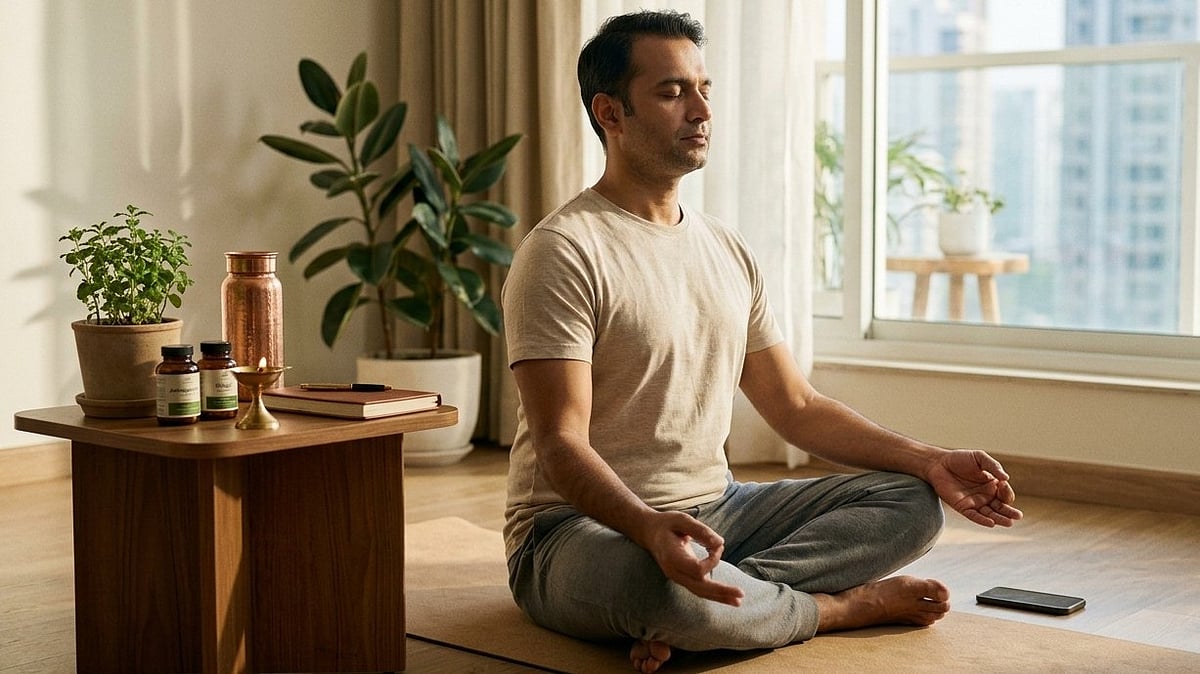
Ayurveda has long emphasized building resilience through daily ritual rather than episodic intervention. Pranayama (breathwork) to regulate the stress response, Abhyanga (self-oil massage) to calm the nervous system, and morning sunlight exposure to anchor circadian rhythms are foundational practices backed by both ancient text and modern research.
Adaptogenic herbs, particularly Ashwagandha, Brahmi, and Shankhpushpi, have been traditionally valued and are increasingly studied for their role in supporting stress resilience, mental clarity, and nervous system regulation.
Energy, digestion, & agni principle
Many men today report persistent fatigue despite adequate sleep and reasonable nutrition. The explanation is rarely a single deficiency. Irregular eating habits, digestive stress, micronutrient gaps, and chronic cortisol all affect how efficiently the body generates and utilizes energy.
Ayurveda places Agni, the digestive fire, at the center of vitality. When digestion is compromised, nutrient absorption suffers, and the entire system operates below capacity. Simple, consistent habits such as eating at regular intervals, avoiding overeating, beginning the day with warm water, and eating without digital distraction support digestive balance and recovery.
Herbs such as Shilajit, Safed Musli, Gokhru, and Ashwagandha have long been used in Ayurvedic practice to support stamina, physical recovery, and sustained vitality. Their value lies not in stimulation but in nourishing the underlying systems that sustain performance.
Sexual & prostate wellness
Sexual wellness remains among the least discussed dimensions of men’s health and among the most misunderstood. Research published in the Therapeutic Advances in Urology journal reports erectile dysfunction prevalence ranging from 20% to 64% in Indian men, while premature ejaculation affects an estimated 18% to 55% across different age groups and settings.
Prostate health is an equally significant and emerging concern. By the age of 60, nearly half of men may experience symptoms associated with an enlarged prostate, including frequent urination, weak urinary flow, or disrupted sleep.
These are rarely isolated conditions. Chronic stress, poor sleep, metabolic dysfunction, sedentary lifestyles, and anxiety consistently appear as contributing factors. Ayurveda takes a broader view: sexual wellness is an outcome of overall vitality, not a standalone concern. Herbs including Kaunch Beej, Gokhru, Safed Musli, Shilajit, and Varuna have long been used to support vigour, stamina, urinary health, and reproductive wellness as part of an integrated approach.
Recovery is the strategy
Ayurveda has always recognised Nidra, sleep, as one of the three foundational pillars of health. Modern performance science agrees sustained output depends on the quality of recovery, not just the quantity of effort.
Many men today are tired but wired, spending enough hours in bed but waking unrefreshed, because sleep is a downstream outcome of how well the body regulates stress, processes nutrients, and transitions from activation to rest. A regular sleep schedule, lighter evening meals, reduced late-night screen exposure, and calming bedtime rituals are not lifestyle indulgences. They are recovery infrastructure.
Living longer is not enough
Men’s health cannot be reduced to a single biomarker or a symptom checklist. It is shaped by how well the body sleeps, digests, recovers, adapts to stress, and sustains energy across decades.
Modern medicine and Ayurveda each bring unique strengths to this picture. One offers precision and diagnosis. The other offers preventive wisdom and a framework for daily living that supports the body’s own repair mechanisms. Together, they point toward a more meaningful goal than symptom management: not just living longer, but living with greater energy, resilience, and balance.
True strength, as Ayurveda has long understood, is not the ability to keep pushing. It is the capacity to recover, adapt, and thrive for the long run.
(Gurmeet Kaur, Co-founder, Ubalance Naturals)

