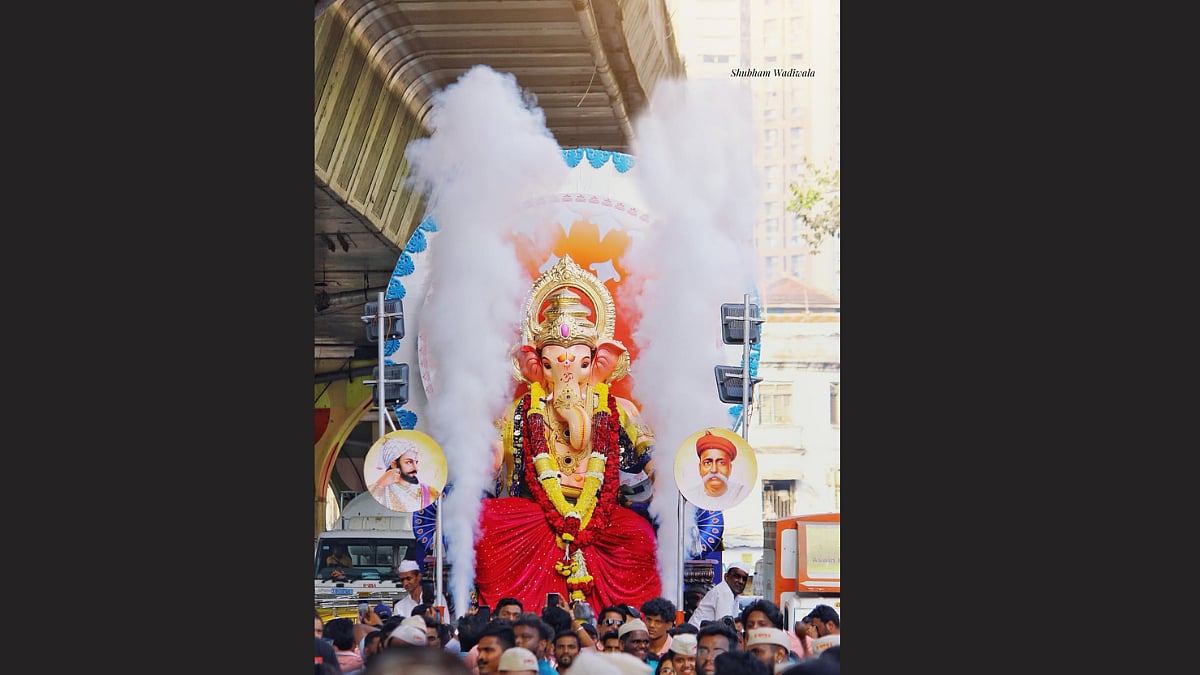
Maharashtra recently witnessed the celebration of Maghi Ganeshotsav, a festival that holds deep spiritual and cultural significance. Lord Ganesha is not just a deity in Maharashtra; he is the beloved
presiding god of the state. Naturally, Ganesh worship occupies a central place in Maharashtrian life. Yet, Ganesha’s appeal goes far beyond the borders of Maharashtra. He is revered across India and even outside the country as a major divine figure.
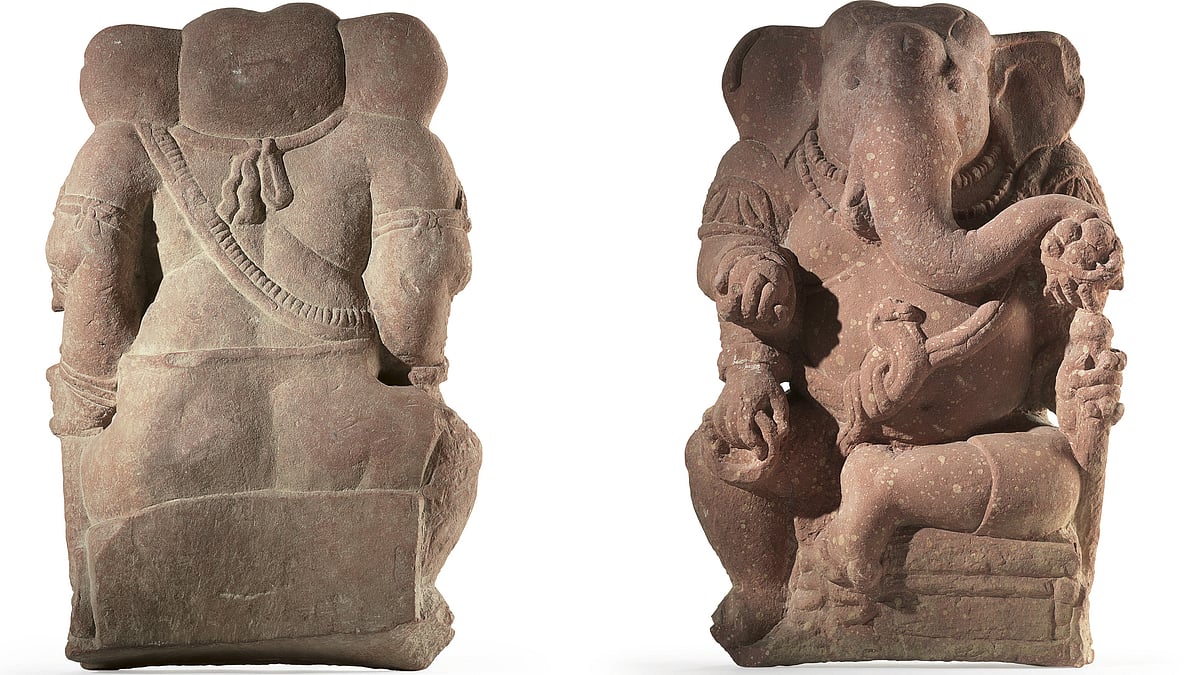
In South India especially, Ganesha enjoys immense popularity. His distinctive and captivating form of an elephant's head atop a human body is perhaps one of the main reasons for his universal appeal. Within Indian religious traditions, Ganesha occupies a prominent position, but what truly underscores his importance is that Buddhist and Jain traditions have also embraced him within their pantheons. Sculptures and idols of Ganesha are found in several Asian countries outside India, leading many to regard him as a deity worshipped across the Asian continent. He also held a significant place among followers of Tantric traditions. Because of his popularity and unique appearance, countless legends, myths, and stories have evolved around him. Ganesha appears repeatedly in the Puranas, epics, and classical literature, often as the hero of fascinating tales.
For most people, the word “Ganeshotsav” instantly brings to mind the months of August and September. Dark monsoon clouds, rain-soaked streets, and the unmistakable festive energy fill the air, yet the rain never dampens the enthusiasm of devotees. This familiar image is associated with the Ganeshotsav celebrated in the Marathi month of Bhadrapada. However, alongside this well-known festival, several regions of Maharashtra also celebrate Maghi Ganeshotsav with equal devotion and fervour.
What exactly is the difference between these two Ganesh festivals?
According to tradition, the day Lord Ganesha was born is Magh Shuddha Chaturthi. From this belief emerged the deep connection between Ganesha and the Chaturthi tithi. Magh Shuddha Chaturthi is celebrated as Shri Ganesh Jayanti. References to this belief are found in the Vishnu Purana and the Ganesh Purana. The Ganesh Purana, an important text of the Ganapatya sect, was narrated by Brahma to Vyasa, by Vyasa to Sage Bhrigu, and by Bhrigu to King Somakanta. The Purana is divided into two parts the Upasanakhanda and the Kridakhanda and contains numerous stories related to Lord Ganesha.
Bhadrapada Shuddha Chaturthi, widely known as Ganesh Chaturthi, is primarily observed as a religious vow (vrat). Some people believe that Ganesha was born on this day. However, according to the Ganesh Purana, Ganesha’s birth did not occur on Bhadrapada Chaturthi. This day is also known as Mahasiddhivinayaki Chaturthi. In contrast, Ganesh Jayanti celebrated in Magh is considered the true birth festival of Lord Ganesha.
Renowned author Devdutt Pattanaik, in his book 99 Thoughts on Ganesha, writes that Ganesh Jayanti is celebrated on Magh Shuddha Chaturthi, as it is believed to be the day Ganesha was born. He also notes that while some traditions consider Bhadrapada as the birth period, Maghi celebrations are observed in Maharashtra as well as parts of Uttar Pradesh.
Ganesh Jayanti also known as Maghi Ganeshotsav or Magh Vinayak Chaturthi is celebrated on the fourth day of the Shukla Paksha in the month of Magh. Devotees believe that on this day, Lord Ganesha was born in his Vinayak form. According to one mythological account, Ganesha was born to Sage Kashyap and Mother Aditi, and his incarnation was meant to destroy evil forces on earth.
In ancient times, Magh Shukla Chaturthi held greater importance than the Bhadrapada Chaturthi. The reason lies in the nature of worship: Bhadrapada Chaturthi involves the ritual worship of a clay idol (parthiva puja), while Maghi Chaturthi marks the actual birth celebration of Ganesha. However, after Lokmanya Tilak transformed the worship of the clay idol into a grand public festival, Bhadrapada Ganeshotsav gained widespread prominence. Despite this shift, Maghi Ganeshotsav continues to be celebrated with grandeur in many places even today.
The idol worshipped during Magh can be made of clay or metal. Unlike Bhadrapada Ganesh Chaturthi, where clay idols are installed in almost every household, there is no such widespread tradition of household idol installation during Maghi Ganesh Jayanti. Religious texts also do not prescribe a fixed duration for worship or immersion of the idol during Magh. In some regions, public celebrations are organised, while in certain families, Ganesh Jayanti is observed as a traditional fast or vow.
Maghi Ganesh Jayanti is also known as Tilkund Chaturthi or Vinayaki Chaturthi. Sesame seeds and jaggery occupy a special place in the rituals of this day. While steamed modaks are offered to Ganesha during Bhadrapada, til-gud laddoos or modaks are traditionally offered during Maghi celebrations. Sesame seeds are believed to symbolise purity and positive energy.
According to the Puranas, Lord Ganesha took various incarnations to destroy evil forces on earth. The incarnation taken on Magh Shukla Chaturthi is considered especially significant. On this day, Ganesha is believed to have slain the demon Narantak. Hence, Maghi Ganesh Jayanti is seen as a symbol of victory, protection, and the removal of obstacles.
Recognising the deep influence of Lord Ganesha on the public psyche, Lokmanya Tilak gave a public and social dimension to the Bhadrapada Ganeshotsav, using it as a platform for social awareness, reform, and the awakening of national consciousness. After independence, the festival not only retained its significance but grew into one of India’s largest celebrations. The number of household and public Ganeshotsavs increased manifold. In recent years, even Maghi Ganeshotsav once largely limited to temples has begun to be celebrated both at home and publicly.
Ashish Tambe, a volunteer associated with the Mumbai Ganeshotsav Mandal, recalls that about 16–17 years ago, Maghi Ganeshotsav began taking a public form in Mumbai. “Though the number of mandals is comparatively smaller, the enthusiasm matches that of the Bhadrapada festival. According to him, the Charcop Cha Raja Mandal was among the first to organise Maghi Ganeshotsav on a large scale. Many households in Mumbai now install Ganesha idols during Magh, and the festival also generates significant economic activity. Processions, arrival ceremonies, and immersions closely resemble those of the Bhadrapada celebrations, with some mandals immersing the idol after five days and others after seven,” he shares.
While the public celebration of Ganesh Jayanti in Magh is a relatively recent phenomenon, its growing popularity is unmistakable. What was once confined to temples has now taken on a broader public and domestic form. Though the scale of processions may be smaller, the spirit of devotion is steadily expanding. Just like the Bhadrapada festival, Maghi Ganeshotsav is gradually finding its place in both homes and public spaces, with its presence and enthusiasm increasing year after year.
